It was called depressing back then to write like this, nobody wanted to hear it. It went against the culture of make believe and eternal optimism. I lived in New York during those years, a place that for a century was held in popular esteem as a beacon of hope, as the manifestation of the greatness of the ideology that took root after the world wars ended, a place where materialism and its culture reached new heights. There were more cars in the Unites States than people. We used machines and energy to perform most of our daily tasks. We were able to eat tropical fruits in the dead of winter and eat meat on a daily basis. We regularly took trips to other climates to find reprieve from harsh Northern winters. We had incredible hospitals offering extremely complicated procedures and body modification. We regularly threw out perfectly good clothes if they were not of the same style being marketed currently. Overconsumption of food, alcohol, drugs, and tobacco were the primary problems with which our society struggled. The Western world had embarked on a journey to ameliorate conflict through growth and a more equitable distribution of its spoils, a distinctly materialist philosophy that was intended to supplant or transcend the divisions hewn by religion and ethnicity.
There were periods of ostensible tranquility, although maybe the violence just took on another form. There assuredly was extreme violence against the natural world to which our destiny is inextricably linked. There was also a more subtle war against the individual, against the human spirit. Later on conflict over resources began to occur.
It took many decades, but the economic and political machine was taken to its apogee by rational thought and it began to groan and occasionally falter. There are problems with the idea of perpetual growth; we live in a world of limits. The resources were bound to begin to feel the strain and we were forced to search ever farther, scouring and scarring the globe as we did so. The productive machine required an ever expanding resource and energy base to feed an ever expanding population that expected an ever increasing quality of life. It was required to work even harder to try and hold back forces that worked against it assiduously like friction or gravity against a perpetual motion machine.
We all wanted to believe that we had created the perpetual motion machine though, that we could continually invent our way out of problems and continue on this path. That was how it gradually became a marketing game, a game in which statistics and studies were produced to inform us about our ever improving quality of life, unprecedented freedom, expanding resource base, essentially that everything was the best that it could possibly be.
When those of us who lived through those times look back upon them though, we all felt the discord deep within ourselves. We knew what was going on as our military roved the world ‘freeing’ oppressed people, opening up their markets and resources; we all knew it as the air, water, and soil became increasingly polluted and unproductive; we all knew it as excess housing was built and then millions were forcefully evicted, we all knew it as record profits were trumpeted as 40 million people lived from government handouts during those years. Those who experienced this discord too overtly and were disillusioned as to the nature of reality, were often diagnosed with mental illness and left to fend for themselves. Addictions and escapism ran rampant.
Politically and economically everything became more precarious with each passing year. The social safety net and the legislated equality that resulted from the war years were dismantled starting in the 1980’s and more inequality was created than ever before to preserve the illusion for the few.
Our politicians and business leaders deemed it necessary to strive at all costs to maintain the status quo. Interest rates were perpetually slashed and legal constraints lifted to remove some of the friction constraining the perpetual motion machine. Our government at the time, or really everyone, just kept borrowing against a future that was incapable of actually paying all of the debts with which it was being saddled. Economic bubbles swelled and burst, often several times in the same decade as the dream machine took itself too literally. It became necessary to preemptively address any threats. Our calls and internet usage began to be monitored by a vast information gathering network with no clear purpose. Drones first began to appear in the skies over our heads. More citizens were imprisoned in a vast and ever expanding network of prison complexes run by private companies. Some were held without trial.
The paragons of our society at this time were the manipulators, the ones who created nothing but an illusion through numbers that did not correspond to reality and reaped fortunes similarly denominated in numbers that only existed in computers. Most of society had a vested interest in maintaining their slice of the imaginary pie. The politicians, the businessmen, the academics, and the bankers largely merged into one ideologically cohesive group to trumpet the perpetual motion horse on which they had staked their money. We had a president who exhorted us to ‘go shopping’ days after thousands of people died in an attack on the physical pillars of this ideology in New York. A mood familiar to all of us as individuals took hold on a national scale, one of repression, denial, and a grasping for the comfort of childish ignorance.
The ground upon which we stood was undergoing tectonic shifts, yet we refused to adjust to this reality. No one at the time knew what was to come and we consciously avoided thinking about it. You have to understand that we couldn’t countenance what this said about our culture, about our country, about ourselves as inextricable cogs in this vast machine. It would have all fallen apart overnight and we were terrified by what alternatives existed. It was all that we knew. The established order tried to assimilate all threats and challenges. The problem is that the shifts were of an order of magnitude that could not be managed, like trying to hold back a glacier or cap a volcano.
Wasn’t there a way to have reached a more moderate, more just, more humane outcome? As we look back upon and teach about this era in world history it is clear that the seeds of this dissolution had been sown long before we ever became conscious of the growing problems. It seems axiomatic now that the perpetual motion machine would eventually succumb to natural forces and that change is the only constant, but this experiment had to run its course for us to now understand. At that time for anyone who did see the problems, there was nothing to do anyways but wait for the first contraction signaling the birth of the future.
I arrive in the early morning, after driving all night from Terre Haute in the wood paneled AMC Eagle that serves as both transport and my residence currently. I haven’t been to the city in fifteen years, not since I had been drawn to a place that even its denizens described as the ‘armpit of Indiana.’ It appeared during my years of exile there that there was no shortage of competition for this degrading title and that Hoosiers had contentious debates regarding this matter. The university where I worked had to put up signs around the dormitories exhorting students not to defecate in the shower and try to stomp it down. This helped maintain Terre Haute as the forerunner in my mind. I pull off of the Brooklyn-Queens Expressway onto McGuiness Boulevard and stop to get gas. I try to quiet my mind as I watch the numbers climb on the pump. Didn’t we start a war to deal with this?
The car won’t start as I try to pull away. I am chastised in broken English before several other strange foreigners materialize to push the car while I guide it into an empty parking space. I feel like it would be pointless to ask them where to get another starter. I debate asking them to help me push start it, but I am deterred by thoughts of the barrage of irritated protests that would emerge. I crawl under the car and bang the starter with a tire iron, but it dawns on me that someone else needs to be trying to turn over the engine as I do this. I grunt and worm out and set out on foot towards an area that I remember from many years before as having a preponderance of mechanics shops and warehouses that seemed to deal in nothing but piles of disorganized metal trash. I walk West towards Williamsburg. I skid my boot through yellow dog poo on the sidewalk. I look for some leaves of grass where I can wipe it off, but everything is fenced or paved. I walk to Bedford Avenue.
The prostitutes and drug addicts are gone, but what remains? The poverty still seems palpable in the cacophony of competing buskers that occupy each block. There appears to be little work as men and women alike lean against buildings exhaling smoke. Young men listlessly shamble through the streets wearing pubic beards and tattered clothes. Several women pass me with a radiant pallidity and muscle tone that leaves me thinking of color inverted National Geographic photos from the fringes of the Sahara. Many enter and exit blighted industrial buildings that do not appear fit for human habitation.
I overhear two striplings speaking a barely intelligible language.
‘We went to this new space that just arrived in Gpoint. It has no name and they aren’t even on yelp yet. It is called 455 Noname. It is an orgogastropub with walls decorated in flea market fare and artisanal art. Standard, right? But every night there is a different band playing Tuscan Noisegrass.’
I see piles of cars in varying degrees of disassembly – most of them similarly from the late seventies and early eighties – inside a rollup garage door in an old warehouse. My Eagle is an ’84 and I figure this bodes well. There are rusted parts littered everywhere and an overwhelming smell of gasoline.
I approach a counter and am greeted with a glare from a man with the hair shaved off of one side of his head and a veritable suit of black leather. He drums immaculately clean nails on the counter top. I am strangely obsessed with hands. Bitten nails, dirty finger nails, calloused hands, scars, knuckles shaved by a slipped wrench…soft supple office hands.
‘Uhm… I am trying to find a starter for my AMC Eagle.’
‘We have Americanos, macchiatos, breves and lattes. It is all microroasted.’ I struggle to hear him over the grating electronic music.
‘Yeah… I just need a rebuilt one from an AMC, a pulled one, anything to get it out of the gas station on McGuiness before someone steals the fake wood panels for firewood.’ I am confused, so I just repeat myself and hope that will smooth things over.
‘You can get a tall, venti, or grande.’ He rolls his eyes.
‘Do you know where I can just get a normal starter for a 1984 AMC Eagle?’
‘No, look you are holding up the line.’ He moves his tapping fingers from the countertop to a small handheld computer. There is nobody behind me.
I walk back out onto the street and find myself stopping in front of a strange piece of graffiti that hooligans have made advertising Rayban sunglasses.
‘Where did you get those patches?!’ I turn around to see a guy and his girlfriend staring at me.
‘Uhm… at an outdoor store. I slept next to a fire and some embers burned holes in the jacket.’
‘Amazing. It is beautiful. I don’t do any camping, but I love outdoor fashion. I shoot men for a living.’
‘Oh…..Hah…Yep.’
‘Can I take your picture?’ Some light is shined on the previous sentence at this moment.
“Can you stand with your arms crossed? So I can see the patches better. Oh amazing!’
I walk on. I realize that I haven’t eaten anything in hours and look around. I had seen half a dozen natural, organic, whole food type markets in the past two blocks and I find myself serendipitously standing across the street from a leafy green neon sign that reads ‘Natural Organic Land.’ I cross the street and enter through the chrome doors.
The isles seethe with shoppers, eyes roaming and scanning for edibility. I feel self-conscious as ravenous eyes greedily survey me. I am not sure where the checkout line begins and the shopping ends, nor what I would like to buy. I wonder if there a natural disaster looming? I grab a few items swaddled in plastic and stare at labels proclaiming pastoral simplicity, wholesomeness, and naturalness. Boutique Brazillian coffee syndicates, Belgian chocolatiers, pink seasalt evaporating schemes, black pepper merchants of Malabar. While stuck in my reverie, a few shoppers repeatedly elbow and ram into me, ostensibly on purpose, while muttering apologies. I begin walking in a rapid frenzy to simulate what the other shoppers are doing; I am trying to exude purpose and importance. Mindlessly I grab a box of Monkey O’s and get in line. The box informs me that 10% of the proceeds from each sale are actually directly handed, in cash, to Marmoset Monkeys in Madagascar to recompensate them for habitat destruction.
I breathe deeply as I exit the frenzy and quickly ram my hand into the box of cereal. I absentmindedly stuff fistfuls into my mouth and walk until a massive pile of junk catches my eye. I enter through the gate of a boarded up, rusted out rat den. There is a sure to be a starter that would work amongst the scrap heaps that loom on either side of the path as I walk towards the entrance. A cheap one. I see a man welding a gas lamp onto a 35 foot tall penny-farthing while wearing a vintage brass scuba helmet. He looks up as I approach and opens to door of the mask to greet me.
‘Hey. Osiris. What do you need?’
‘Uh.. yeah… I am Alex…. I am looking for a starter for my 1984 AMC Eagle? I thought maybe you could help me since it looks like you have a pretty good junkyard.’
The curls of his mustache burst forth as he raises the helmet over his head. I think of the circus.
‘Wait is it a real AMC Eagle? Or is it a replica?’
‘It is definitely real and really not starting right now.’
‘It has the original PlastoPine panels?’
‘Yep. Hopefully they are still there when I get back.’
‘I need to make a call real quick. Gimme a sec.’ He walks around behind a what appears to be a small zeppelin that is connected to a tank of hydrogen. I can barely hear his conversation as it bounces off the bricks and iron.
‘…Yeah… Yeah…A real Eagle… He looks like a vintage dealer. He has some pretty nice threads and definitely knows what he is sitting on.’ I am wearing my dad’s jacket that I found in his apartment after he passed away, and an old pair of corduroys.
‘Look…I’ll give you ten.’
‘I just need one.’ Repetition seems to be the key with these difficult people.
‘Ah… Oh… Nobody has one of those anymore. It is a such a time piece. It is moving art.’
‘I do and I don’t even want to imagine myself in it.’
‘Alright. Twenty thou.’
We went back and forth, me wanting a starter and him wanting the car. Eventually we came to an understanding and I sold the AMC Eagle that had served as my home for the past few months. I used the money to buy a house outright in Detroit where the Eagle was produced thirty years ago. Osiris wrote me a letter thanking me for my generous support and letting me know what became of the car. He installed the car in a gallery in Soho, without even cleaning the cigarette butts out of the ashtray, before selling it for $200,000 to an investment banker who made a fortune betting heavily against the Lesotho deep sea fishing industry.
I pass many of my days walking the streets and exploring the parks. The weather is capricious, oscillating between sunny warm day when the only hint of winter is manifest in the long Southern light that disappears behind the buildings far too early and grey days with a humid chill that cuts through my greasy down jacket. The squirrels are fat and indolently ascend the skeletal, naked trees. It is as if the air is different here, as if there is something constantly pending, something waiting, a chill that doesn’t subside indoors. It could drive me mad.
The city seems surreal to me, the style and structure unintelligible, yet intriguing. Everything here comes from somewhere else and exudes an overall feeling of impermanence to me, it seem precariously poised. Maybe this explains the desire to create permanence through impressive structures and the constant search for authenticity. I walk through the Metropolitan Museum of Art and see the works of hundreds of civilizations whose course could be represented by the shape of a parabola.
Anyways, Lauren and I meet a friend of hers from school at a restaurant in Williamsburg for brunch. She greets us with her boyfriend, Doug, and his son, Mitchell. Lauren and Caitlin catch up, while Doug and I talk about bicycle touring and sailing. Not more than ten minutes pass before Doug casually offers what amounts to a break from the omniscient pressure:
‘I am going to sail a schooner that the owner of this place just rented down from Maine to New York. If you have any interest in coming, I could use a hand.’
We quickly made plans and exchanged numbers. Doug anticipates that it will take us roughly three or four days to make the journey. After years of writing my present location in my journal, I was so certain that I would be in New York for a lengthy, continuous period of time that I debated giving up the practice. I am not sure why writing three letters would have been too much for me at the moment; I think of it as an amusing manifestation of my level of resignation to this place.
We go shopping the following day with the restaurant owner, who ranges the grocery store in defiance of the shopping list. I chortle as he argues contractual semantics with a thick accent while frantically loading the cart with cookies, mini muffins, brie cheese, olives, pickles, butter, hummus…. He is on an inspired spree, something that seems inappropriate to interrupt.
I wheel my bike out the door the following morning and am greeted by a flurry of white lashing my face. I haven’t seen snow in two years. I pedal hard across the Pulaski Bridge as cars howl past. I stand under the outcropping of a loading dock jumping up and down as my hands thaw. Manhattan lays across the East River, its phallic phalanx ejaculating steam skyward. Everyone else slowly begins trickling in. The restaurant owner, who seems perplexing and curious in the way that I always find wealthy people to be, plies us insistently with an armload of pita bread, a gallon of ketchup, a garbage bag of indiscriminately intermingled beef and veggie burger patties, five pounds of salt, and a pound of exquisitely marbled pork belly before we set out.
We begin unknotting ourselves from the turnpike tangles. So far we are five, but we will pick up four more along the way. In the 15 passenger van, the talk centers around the only perceptible common ground that we share at this moment: sailing. I cannot blame them for assuming that this was somehow a shared passion or skill amongst all of us. I furtively downplay my scant experience on sail boats; I am not sure how frank I should be. I have been on a sailboat once before, albeit I was working as crew for five days on a crossing. I have never seen the Atlantic Ocean before. I have never been to any of the other states that we will be passing through/along. I have known Doug only three days. I don’t even know where we are going, having neglected to look up Eastport, Maine on a map. I really just want to start talking about Moby-Dick and whales, but I suppress this urge.
I imagine New Jersey to be full of overweight teamsters. I imagine Connecticut to be a bastion of snobbish dilettantes. I imagine Massachusetts to be full of pugnacious drunkards and pale pedants. New Hampshire brings forth neither negative nor positive, aside from their respectable state motto. Maine could simply be a gigantic Red Lobster. We drive past Kennebunkport, Harvard, turns for Boston, for Cape Cod… All are loaded with strange literary and pop cultural associations.
Greg sits in front, occasionally turning around to squint through his glasses and rant in short overwhelming torrents about his work in IT marketing. His bodily movements are evocative of a terrier. Stephen thankfully keeps the conversation in the realm of sailing and living in New York.
We pick up Carlton, Joan, and Bill. They graciously feed us before setting about finishing their pack. Stephen and I are looking at old maps of New York State in the living room when Joan interrupts.
‘Is the van loaded?’ She sternly asks.
‘Uhm… I am not sure.’ I stumble in response.
‘Well, we are all waiting on you guys.’
I stifle an impudent laugh.
In the van she continues:
‘Stop at exit two, I need to use the restroom.’
‘Okay. How about this reststop?’
‘No. I want to go to a gas station.’
I am pulling off at exit one after I see a sign advertising two gas stations when she cuts in again.
‘Where are you going? I said exit two. There are better gas stations there. It is a more developed exit.’
Nobody says anything. A more developed highway exit?
‘I guess this will be fine.’ She capitulates.
We pick up Simon on the dark roadside in Maine in front of a sign for a farm that produces Maine wildflowers.
I warm to Joan as she tells me a story about a juvenile delinquent rehabilitation program where she worked many years ago. The program ran authentic horsedrawn wagon trains, pioneer style, down the East Coast to Georgia. The troubled youths would walk alongside. Tepees were set up and broken down in roadside fields each day. In typical wagoneering fashion, many teenagers got pregnant during the voyage. Life did not stop. There was a wagonmaster who would regularly beat the children, hospitalizing several of them during the course of her time working there. The wagon train rehab approach was lauded by popular media and received widespread accolades, although this faded as the sanctions for neglect and abuse mounted. Individual kids could spend over a year on various different wagon trains that bizarrely ranged the East.
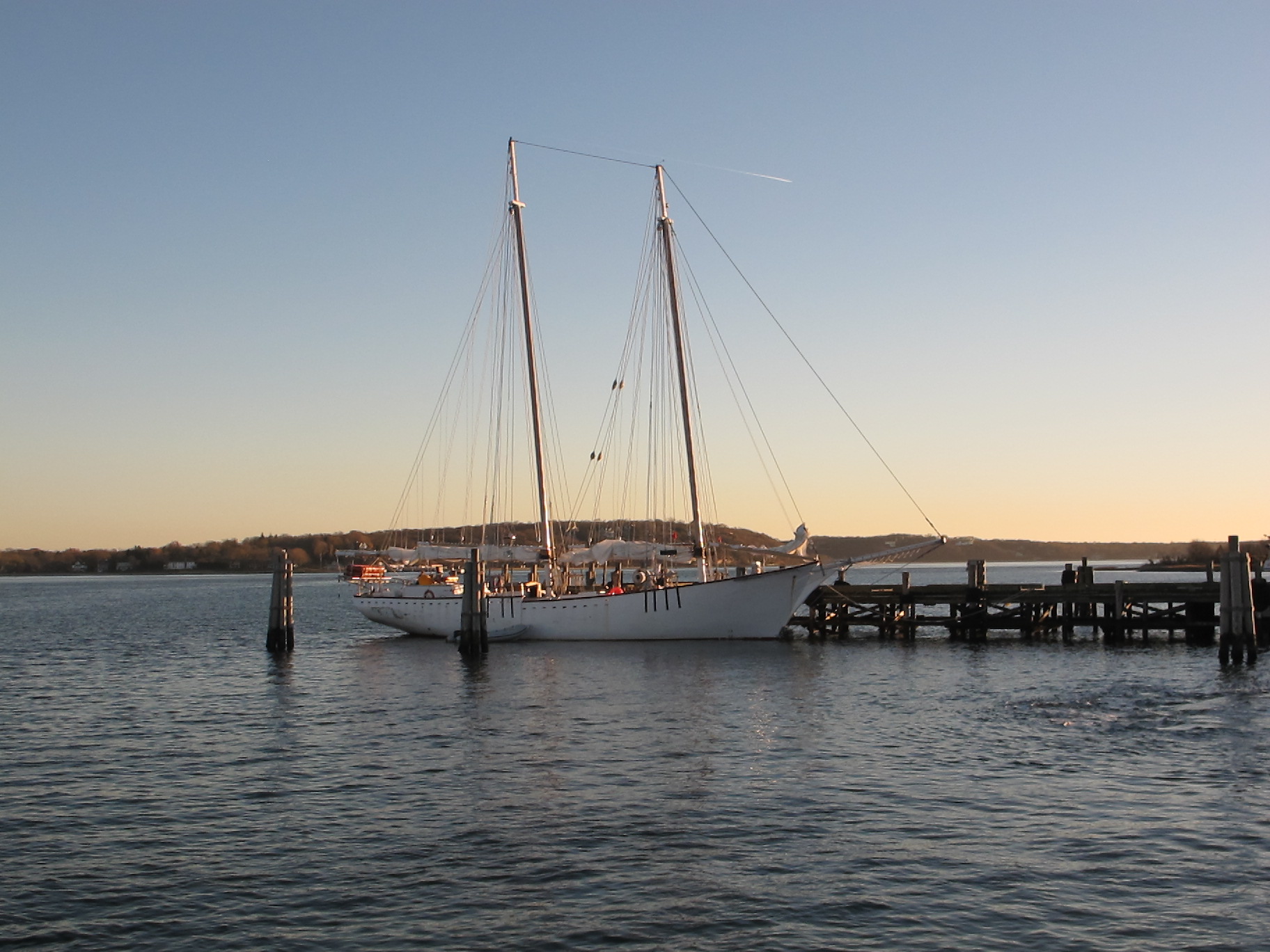
The schooner in Greenport, Long Island.
The wind carries a stiff chill with a breeze off the Bay of Fundy as we unload at the pier in Eastport. I look out upon the brilliant stars and savor the redolent stink of cod and salt water. We arrive at low tide and the twin masts of the schooner are all that are visible from behind the pier that towers out of the water. The Bay of Fundy holds the impressive distinction of having the highest tidal range in the world with an over 40 foot differential. We lower our gear on ropes and quickly find a place below deck to get out of the cold.
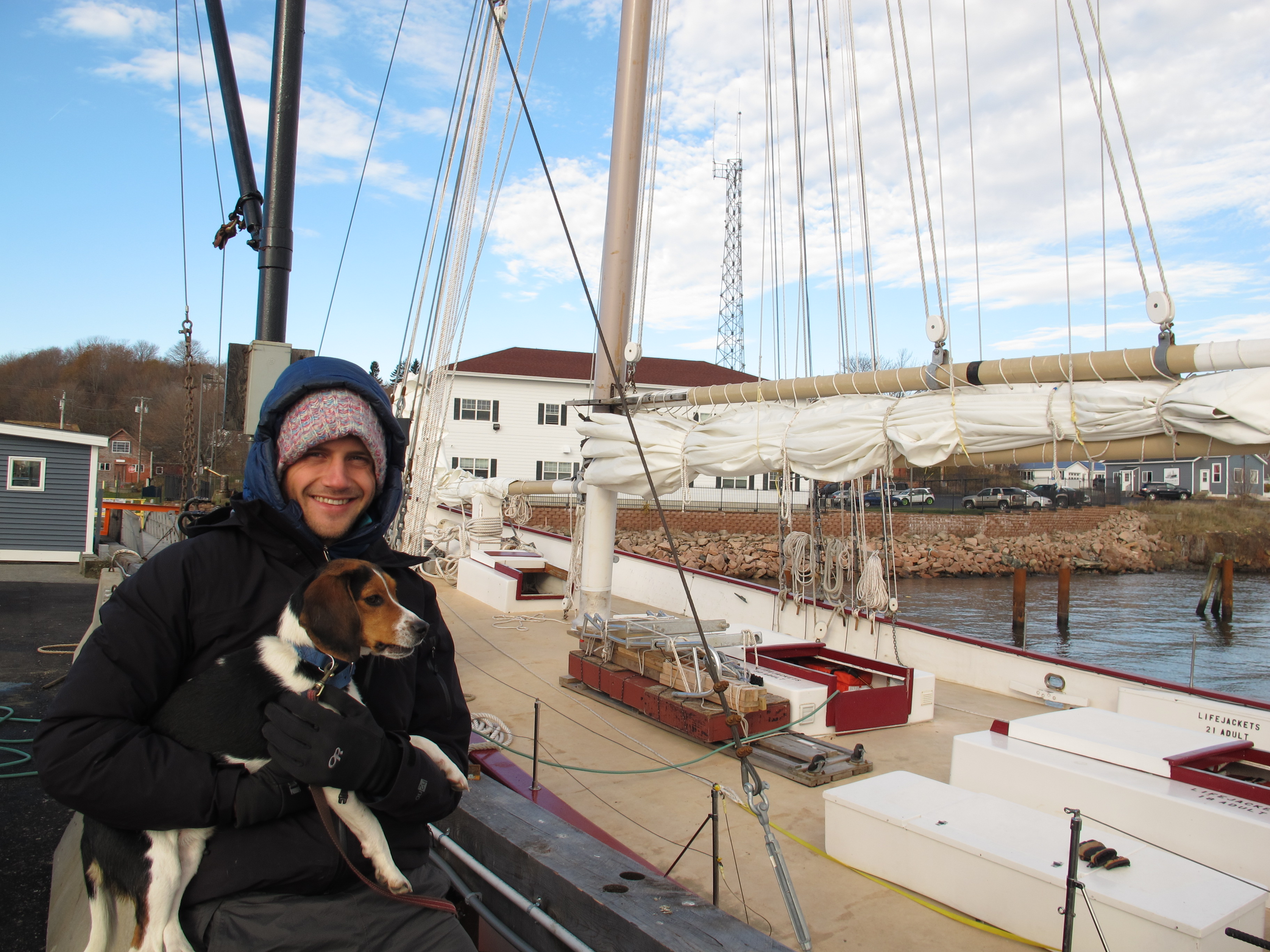
Our challenge becomes apparent as we check out the galley. The ship is in disarray with many projects left unfinished, despite assurances to the contrary. Pat, the engineer for the ship over the past few years, stands holding his beagle in his arms while discussing the condition of the ship. I overhear phrases like the following:
‘If there is a fire, don’t stand there as you will get sprayed with water that will electrocute you.’
‘The radar is not installed. We will try to get to it tomorrow.’
‘The screen on the chart plotter isn’t really working, it is scrolling and flickering.’
‘The generator is currently being run out of a five gallon bucket, so we can’t run it long.’
I put on all of my clothes and jackets before crawling into my sleeping bag.
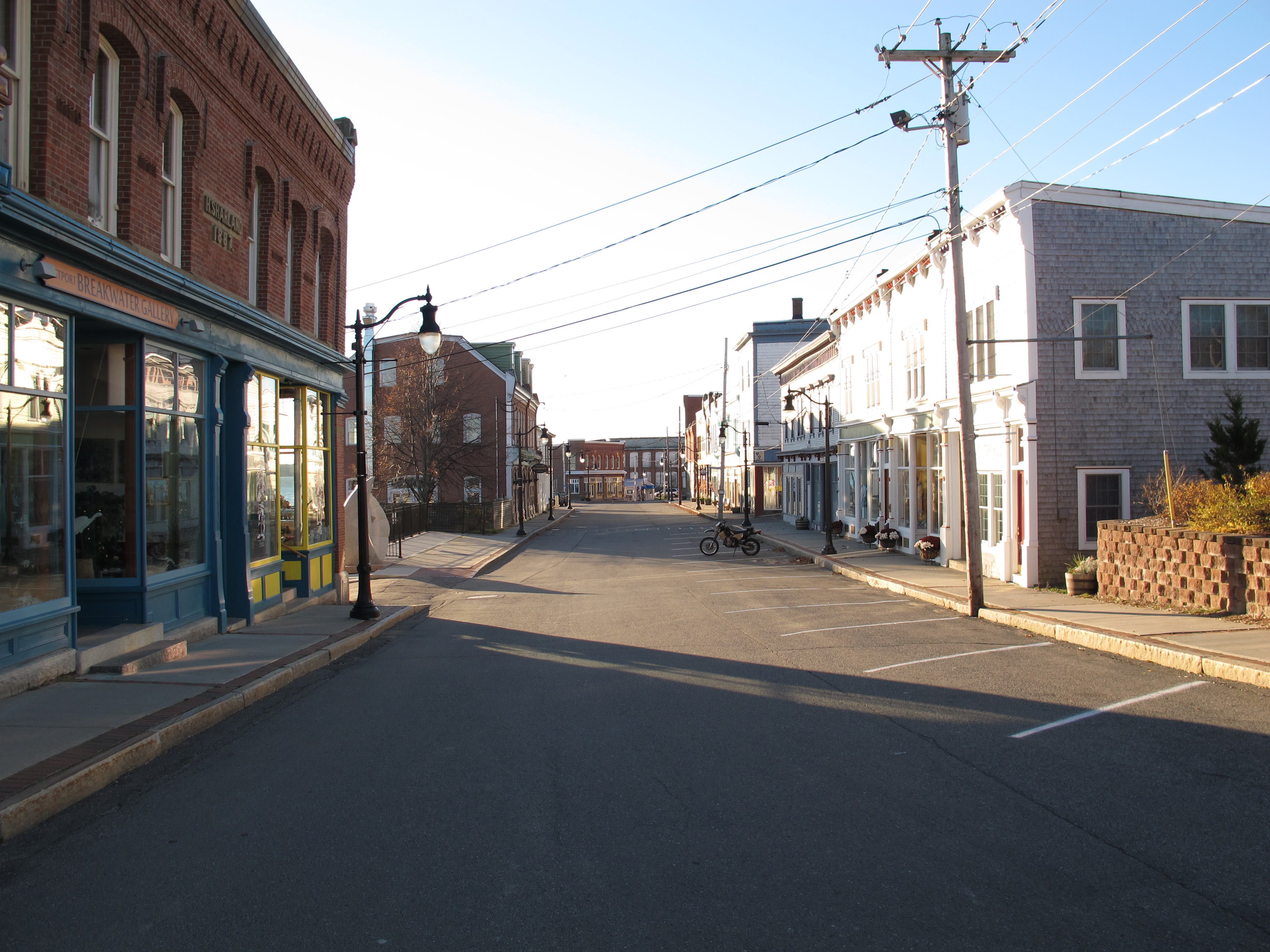
Eastport, Maine
The following morning I get up at sunrise. It is too cold to do anything but go back to sleep or start moving. I set out into town, the ship having risen enough at night to allow me to step right off the hundred plus feet of fiberglass onto the dock. Nobody is about; this is why it is the best time of the day. I wander through streets and homes built with pride with an eye towards longevity. Winter has crept in here.
The morning is strange. Joan, Carlton, and Simon seem to be on the verge of mutiny. They are all genuinely vexed by the lack of communication and the general disorganization. I sit equanimously weighing their remarks, not feeling the same level of concern for some reason, possibly out of sheer ignorance. Their concerns and criticisms words do not amount to anything later on.
We fill the boat with 800 gallons of diesel fuel. It takes a fuel truck an hour at least to fill the boat. Think about that for a moment. I organize all of the food; Joan comes through later and undoes everything that I have done. I snicker when I notice.
Burton and me.
We divide the rest of the tasks. Bill and I undertake the job of attaching the stay sail in front. This simply involves wrestling unwieldy canvas and tying knots with frozen hands while precariously balancing on the bowsprit above the icy water of the Atlantic. Bill seems elsewhere; he handrolls cigarettes and carries on a curious conversation that seems to be altogether independent of me.
Dinner is an affair. The crew is already divided along strange lines with me in the typical position of not knowing where I fit in. I am generally indifferent though. We have fresh live lobsters, twelve of them. Stephen balances one into a headstand with its claws outstretched, a position it unwaveringly holds. The lobsters are lowered into boiling water head first, a death that I watch with horrified intrigue. It is definitely not ‘painless’ or ‘instant.’ I assuage my guilt by acknowledging that this is what grows here, what is fresh and readily available.
I crack and crunch. A torrent of green pours forth and mixes with the butter on my plate to create a delicious soup. The toilet in my cabin won’t flush. I lie in bed as Pat’s radio plays strange music on one side and Carlton and Joan moan on the other.
Leaving the Bay of Fundy.
We ease out late in the morning, catching the last of the ebb tide that we hope to convey us down the coast. I watch the mysterious currents swirl and surge as the glide across the Bay. We discuss the watches: I will work with Bill and Pat from 8pm until 12am and 8am until 12pm. We will have three watches of three people, each working two, four hour shifts each day. Everyone disperses across the deck and into the cabins once this is determined; we only see each other in passing for the rest of the voyage.
I sit on a bench midship pondering the pitching and rolling that are building in my stomach as the waves build. I am utterly silent as I try to ignore the rising pitch of the complaints from my body; it is like trying to ignore a fire in the corner of a room. My hands begin to strangely tingle as time goes on; I can focus on nothing other than the sensations that are assailing my body. It is unlike anything that I have ever felt before. Burps arise that promise to ameliorate the discomfort, but they always fall short with great risk of unanticipated projection. Hold it together, with enough focus you can stay in control.
‘If you need to feed the fishes, go port side since it is downwind.’
Someone says this and I am involuntarily running with the phrase ‘feed the fishes’ echoing in my head. I brace myself against the railings and let loose thick, viscous streams of particoloured organic matter. The stream twists and moprhs as it falls towards the churning water.
Pat grins at me and tells me, ‘You look a lot less green.’
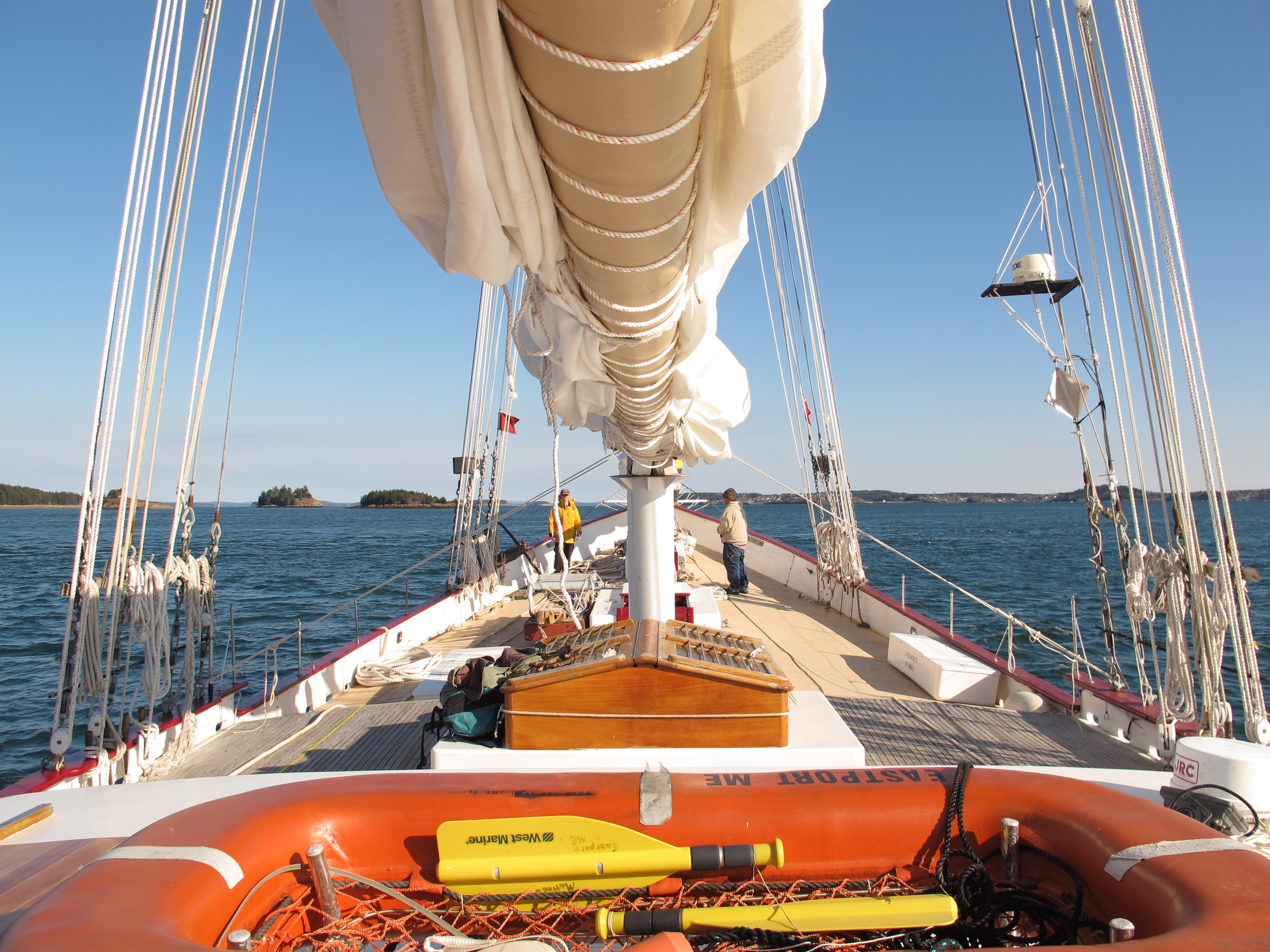
Off the Maine Coast
All of the tingling is gone out of my limbs. I vomit another time, curl up in a ball, vomit some more, shiver on the floor in the fetal position, go to my cabin, get up, vomit in the toilet that doesn’t flush and is already filled with smelly urine, eat some saltines, drink some water, vomit, I dry heave, I have completely vacated my stomach, irrational fears and nightmares taunt me in my delirium. My body is revolting.
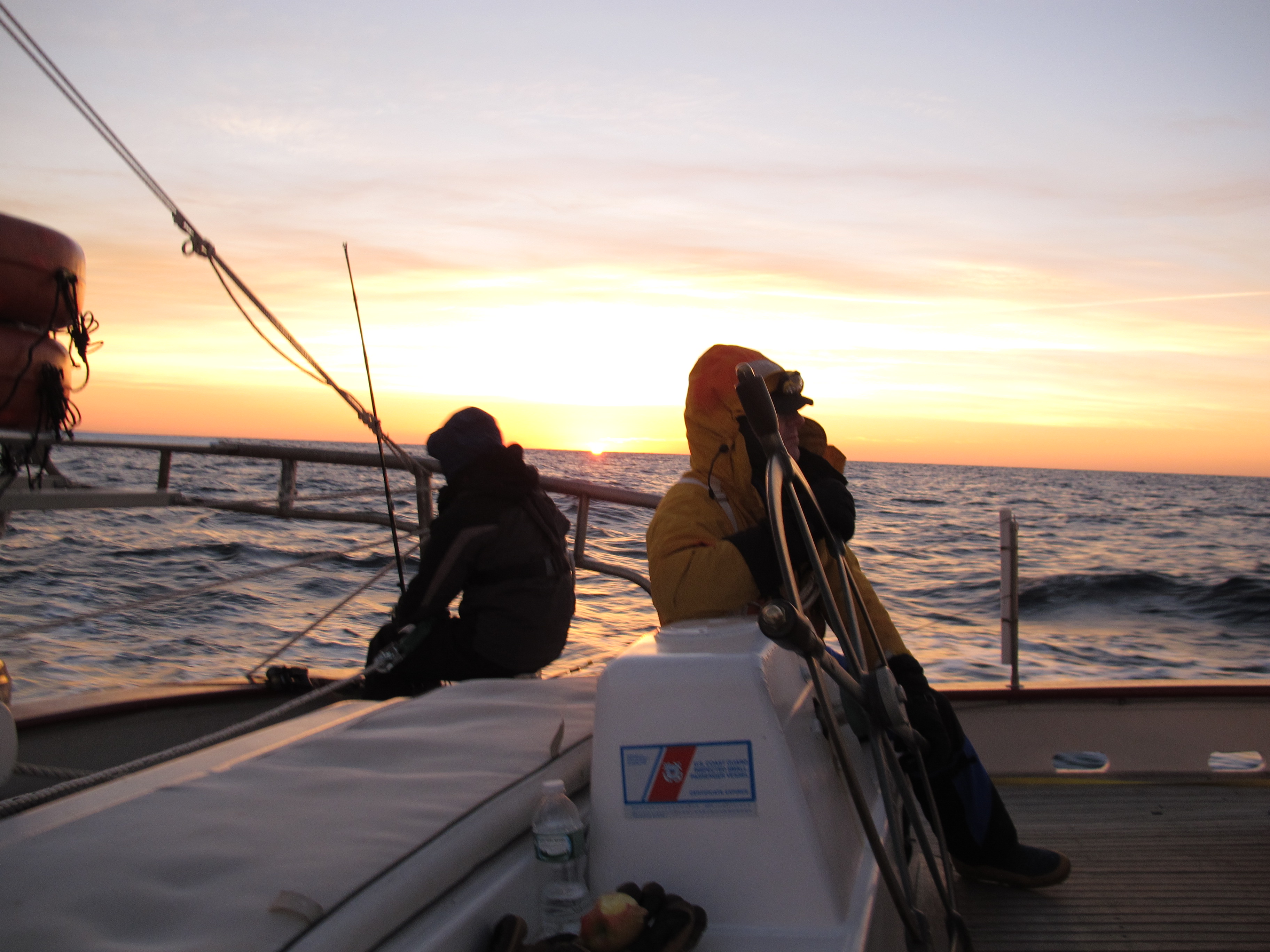
I get up for my watch and am greeted by a clear sky, the waxing moon painting a chrome stream across the water’s surface. We navigate by the stars, using them as fixed reference points. I steer the boat, initially cutting sloppy zigzags across our source as I get a feel for the rudder, the sails, and the motor in the rolling sea. Steering helps to take my attention off of the sickness.
Bill says virtually nothing during our hours on watch. I am relatively confident that he is drunk.
The radar on the boat failed to work, so we brought a second radar system, which subsequently failed to work. The boat’s primary steering compass has failed. Nobody knows how to operate the chart plotter properly and I vomit whenever I stare at the screen.
I eat an apple and a pear, which counterintuitively make me feel better. I again fall asleep in all of my clothes. My cabin smells like a truck stop men’s room. I pity myself and laugh as I lay a seaman stained blanket that I found in the cabin over myself. I roll with the boat.
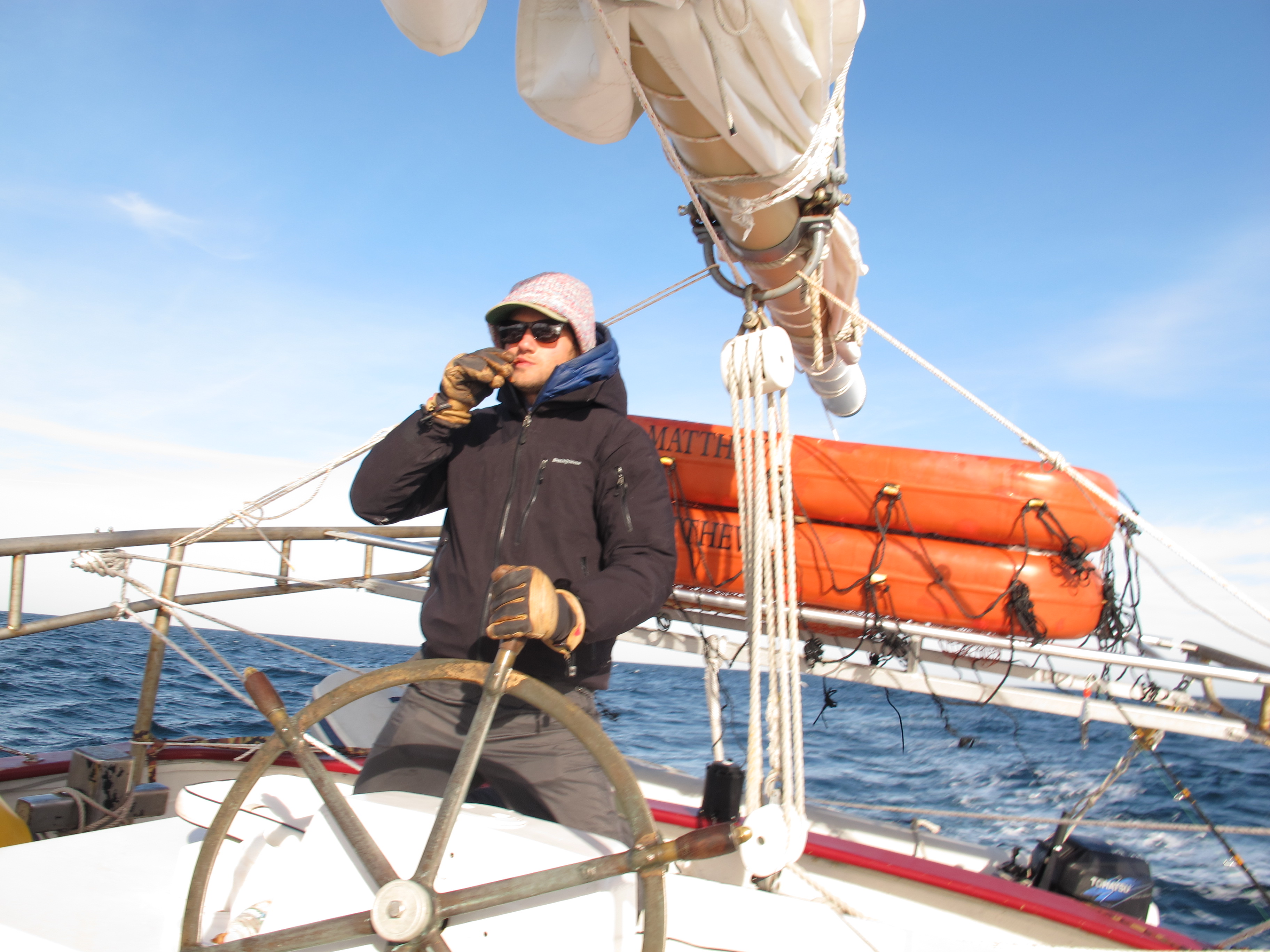
Me at the helm.
I wake up in time for sunrise and sit on deck, the cold seemingly in my bones and my brain nonfunctional from privation. The coastline is out of sight and the sea remains vibrant. The wind has shifted though, despite forecasts to the contrary. It comes straight over the bow from the Southwest, stilling progress. I repress an urge that I have to talk about sailing disasters stories. We could easily be drinking our own urine and be admiring the flesh of each other inside of a week if we let ourselves get blown off course.
After my daytime watch ends, I lie in bed unable to sleep, hallucinating strange shifting shapes and cityscapes. The organic melding with the linear, with the artificial, throbbing with life, expanding, wilting. Night watch is tough; it drags on as I sit huddled against the breeze.
In the morning I struggle out of the windowless cabin to a beautiful day. Pat and I pass our watches telling rambling, loosely connected stories. One summer day I looked out into the yard with my sister, climbing up on the counter to see what was going on outside as our dog Belle ran in front of the kitchen window tossing what looked like a black ragdoll up and down. Our foray into rabbit raising ended the moment that my sister screams resounded through the kitchen upon realizing that it was her rabbit Poco Diablo.
Most of Pat’s stories begin with ‘We just went out for a few beers…’ Getting woken up to a cop toeing him with his boots in a public park, waking up cuddling a napkin dispenser, getting offered to buy crack and guns, beating his friend with a tire iron after an argument erupted as they were stealing hubcaps off a VW bus, doing whippets with Mormons as cases of whipped cream were on sale for $10, He talks extensively about his friend ‘Gay Norm’ who has at least three stories that end with ‘…and then they beat me and left me naked under an overpass.’ Pat shakes and doubles over in laughter as he tells these stories. He is frank and brash in a way that is both repugnant and refreshing.
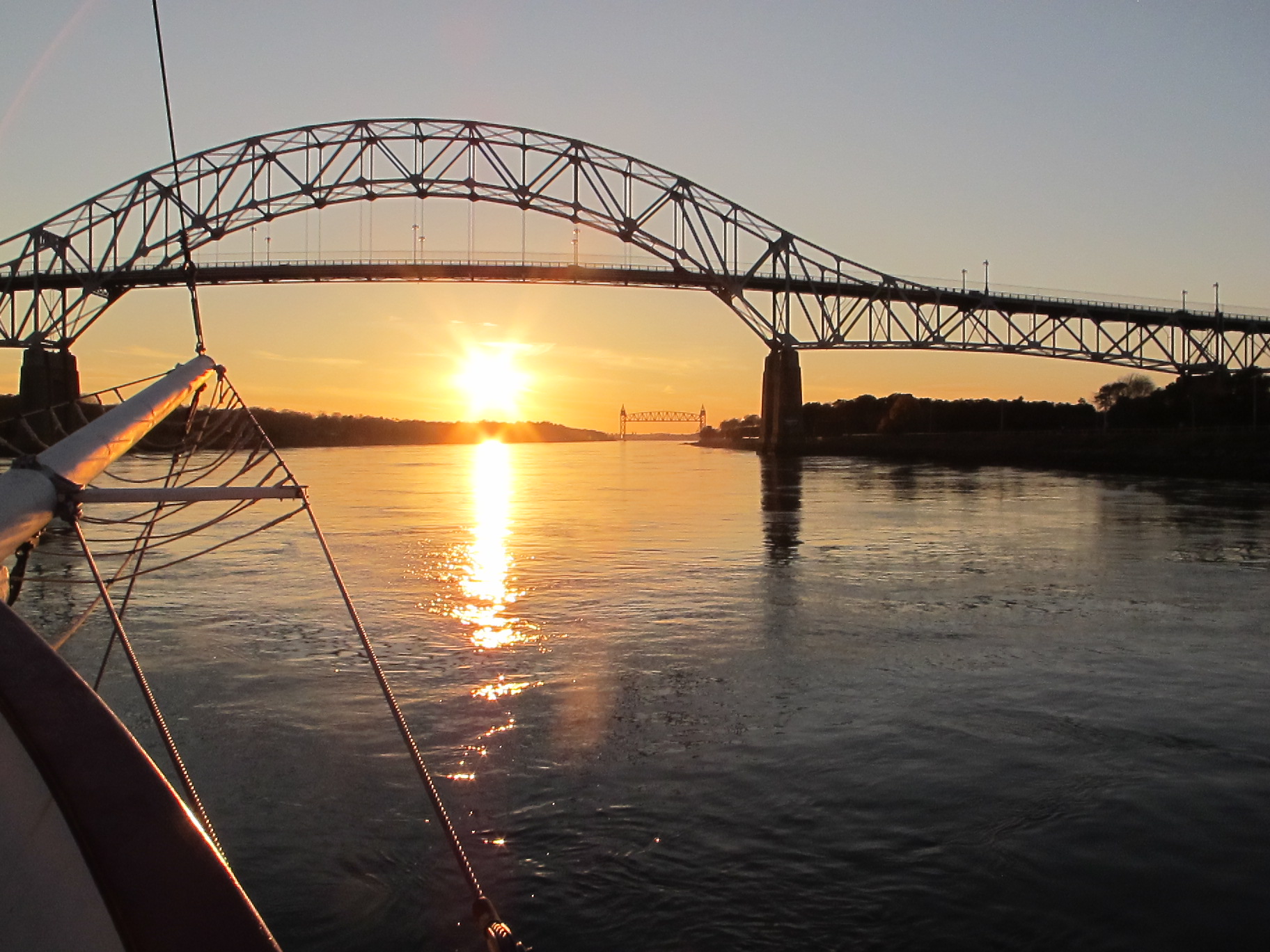
The chart plotter fails. We are now navigating via handheld GPS and paper charts. I look over the starboard side of the boat and see a spray emerge from the water, a whale repeatedly vents into the air before turning its tail and diving. Porpoises jump in unison alongside. We quickly arrive at the entrance to the Cape Cod Canal, just in time to catch the strong current of the ebb tide.
I am at the helm as we enter the canal. We radio the canal authorities who give us permission to proceed with the warning that there is a large barge coming our direction. Half of the crew is on deck. The banks are lined with serene trails peopled by pedestrians and cyclists enjoying a lovely day. Many stop to take our picture as we pass by and admire our good fortune.
Everything suddenly goes quiet; the motor cut out. I continue steering while we get the motor restarted. I can feel the tension start to build as the starter turns for a two, five, ten, twenty seconds to no avail. Our momentum begins to die and the rudder becomes useless; the current begins to direct us.
Doug calls the canal authority to advise them that we have lost power and to ask for assistance. The Coast Guard hears our distress call and scrambles a boat. We begin to spin in the canal and move rapidly portward with the force of the current that was a boon only moments earlier. It is not difficult for all of the people who line the banks to realize that something is very wrong; they begin taking pictures for a different reason. Everyone runs around the deck, a flurry of ineffective motion.
We drop the dingy and Stephen begins attempting to push us away from the portside –although it is no longer portside as we are spinning- steel bulkheads and pylons. I am giddily terrified as there is really not much that we can do and it seems like a collision with either the bank or the barge that is bearing down on us is inevitable. The Coast Guard arrives with a small boat, realizes the sheer size of our predicament and returns with a large boat just as we are nearing the steel I-beams. I grapple with a strong desire emerging from nowhere in particular for the ship to crash, wreck, catch on fire, sink. Some part of me secretly craves destruction and disaster. Unfortunately, the Coast Guard comes in fast, forcefully ramming us on the stern starboard side to straighten us out; a move that buys us a few seconds.
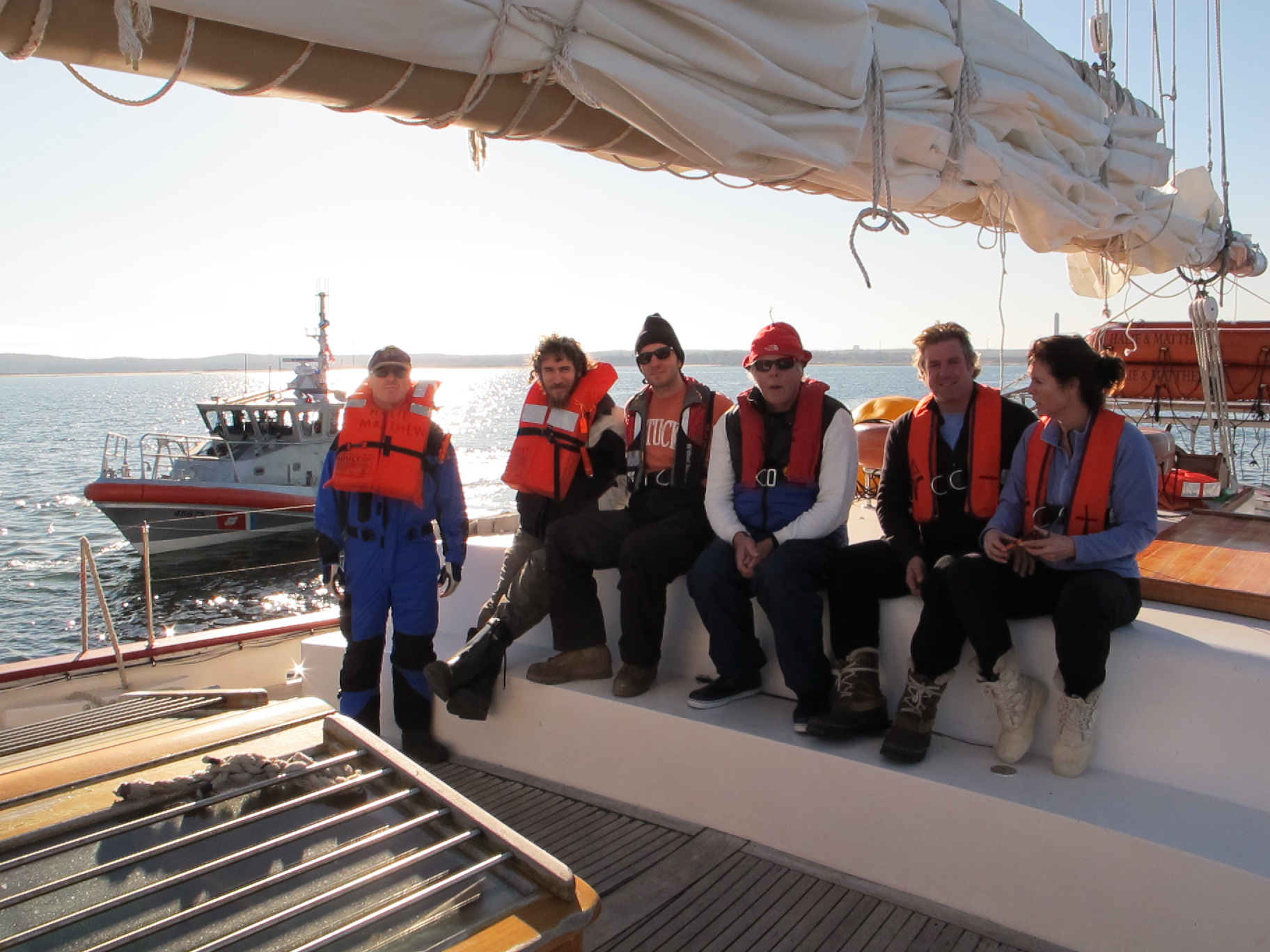
Being inspected.
Commands are quickly shouted and a rope is tossed onto our deck. We scramble to secure it and then yell for them to hit the throttle as we are nearly broadsiding the canal. I stand in wonder at how quickly this has spun completely out of control. We manage to get the motor restarted at this moment, but we are now in tow and at the Coast Guard’s mercy. The problem was a bubble in the fuel line from switching over the fuel filter just before we entered the canal. Pat remedied the situation by bleeding the injectors. We are ordered to put on life jackets and stand by as we are hauled an hour out to sea. We are boarded, inspected, and quickly sent on our way.
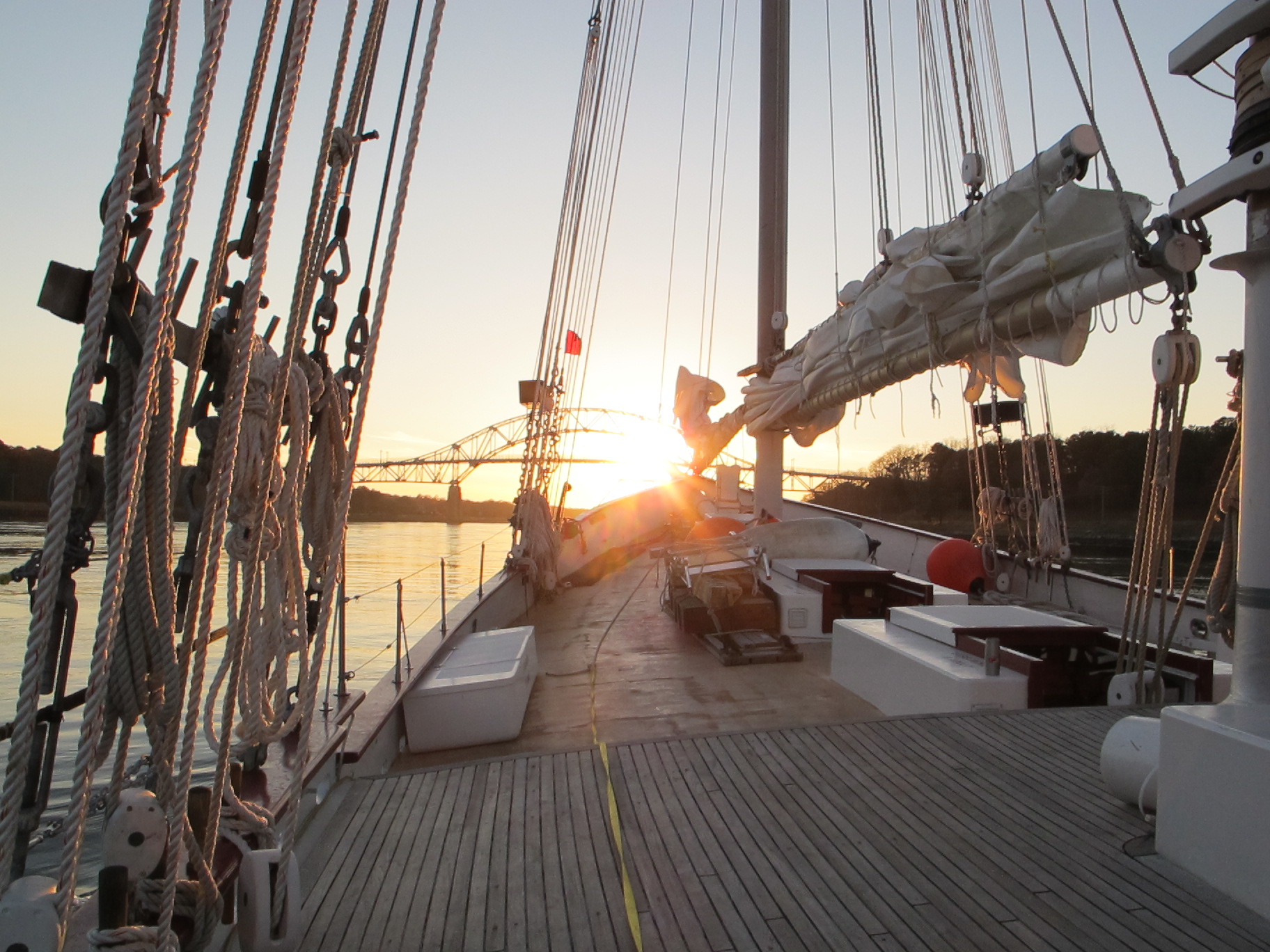
Cape Cod Canal
We miss the ebb tide and find ourselves fighting our way through the canal as the light wanes on the vacation homes and trees that line the banks. As we exit in the darkness we are taxingly navigating by buoy, getting close enough to each one to see the number and verify it on our charts. The fixed lights of shore seem to never move. I stare at the Newport
Cape Cod Canal
Bridge for hours. The sea has calmed, although the dancing inky surface still seems equally menacing. The dark, cold sky and the gaping maw of the sea leave me feeling lonely as I steer. I wonder about the people in the warm, comfortable houses in Newport. I imagine pastoral simplicity and tranquility. A nostalgic desire for home, for warmth, for family rises.
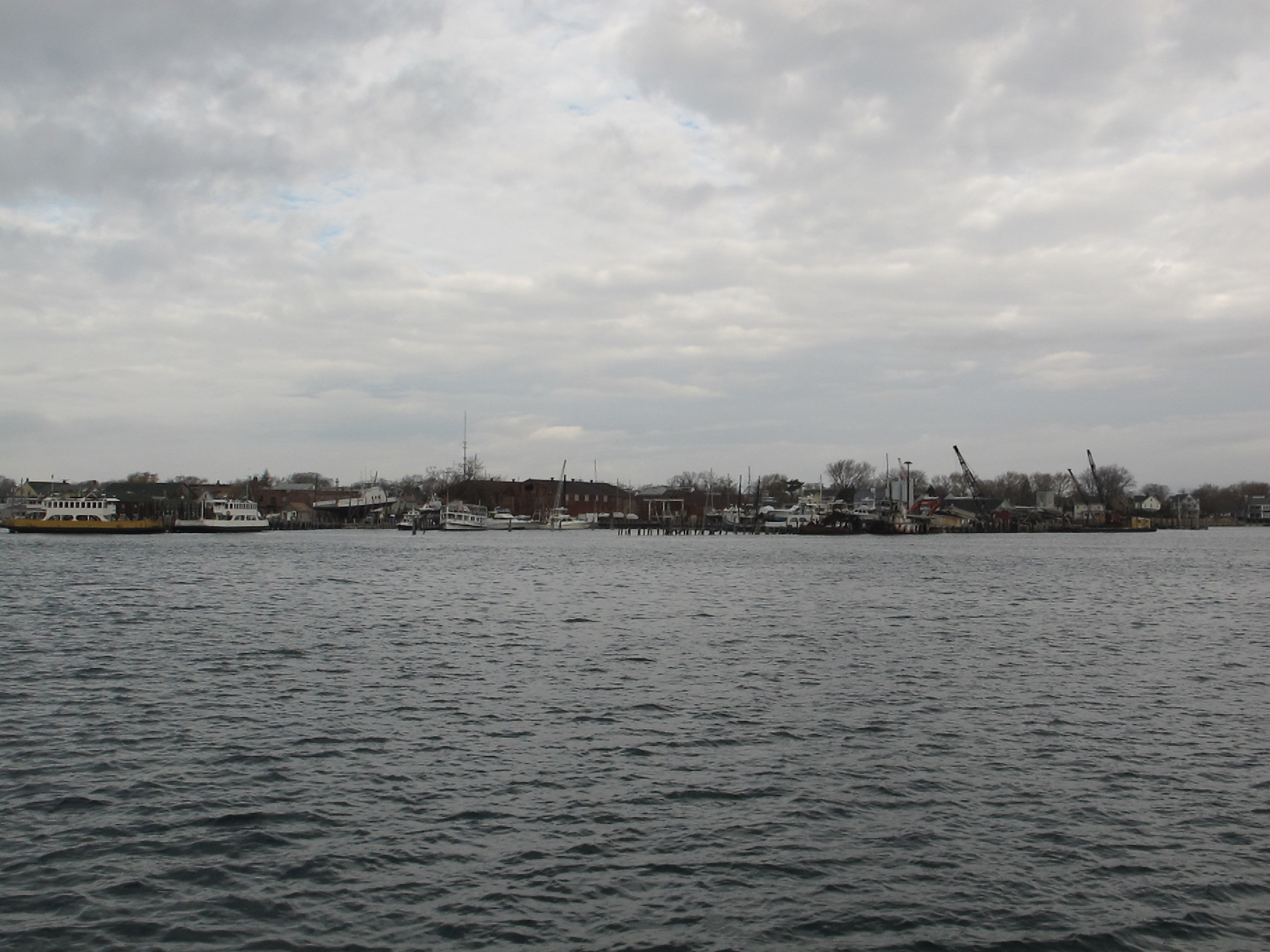
Greenport, Long Island
I wake up with land in sight the following day. The leaves of Oak trees float below the surface and the air smells of fall. Greenport, Long Island. The 800 gallons of diesel turned out to be insufficient. We begin our initial approach on the dock, with the dingy serving to assist. We nearly hit one dock before realizing it is the wrong one. We reposition and make another attempt with 95 tons of boat moving directly at the dock. The harbormaster is screaming as we approach with the boat in full reverse. I once again find myself consciously striving to repress a desire for the boat to smash through the dock, toss the harbormaster in the water, catch on fire, lay over on its side, spread its flames to the kitschy crab shack restaurants and explode.
The bowsprit hits a streetlight that lines the dock, bending it over sideways as the old man runs around yelling irately. Doug calmly mans the controls, making everything seem fine. We toss dock lines and pull her in.
I get off the boat on sea legs; everything seems slightly askew like in a funhouse. An old man stops me wearing similar garb to what Colonel Sanders would wear on a Sunday; I just dismiss him as another East Coast relic from a bygone era. I think it is supposed to convey affluence and evoke respect. He talks about the massive schooner that he owns and the various ‘tall ship events’ that he has attended. I feign interest until he parts with the following words that seem incongruous with his appearance:
‘Be careful here, there are a lot of guns and drugs. This place is fucked up!’
Joan, Carlton, Bill and Simon all depart as our arrival in New York is now uncertain. We need more fuel and the weather looks questionable. Stephen cracks me up with stories of accepting jobs for which he is woefully underqualified. He accepted the job of head chef on an Atlantic crossing, only to be flown home before the long leg after oversalting meat and undercooking pasta. He was the general manager of a 200 million dollar bar in Manhattan for three weeks. He has been a sommelier in Nantucket with no real knowledge of wine other than having watched a movie about it. He has been a bartender, jet ski guide, model, bouncer…..
It begins to spit on us and a thick fog settles in. There seems to be a 65% chance of stabbings.
The winds howl over the boat and gently rock us against the dock. I lie in my windowless room in the early morning listening to the cacophony of clanking, whipping, rubbing, battering, jostling, tapping, lapping..
The fuel truck arrives in the afternoon and I walk out to meet it. I see the old man who looked like Colonel Sanders the previous day walking towards me. He is wearing another stunning outfit: a woman’s widebrimmed gardening hat, boating loafers, and a white knit sweater with an American flag boldly placed in the center. He grabs my arm as I try to greet him in passing.
‘Is that truck for your boat?’
‘Yep.’
He draws in close to me, giving me a weird conspiratorial head tilt.
‘The DEC is watching that truck right now. They are watching you.’
I receive this deadpan as I don’t know who the DEC is. I assume that this is not a good thing from the manner in which I am being informed.
‘Oh…’
‘Do you have a fuel skirt?’
‘I am not sure.’
‘Are you the commanding officer of this vessel?’
‘No.’ I laugh as this comes out. Doug is walking past.
‘Hey Doug! This guy wants to talk.’
‘Gimme a minute. The fuel truck is here.’
‘It is about that.’ I am taking on the weird, furtive tone of this old man for no clear reason. Do they have one of those long distance satellite dish headphone setups? I almost want to cover my lips. Can these people from the DEC read my lips? What does the DEC want? What should I be saying to please them and throw them off my tail?
‘I need to go get this going.’ He responds sharply.
‘Sir, it wouldn’t be in your best interest to disregard me.’ The old man angrily barks.
Doug seems slightly taken aback. ‘Oh..umm… What can I help you with?’
He draws Doug in and I huddle near, intrigued by all of this.
‘The DEC is watching you. You cannot fuel here; the Coast Guard will confiscate your boat.’
‘We have permission from the harbormaster to fuel here.’
‘You can’t. Look, why don’t you just come over to my dock at Claudio’s and fuel there?’’
‘Oh I see. We pay you to use your dock or you call the Coast Guard?’
‘No! Sir, I am trying to keep your boat from being confiscated! I am your friend.’
‘You are not my friend. I don’t even know you.’
‘Yes you do. I am the owner of the ship Lynx.’
The entire thing is surreal; I am riveted in amusement. This dialogue seems strange because it genuinely was. The fuel truck driver hears all of this.
‘I ain’t fuckin’ fueling nothing if there’s gunna be any fuckin’ problems with the DEC.’
Doug calmly addresses him, ‘We have permission to fuel here. I am going to call the harbormaster right now.’ He places his phone to his ear and then turns to the old man.
‘What is your name?’
‘Mayor Nice.’
The fuel truck driver stands on the periphery and sprays chewing tobacco out of his lower lip as he shouts to no one in particular. ‘I’ve lived here my whole life an’ der ain’t no fucking Mayor Nice. Ain’t no fuckin’ Mayor Nice! That guy ain’t no fuckin’ mayor!’
Doug chats with the harbormaster and then hands the phone to the old man. He feigns an inability to hear and hangs up the phone. I start laughing in disbelief at this charade.
He pats Doug’s shoulder and ominously says, ‘Just fuel your boat sir. It will be alright.’ It seems like some sort of knowing blessing or curse. He steps into a beat up old cab and we put in another 350 gallons of diesel.
We sit around laughing later as a few locals explain that he is just the crazy old town drunk.
Doug has a friend come up to give us a hand; his name is Rand. As we walk around town he, without provocation, feels the need to make explicitly clear his disdain for all things organic or locally sourced. This is the mere sprout of something much deeper rooted. It slowly becomes apparent, as his vitriol becomes more targeted, that Stephen and I are gentrification personified. I head to bed early as the predominant form of discourse amongst Connecticutians and New Yorkers appears to be arguing and pontificating with special points awarded for shouting down the other person or not allowing them to speak at all.
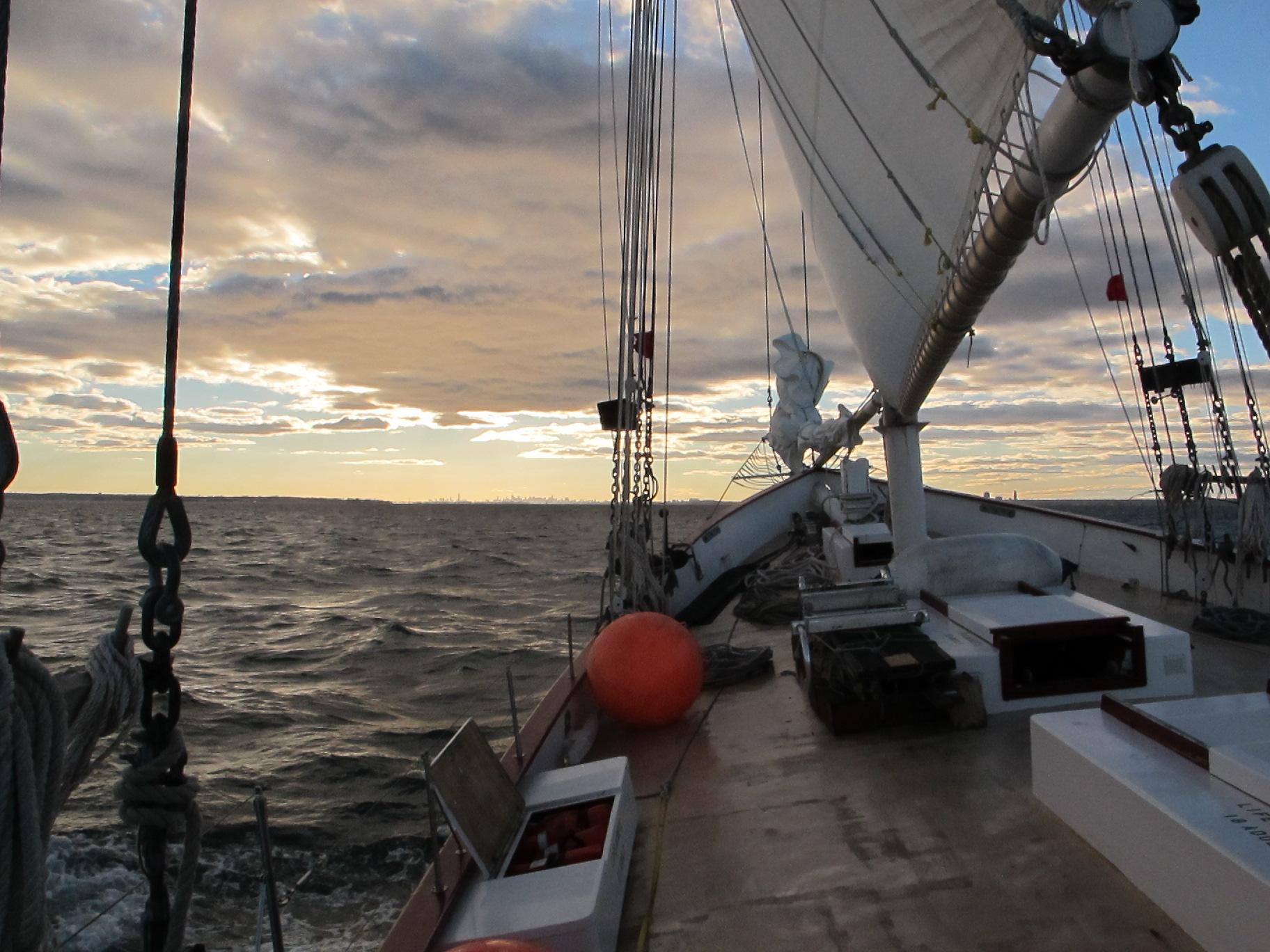
Pat is stomping around the deck at 3am, waking all of us up. We sit in the cabin drinking coffee as an intimidating gale howls outside. We depart nonetheless into the darkness and begin our fight through the Long Island Sound. As the sun rises, the wind and waves do as well. The front of the boat rises and plunges, smashing and vaporizing the steep wind driven waves. The spray whips over the deck and dries into a blurry sheen on my glasses. We raise the jib and stay sails to catch a few more knots from the Northerly component of the stiff wind.
Long Island Sound
Everyone is tired and nobody has eaten as we sit braving the chill and stare at the horizon, conditions that are not exactly conducive to congenial conversation. Rand starts in again and it ramps up quickly.
‘You can take all of your locally sourced organic bullshit and shove it up your fuckin’ asses! All of you hipsters from flyoverthefucknowhere need to stop coming to Brooklyn because you heard it was cool and cheap! It isn’t fucking cheap and you are driving everyone else the fuck out with your parents paying your fucking rent!’
Tower of Babel
I am not sure how this got so out of hand, but the stress that I have felt in recent weeks reaches a crescendo as well.
‘Well where the fuck are we supposed to live? Where do people like us who can’t afford to live in Manhattan go?’
‘I don’t fuckin’ care. Just stay the fuck out of my neighborhood.’
‘How is gentrification my fault? Why are we the ones to blame for all of this? Do you think that we want to pay all of our fucking income on rent? Who ever told you New York was going to be cheap? What in the world ever made you think that real estate separated be a couple of subway stops from the most expensive real estate in the world would ever be cheap?’
Tower of Babel
‘No families can afford to live in their communities anymore. I have watched all of the black families on my block get pushed out by a bunch of fucking hipsters that don’t give a shit about the community. All the local stores are gone and converted to businesses to serve them that are too expensive. It’s fuckin’ out of hand!’
‘Look I am just tired of being made to feel unwanted here. It isn’t right for my girlfriend to come home nearly in tears because she was yelled at and made to feel as if she is the problem, as if she is the white oppressor. Why as individuals are we the problem?’
‘Because you guys are willing to pay these fuckin’ outrageous rents because it is hip!’
‘Once again: where the fuck are we supposed to go? What about the real estate investors, the businessmen, the crooked politicians, the broken system, the banks?’
There is no solution, although there may have been a slight catharsis through our venting. This is the cage: perpetual insecurity.
Tower of Babel
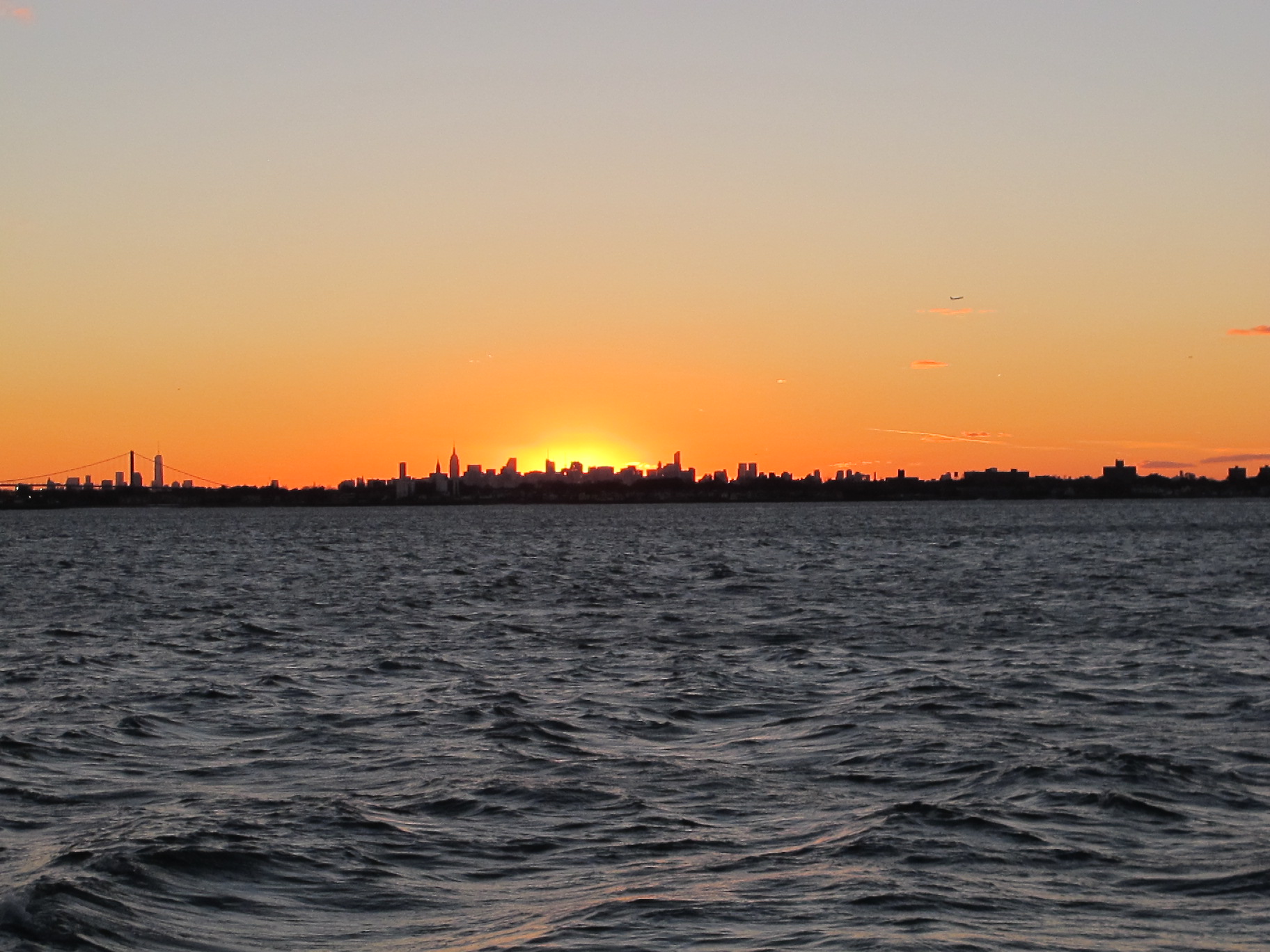
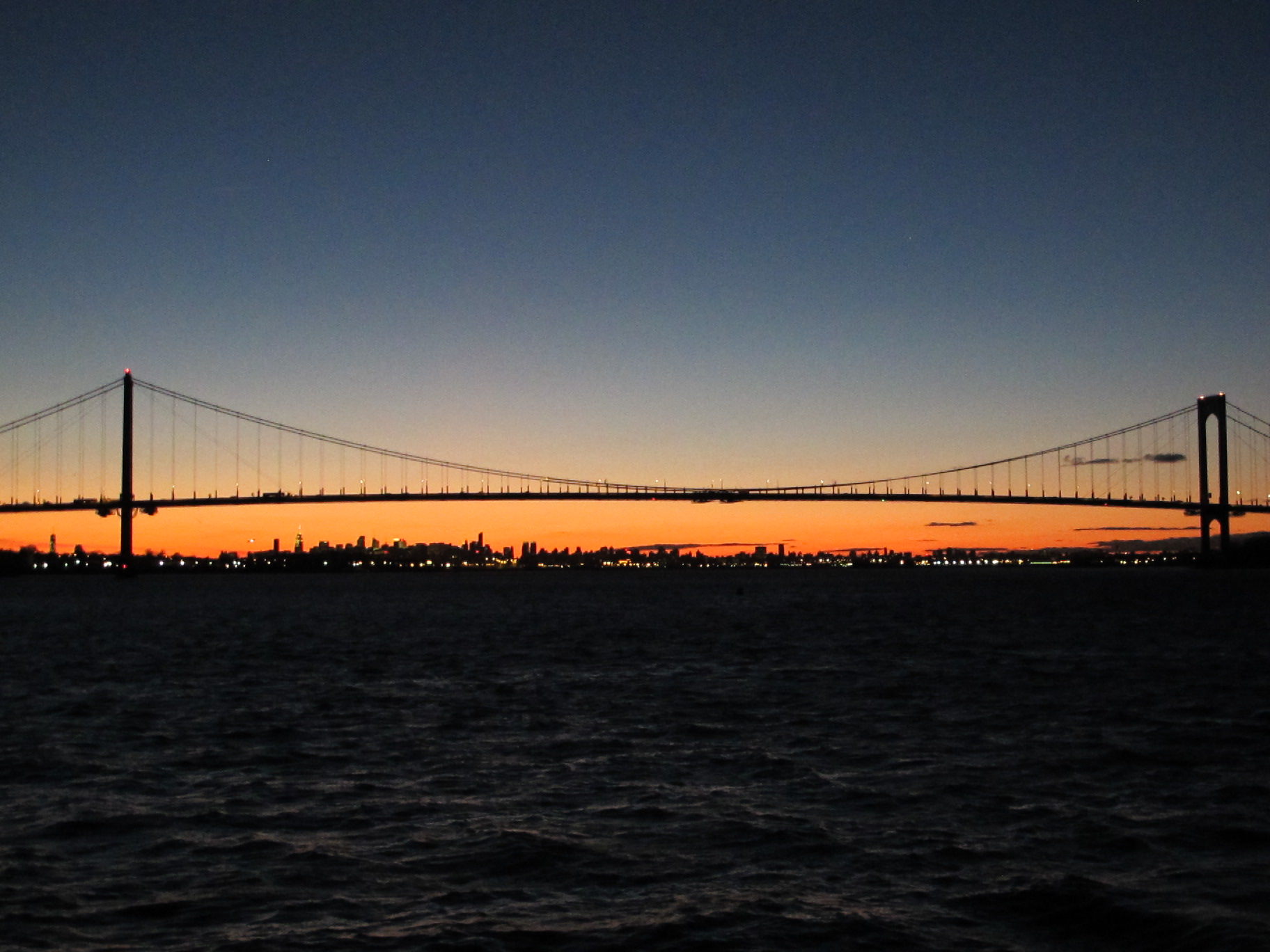
The city appears on the horizon, emerging out of the mirage that shimmers where the sea meets the sky. It grows as the day fades; it swallows the sun. The city rises around us and similarly swallows us into its glow, into its concrete web, into its madness. We enter the Bronx on the pulse of one of the main arteries, flowing in through the back entrance to the city. The air smells of asphalt, of sewage, of acrid chemicals, of exhaust. Sirens wail in the distance.
At night you can feel it the best.
It is in the decaying buildings and in the trash swirling in the cold wind.
It is in the clatter of metal and rasp of tires on concrete.
It is in the barred, the locked, the shuttered.
We silently pass each other;
your face tired and eyes downcast in the artificial light.
It would be too terrifying to ask what you are doing here,
because of what it would say about myself.
I finger the keys in my pocket and quicken my pace.
I am moving to Brooklyn in a few weeks. This is the end of my Southward travels. My bike is sadly disassembled in a box. This abrupt shift in life plan has led to some very poignant questions: What do you do for a living? What are you going to do with your life? What is your thirty second elevator speech?
Well, to begin with, I haven’t been in an elevator for several years.
I need to revise my resume. Who am I? What have I done in the past few years? I would probably be listed as itinerant or destitute by most federal agencies. I would definitely fit into the category of ‘disgruntled worker’ in an economic census. I have virtually no physical manifestations of what I have been doing with my life. It helps to look back. This is what I was doing on this very day in recent years:
I wrote the following in my journal on a motorcycle trip in India seven years ago on October 16th:
“Left this morning after an okay breakfast. We cruised some beautiful mountain and coastal roads with no idea where we were going. I have finally gotten a real good hang of banking the bike around turns, which is a blast.
Finally we got to highway 17 and we were forced to blow around a police roadblock. It was a thrill. I am now sitting in a beach villa writing since we cannot return until later due to the police roadblocks.
Leaving later had no effect on the police presence, which lead to us blatantly blowing through about 3-4 police roadblocks. The force was apparently stepped up due to the once a year unveiling of the ‘Infant Jesus’ in Culver, which draws people from all over Goa.
Blowing through one police roadblock I actually made eye contact with cop as he stepped in front of my bike and clearly motioned me to the side. I motioned to him that I was pulling over and started pulling to the side, and then hammered down on the throttle and took off.
After consciously avoiding police several more times, we made it back to Baga for the night. We were delayed since Anthony suffered a front tire blowout. We had to go to a shady shack in the woods to get it fixed. The guy there guessed we were from the states right off for the first time, but I believe that it is due to the fact that we were smoking Camels. They patched the tire, but the power had been out all day, thus they said they could not fill it. The power miraculously switched on and off we went.
We got back to Baga and checked in at Traveler’s Guest House. We ate and went out for drinks since it was our last night together.
We were playing pool at the bar and getting pissed, it was a blast. We were the only customers thus the bar tender felt free to produce a hash joint which I promptly smoked with him. I feel asleep after sitting at Maioka for a while again.”
Five years ago I was living in the Central Yucatan in a small village called Xpujil where nobody spoke English and I spoke a modicum of Spanish where I wallowed in post-graduation confusion.
Here is some of what I wrote as I was hitchhiking through Chihuahua two years ago on October 16th:
“We decide to hitchhike to Recusarare Falls and start our walk South out of town to hitchhike from the rotunda. It is a beautiful morning and there are cottonwoods with their leaves changing. We get to the rotunda and there is virtually no traffic; I am worried that I am going to look like an idiot for pushing this plan forward. We are chatting with a local guy after waiting for 30 minutes or so and a family in a pickup rolls by and throws us in back with a brand new big screen TV. Miriam and I have shit eating grins on our face for the whole ride. Once again, the best way to see the world is from the back of someone else’s pickup.
We get dropped off and start our hike down. We are going along a creek bed and through lush stands of ponderosa pine. There is a group of donkeys grazing in one meadow where two small streams converge; I try to pet them but they will have none of it. The trail winds into more rugged terrain and there are many Tarahumara women about, all industriously working on artisan crafts: baskets, scarves, belts, bracelets. All of it good quality. They are selling it, but will not say anything to us but a quiet, muttered ‘buenos dias.’ All with the most piercing black eyes that the indigenous people of Central America have and bright dresses.
After laying out on the rocks in the midday sun to warm up, we head down canyon through a boulder choked canyon with blue pools in between. Everything is mossy and lush, yet littered with the remnants of globalization in the form of Coke bottles and Frito bags. All of this requires a lot of jumping and bouldering. Miriam says in English how doing this makes her feel alive; I couldn’t agree more. I find a super creepy dolls head and put it into my backpack. We finally reach a pretty tricky point and decide to turn back.”
A year ago today I was training to ride my bicycle South.
Eight months ago I arrived in Guatemala and randomly met a girl named Lauren in Guatemala who had taken a four hour car ride with my mom at one point before deciding to travel to Guatemala after hearing about my adventures.
Seven months ago I decided to quit my job, break up with my girlfriend in Utah, and stay in Xela, Guatemala after staying up all night watching a volcano erupt.
Two weeks ago I was training and prepping to ride North through Mexico with Lauren.
Ten days ago Lauren received an email from a friend regarding a job opening that was essentially her dream job.
Seven days ago she accepted the job on the condition that we move to Brooklyn within three weeks.
Here are some excerpts from conversations in the past week:
‘Dad. I wanted to let you know before anyone else that Lauren accepted a job in Brooklyn that starts in a few weeks. We aren’t going to do the bike trip anymore and will be home in a week or so.
So you called to tell me that you are becoming a barrista?’
–
‘I spent a summer living there once. To succeed, to survive, you need to be angry. Don’t worry though, you will become angry just by living there.’
–
‘The East Coast is weird. People there care where you went to highschool, what your parents do for a living. I had a boyfriend’s dad ask me my SAT score the first time that we met, apparently he does it to all of his kids partners.’
–
‘How are you going to live there? How do you have any money left? I think I should explain this to you since you have been in Guatemala so long: having three figures in your bank account shouldn’t make you feel rich.’
–
‘You could probably get a job cleaning the building where Lauren works or maybe making tortillas. Cuatro por cinco!
Yeah…. I am going there like an immigrant with everything that I own strapped to my back and no clue as to the future. I am like a cockroach though, I know how to adapt and survive.’
–
‘I saw this movie with Michael J. Fox where he went to work for a publishing house in New York, something you could do since you like writing, and he rose up to editor from copy boy. He did it by snorting mounds of cocaine and staying up all night.’
–
‘Don’t worry, there are plenty of weird people like you there. Everyone is doing something interesting.’
–
‘Hahahaha. I can’t imagine you there. Good luck adjusting to the sedentary life!’
–
‘I get self conscious when I am there. There are literally flocks of supermodels roaming Manhattan. Flocks of them!’
–
Yesterday I was vexed with anxiety over what I am going to do in Brooklyn, over where I am going with my life. I have not built my life around work like the hypertrophied, ravenous, career professionals for which New York is famous. I have traveled extensively, met incredible people, learned another language, read hundreds of books, and discovered more about myself and humanity than I ever could have imagined. How do I reorient all of this to sound like I am a valuable and diligent worker?
How am I qualified for this position? Honestly, I am probably not.
Today I am reflecting on my life. I have chosen the path that I walk, over and over again, yet all too often I look back in frustration at its sinuous course. I navigate through life with my values as a compass, often leading myself in directions that are confusing to others and myself. I don’t really know where I am going, but as usual I feel good about it. I haven’t had a boring chapter in a long time and I am sure that this one will be no different. It is just a continuation of the adventure, of my life.
The coyote called today from Juarez; he wants the money before the month is out. He threatened the milpa in San Pedro Matagallinas again. The farm isn’t worth anything anymore; the rains never come on time and we can only grow maize. The seeds and fertilizer are expensive. It is home though. Carlitote and Josephinita need new school uniforms, they need books, they need a future. I need tortillas. There is not enough work. There is the rooster though, The Gallo de Oro.
I promised him a peaceful life in the North as we waded across the Rio Grande. It cannot be though; there is a greater fight. He will strut under the lights of the ring once more, squaring off against a sleek, bowled cockerel with filed talons raised behind a bodega in the Bronx. The Gallo de Oro is hard and lean from the free range; he has fought in Hormigas, in Hermosillo, in Tecpatan, in Cholula, in Nogales, in Juarez. The pluck has seemed to have gone out of him with his departure from the ring; he was meant to dance. And so it will be. I am the Gallo de Oro.
I enter the fray, no limit to my potential other than my own ambition. I am working in an office with my face against my palm as the fluorescent lights bleach my soul. I am stressed; my teeth hurt from grinding them at night. I stand up to shovel Chinese food into my mouth as I peer out on the shimmering lights of the city from an office building, exhausted from a frantic night of scribbling out the nonsense that is in my head onto a white board, only to be interrupted as someone taps me on the shoulder to hand me a comically oversized check. I twirl in Time Square, reveling in the brilliant light of the utmost manifestation of the material dream. I see Thomas Pynchon cross the street in front of my car; he is just another human. I read ticker tapes that reflect my prudence and intelligence of my investments, numbers that hint that I may be able to get a little place in the Hamptons someday.
2010-2011. It started to snow in early October and did not cease until the following summer; the storms were relentless and were drawn to the Wasatch mountains in Utah from the Southwest, from the Northwest. At this point in my life I did very little other than ski; I spent five or six days a week working as a ski patroller and every other moment I could in the backcountry of the Cottonwood Canyons. I skied all but a few days between Halloween and Easter, trying to take advantage of a once in a lifetime winter. The amount of snow that fell can be quantified in the number of cups of coffee that I drank per day, which topped out at roughly 12 before I decided that I had a problem. I would wake up before 5am for both avalanche control and days in the backcountry; I tried to keep going, always knowing that it was bound to stop at some point. But there were so many lines and chutes that I had been lustfully eyeing for years, waiting for the right moment to approach.
Monte Cristo, The Hypodermic Needle, Mount Dromedary, Thunder Bowl, lines off Mount Superior; memories of deep powder shimmering under a blue sky, of hours of trailbreaking, of stable conditions, of standing atop monochrome monoliths remain as pleasant, but hazy recollections. Although there is one foray into the backcountry that has endured as it is of a different character; it has a tinge of danger and disaster. The mind understandably works this way; its self preservation instinct is better served by searing threats to life and limb into the memory than the tranquil and pleasant.
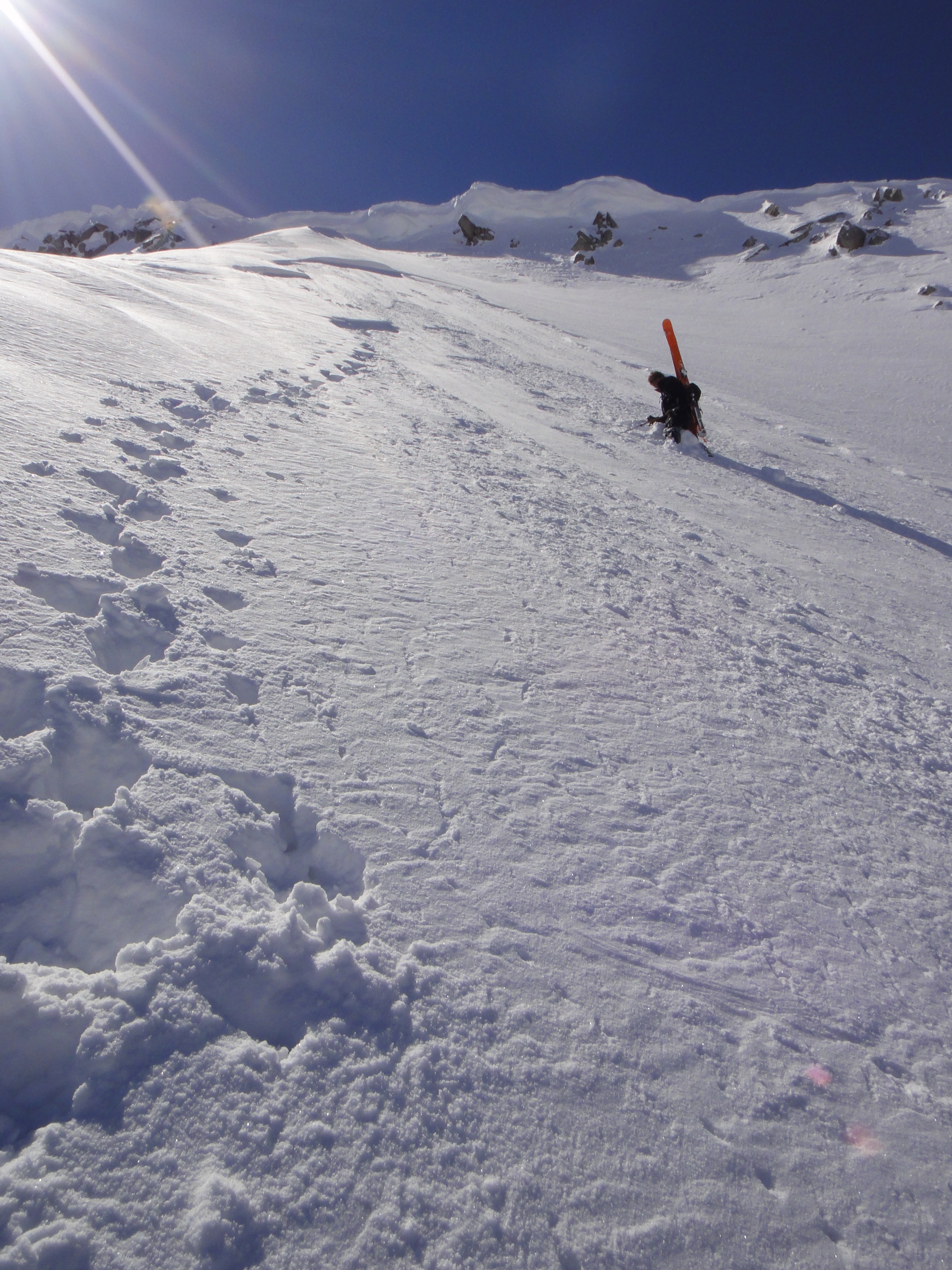
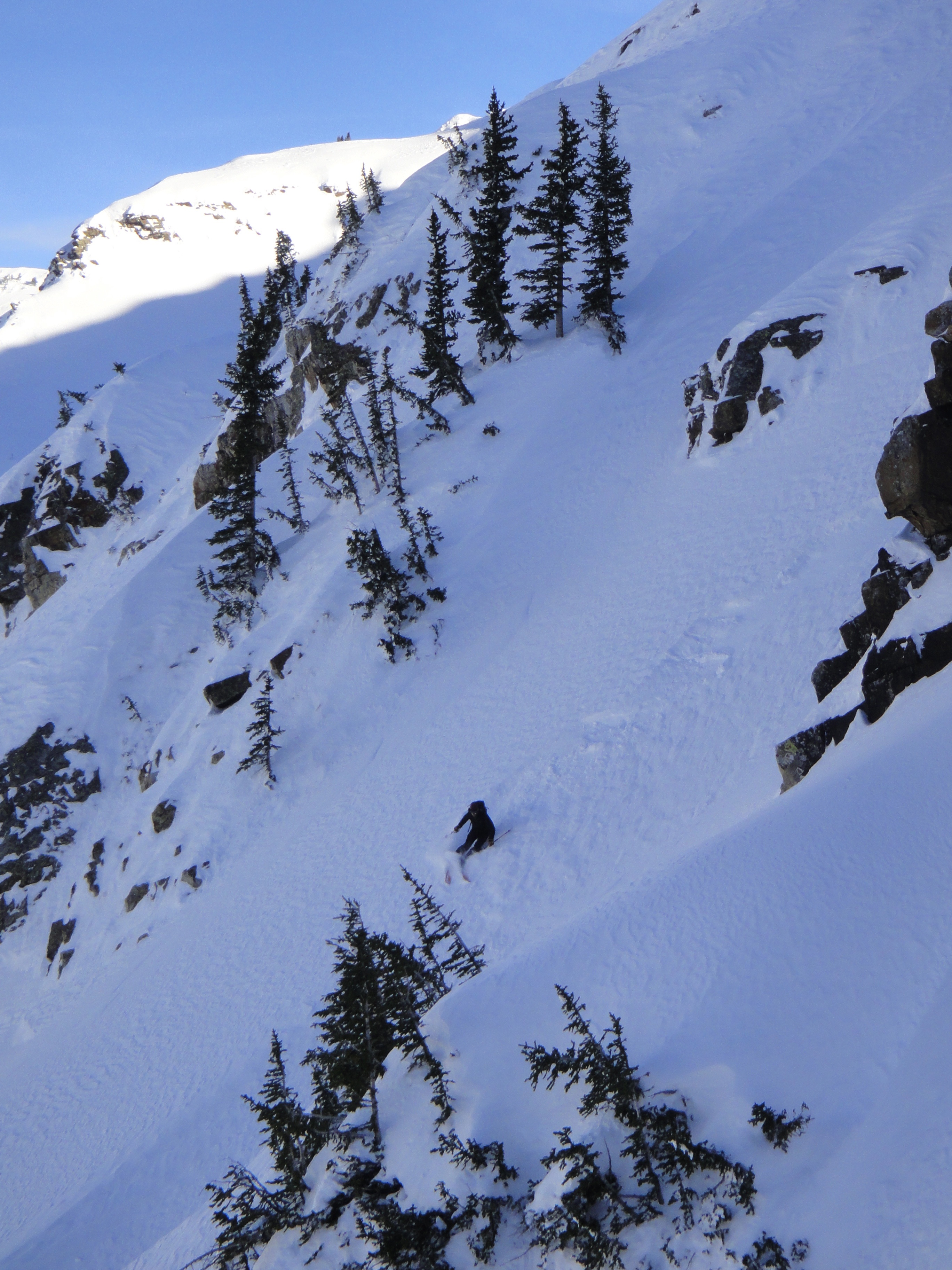
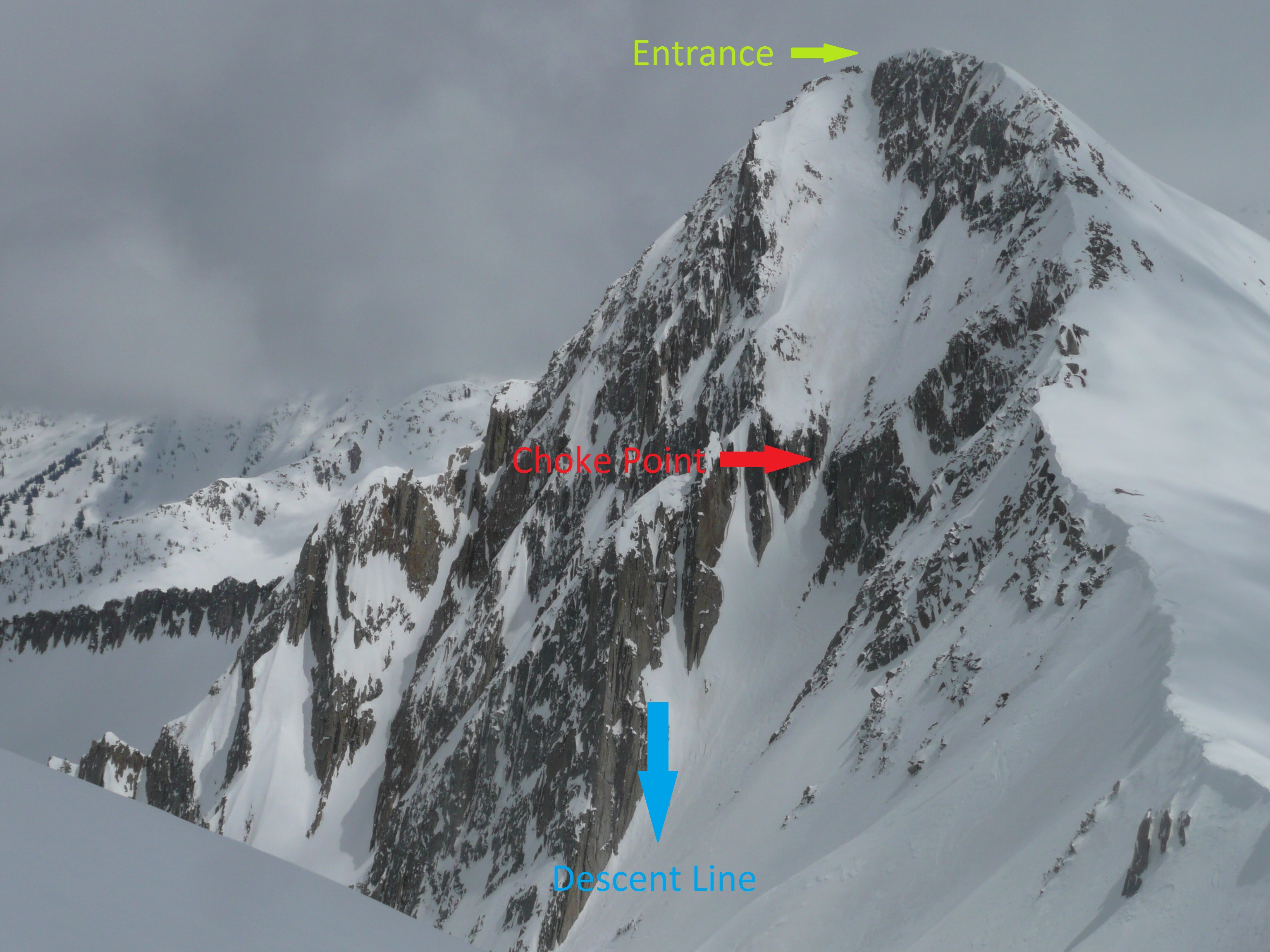
The Northwest Couloir of the Pfeifferhorn. Steep. Narrow. Classic. An hourglass shape, the upper end of which feeds you into a constriction that terminates with a cliff, typically requiring a rappel, before opening into a vertiginous apron. The line consists of a 1000 foot descent with an average pitch of 50 degrees. The approach to the remote 11,326 foot peak is long and committing. The couloir itself is noted for its often treacherous conditions, something that I hoped to avoid by skiing it after the right storm.
In the middle of February a storm was approaching that promised to drop a significant amount of snow on top of what was a stable snowpack. My friend Joel and I had decided that we were going to make an attempt on the Pfeifferhorn the following day; for me this meant calling in sick to work, something that I didn’t lose any sleep over. Joel and I had undertaken a few different adventures together and our demeanors were well matched. Joel has a love of skiing that is matched with fearlessness and intelligence, despite his Australian origin. His ability to carefully navigate the perilous backcountry with savvy can lead to nothing other than thoughts of a snowbound version of Mick Dundee.
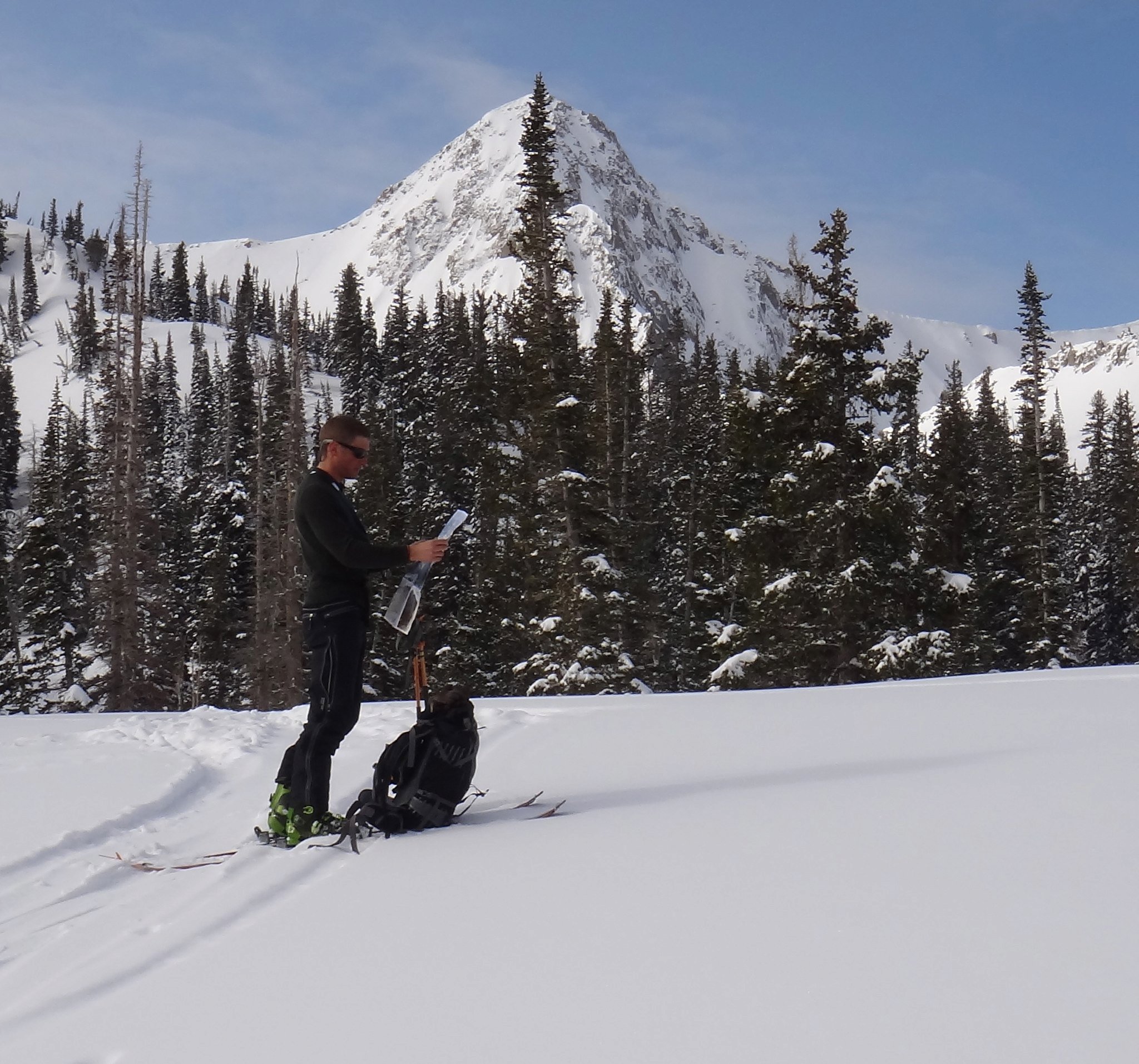
Pfeifferhorn in the background.
I woke in the morning darkness to take a look at the weather stations around the Wasatch and the avalanche report; it looked like it was going to be a perfect day. The Northwest flow had dropped a foot of snow without any terrifying wind or other irregularities from what we could gather.
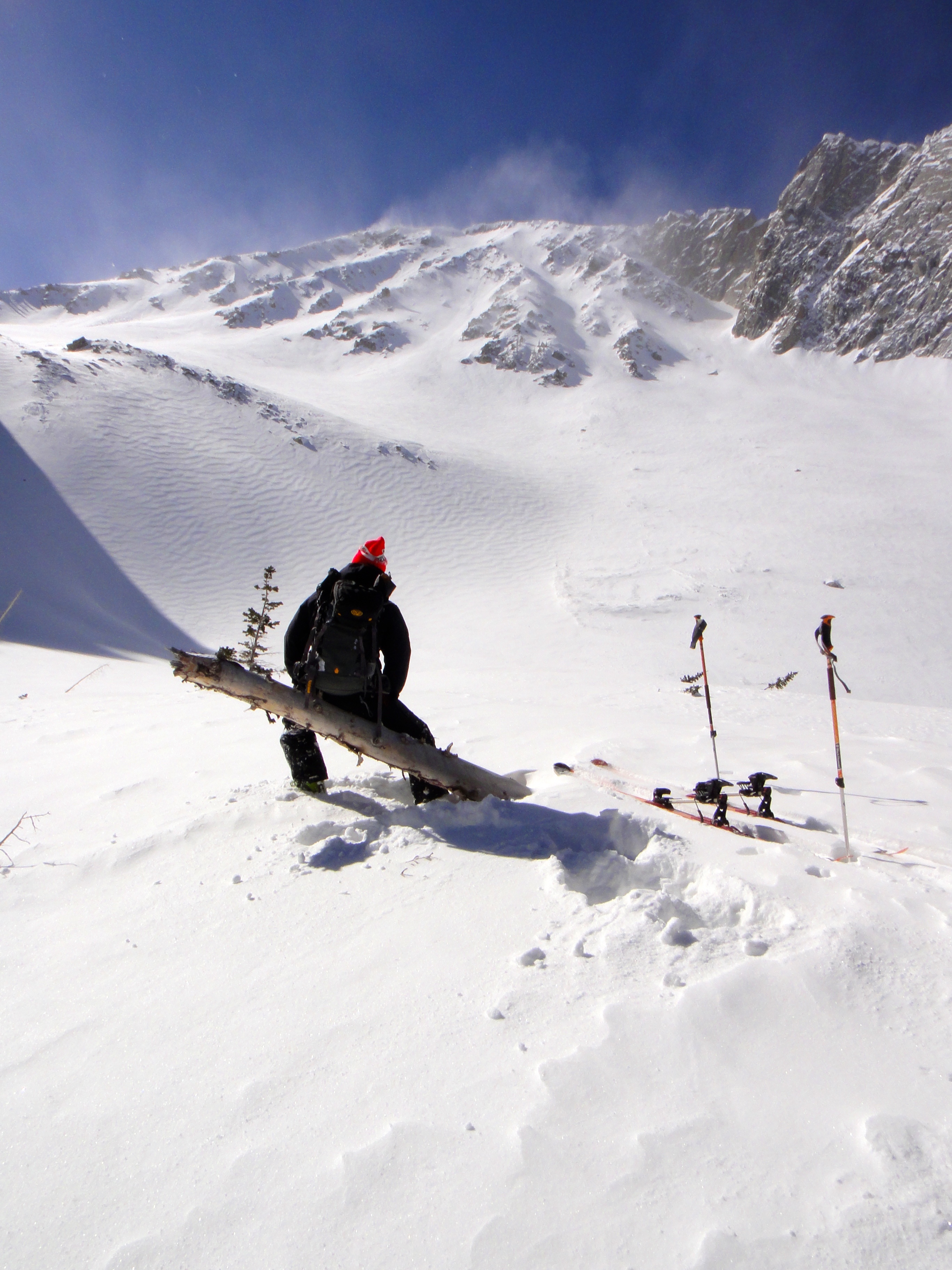
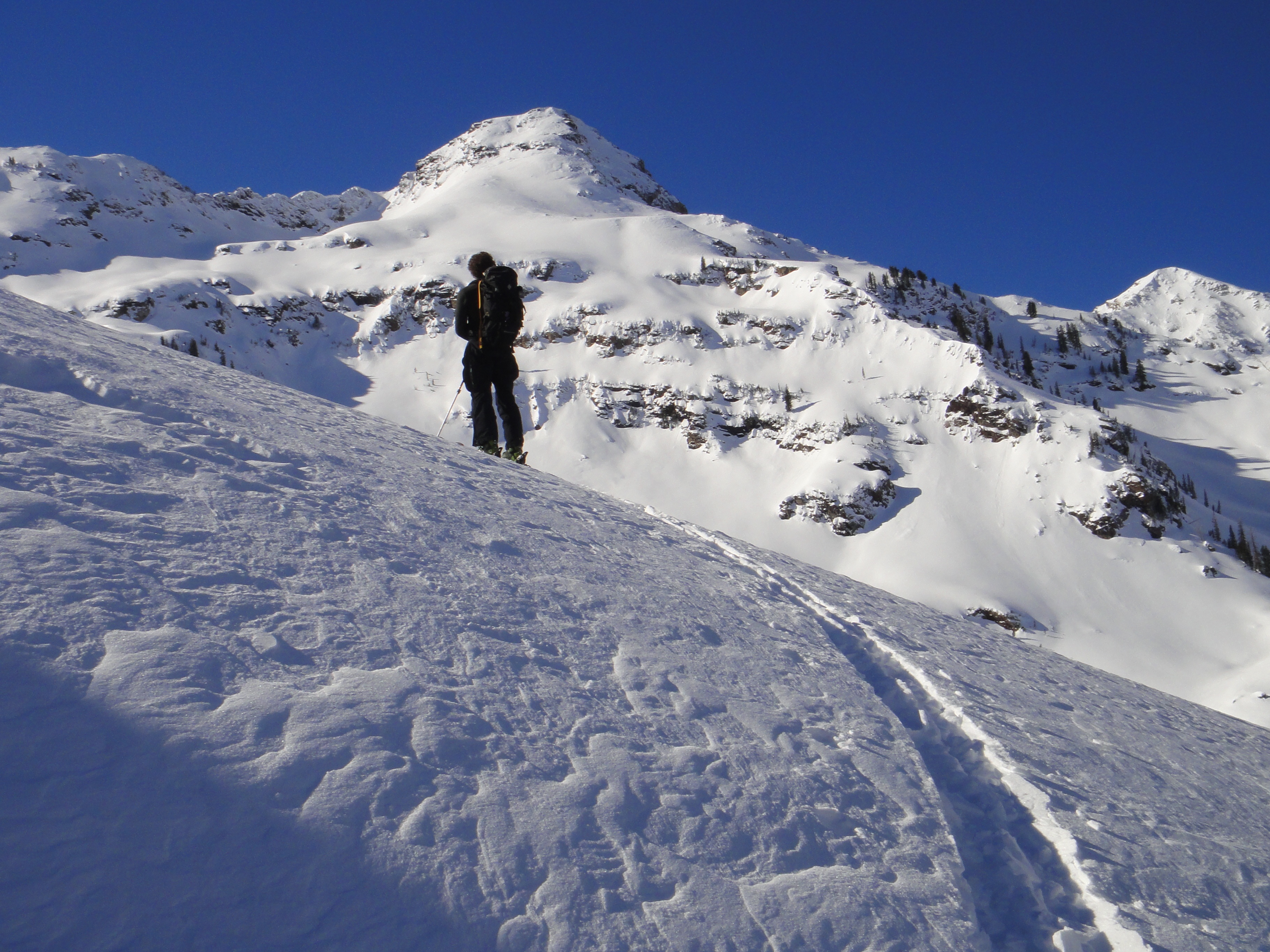
We parked in Little Cottonwood Canyon and started skinning towards Red Pine Lake in the predawn glow, slowly making our way upwards with our headlamps aglow. We broke trail through the fresh light snow, sweating despite the morning chill. The surface began to shimmer as the sun broke over the crest of the range, the pristine blanket covering every surface took on a blinding pure whiteness. We assessed the conditions perpetually; everything seemed stable and lacking in spatial variability. The peak was within sight, intimidatingly looming over us, growing with each lunge forward.
Looking at Mount Dromedary
Touring in the Wasatch gives me a feeling of remoteness and peril despite the hum of cars in the canyon below and the thunder of Howitzer artillery up the canyon. It is a different world beyond the road; it is harsh and unforgiving.
There is a very little that I remember from the approach despite the many hours that elapsed; I often go into a strange meditative state as I step and breathe. We bootpacked the shoulder before standing on top and peering out upon the rugged and serene landscape as a gentle wind swept over and chilled us. It was noon. We put on our harnesses. I prepped my daisy chains to clip into the anchors, and checked the rope.
‘Do you feel good about it?’ I asked Joel as we looked over the seemingly vertical precipice that lay in front of us.
‘It looks a little icy and scoured, but I feel good about it. You?’
‘Yeah, it just looks like the entrance to any couloir.’
‘Who is going first?’ Joel asked me.
‘Uhhhmm….I’ll go? I’ll back off if it gets sketchy.’ These moments are always strange. You are putting yourself up against your own judgments about the conditions. The first person is the canary.
Joel turned on his helmet cam and I cautiously stepped into the couloir. Adrenaline coursed through my veins, a temperamental chemical that can either go the way of fear or focus; I channeled it as I moved out towards the right shoulder of the couloir to check its condition. The sound of my edges grinding against the icy surface filled the air as I cut across; it was slightly terrifying. I stopped to take a deep breath at the shoulder, which held some snow, but I decided to traverse back and forth across the couloir rather than trying to make turns. There was nothing that a normal human being would identify as skiing yet.
The slope got steeper and the walls began to close in. The couloir at this point consisted of nothing but sheer ice, something that is typical in the upper end of couloirs. I meticulously worked my edges on the surface; I tried my best to keep my doubts and concerns at bay. The anchors were within sight, as was the powder field below. The cliff did not look substantial and a fall, as long as I didn’t hit any rocks, would mean nothing but landing in the soft cushion of fresh snow that covered the lower end.
I worked my way down into the choke point, moving with slow deliberateness. I muttered gratefully about how sharp my skis were and yelled my plan up to Joel. As I neared the choke point my ability to hold an edge was progressively compromised by its concave shape, I was only holding an edge with my tips and tails. I committed too far before realizing that I was precariously balanced above a cliff on ice, unprepared to take a fall. Moments slipped away as I held my edges at a ridiculous angle perpendicular to the 50 degree slope and stared at the anchors that were several feet beyond my grasp, with a rope someone had left behind strung through. My legs started to burn and quiver as I schemed to get out of this predicament. There was no boot packing or side stepping back up; the ice and shape of the surface made these options out of the question. The cliff was just an icy ten foot waterfall and there should be perfect snow below. There seemed to be only one option; I quickly thrust my hand out for the rappel anchors and rope, hoping to quickly clip my harness in after I got a grip. Ice is best understood from a tipping point perspective, you have purchase until you don’t; it isn’t something that is gradual or forgiving. I felt the tails of my skis give out as I reached forward over the tips of the skis. The rope was doubled over through the anchors. I only managed to grab one end.
I didn’t have enough time to fully appreciate what was happening or I was simply to disoriented by the way in which it happened. As my tails lost their edge I fell backwards, meaning I was on my back with my head downslope as I went over the icy, rocky chokepoint. My arm ricocheted off of several rocks as I tumbled and gained speed. The whiteness that I had appraised from above as comforting, soft snow received me with the harsh thud of blue ice. I began to gain speed, feeling the irregular surface of the ice below me grating against my back. I tried to stop myself with my skis, tried to catch an edge, but they simply exploded off my feet. My head remained downslope; I starfished outwards, swinging my arms and legs wildly in an effort to create friction.
I tilted my head backwards and saw myself headed towards rocks at a speed that I would place at around 30 miles per hour. My mind didn’t panic as there wasn’t time. Huuuuuuuuuuu Ahhhhhhhhhhhh Huh huh Huh Oh I remember making some guttural animal sounds as I continued futilely flailing. Everything unfolded rapidly, but with an intense and clear focus. The last thought I remember: I never thought I would actually see my own death or that it would be so easy. The rocks came near, but contour of the couloir cradled me, carrying me safely past. As soon as this disaster was averted I found myself rotating through the air, white, blue, white blue. I hit a wind lip built up on a minor fork in the lower portion of the apron headfirst. I cartwheeled nearly to the bottom of the ski line before stopping. I remember having some sort of strange moment as absolute silence enveloped me; the world had stopped turning. I slowly stood up and looked in fascination at the hundreds of feet that I had descended in seconds. There were no alarm signals yet, just shock. I looked down to see red slowly spattering the snow below me; blood was running off of my arm that stilled griped the rope that I pulled through the anchors.
I didn’t have time to look at where the blood was coming from before the panic set in. Joel! The shape of the couloir meant that he was only able to watch me disappear over the lip from his vantage. I needed to get within ear shot of him; I needed to let him know I was alright and that he shouldn’t descend. I was gasping, fighting to get enough air as I kicked my boots into the ice, adrenaline pushing me upwards.
I caught sight of him standing at the choke point; he had gotten ahold of the anchors. We shouted back and forth, although I don’t think we were close enough to understand one another. Suddenly he jumped off the lip of the cliff and hit the sheet of ice. He had a Black Diamond Whippet Self-Arrest ski pole that he drove into the ice with his weight until it was ripped from his hands. I stared on in silent horror as I watched him gain speed, taking the same ride that I had just miraculously survived, and pass within a few feet of me at incredible speed. There was no sound other than the roar of his synthetic ski gear over the ice.
I found myself running down back towards the same point where I had found repose. Joel had managed to pass another 20 feet beyond my mark and lay in a heap with his avalanche airbag deployed.
‘Are you alright?’ I shouted down.
‘You need to go get my ski.’
‘Where is it?’
‘It is stuck in the choke point.’
I accepted this gravely and started upwards without asking any other questions. My arm began to stiffen and get cold from the blood that ran down it. My lungs and legs burned as I tried to work quickly under the assumption that Joel had probably sustained some kind of injury. I was running on nothing but adrenaline at this point, although I started to shake with a freshly conditioned Pavlovian fear as I approached the cliff once more, carefully toe pointing as I went. I grabbed Joel’s whippet that had been ripped from his hands and then began ascending the blue ice below the cliff.
I saw the ski jutting out from a crack in the rock above my head and understood why Joel jumped. I kicked out and carved handholds to ascend the final icy pitch to the ski. I carved out a sturdy handhold as I stood perched over the icy abyss and began to swing the ski pole at the ski to try and dislodge the ski. On my third strike it broke loose and began a chattering bouncing ride downwards towards Joel. I yelled in vain with the hope that it would miss Joel.
I began my descent, working my way across slope to recover poles and skis that were incredibly separated by hundreds of feet. One of my skis had come down vertical and with such force, that only a few inches protruded from the snow and ice. I eventually reached Joel again and collapse into the snow next to him.
‘Holy shit! Are you alright? What’s going on?’ I let out in release.
‘I am good, but I am not sure if I can move my knee, I think I tore something. We need to get out of here though, get me that ski and we will see what I can do.’
I finally looked at my arm. It had swollen to what seemed like twice its normal size and had a significant injury exposed at the elbow from hitting rocks that managed to rip through three layers of clothing. I was convinced it was broken, but accepted it with calm resignation. Everything was not all seriousness though; we were laughing hysterically within minutes, lost in shock and adrenaline.
‘I cannot believe we are alive. Did that really just fucking happen? To both of us?’
‘Are you jealous that I made it further than you?’
A significant amount of time had elapsed in this whole episode; we were well into the afternoon. We still had a run out down Maybird Gulch that was not short or simple. Joel tried moving his knee and had some range of motion and not too much instability. I helped him into his skis and watched in gratitude as he was able to carefully begin working his way downwards. An inability to ski would have likely meant spending an evening out.
Joel, with an injured knee, skied with skill that left me astonished. We reached the car in the twilight, both shivering and drained, mentally and physically. I took off my gloves and looked on in horror at my bloody hand and the pinky finger that was completely black and waxen with frostbite.
‘Whoops!’ I hold out the claw to Joel and start laughing.
We descended the canyon and recounted our respective stories over a pitcher of beer, looking haggard and talking manically, oblivious to the other people in the bar. We realized what had been our undoing: the storm system had arrived from the Northwest, the direction that the couloir faces. It had come in slightly warm with brief rain that had served to bond the fresh snow to the existing snowpack everywhere else. In the Northwest Couloir it had frozen rapidly, due to the direction of the couloir and the wind, and merely created a sheet of ice that attracted no snow. Joel clarified another part of the story, he had lost one of his skis as he tried to kick his ski into the sheet of ice to get purchased; it chattered down the couloir and became lodged in a crack midway through the cliff. Joel decided to jump and try to dislodge it with his ski pole before taking his downward journey. He realized that we needed that ski to get out of the backcountry and there simply was no decent way of getting it.
Joel had to go to the hospital the next day and found out that he had indeed torn a ligament in his knee. I returned to work and tried to continue on like nothing had happened despite my inability to move my elbow joint. I had no insurance, so going to the hospital had to be avoided. I hid my broken wing out of fear of getting caught in my lie and out of a certain degree of shame over what had happened. I did not want to recount the tale, but after a few questions from people on my patrol team, I spun the tale with a grin. Stories eventually just become a piece of you, telling them helps the process along.
I have since developed a deep seated fear of slippery surfaces above precipices; a fear that I find to be completely rational. I have been on an endless summer since that winter finished. Joel has gone on to more ridiculous feats, including supporting his ski habits through the practice of law.