Category: writing

  • The Deus Ex Machina Chaos

    At the end of November I had been out of work for a while and as much as I would like to use my outsized brain to trap or spear animals, to hew a home out of the forest, to break stallions, or to cultivate a field, I was forced to accept that this was not a realistic possibility at this juncture in my life. I got a call from a friend asking if I wanted to do some demolition work for a few weeks here in Brooklyn. I impulsively answered, ‘Yes.’

    After moving to New York from Guatemala I had been doing a lot of thinking and I felt a little unstable, like I was on the verge of something. My mind did sommersalts and wove itself into knots; it vomited forth and then became constipated.  It is just what my brain does sometimes. It isn’t always clear what has emerged from turmoil such as this, but I came up with something and wrote it down. Here is an account of breaking down both physical and theoretical walls and finding something beautiful in the space that was left.
    The strangeness of New York and its complexity was reflected in the job itself: I worked with a Croatian who has been here five years named Mate (accent on the e) and a Muslim from Burkina Faso named Ibrahim who had been in the country for less than a year. Mate lived in Queens, had two kids and a wife who was an English teacher. Ibra, as I took to calling him, was younger and was working to make money for his family in Burkina Faso. He was a married man and was saving to bring his wife over someday. Ibra had no papers and Mate had just received his green card. I amused myself by thinking of myself as an indigenous immigrant.
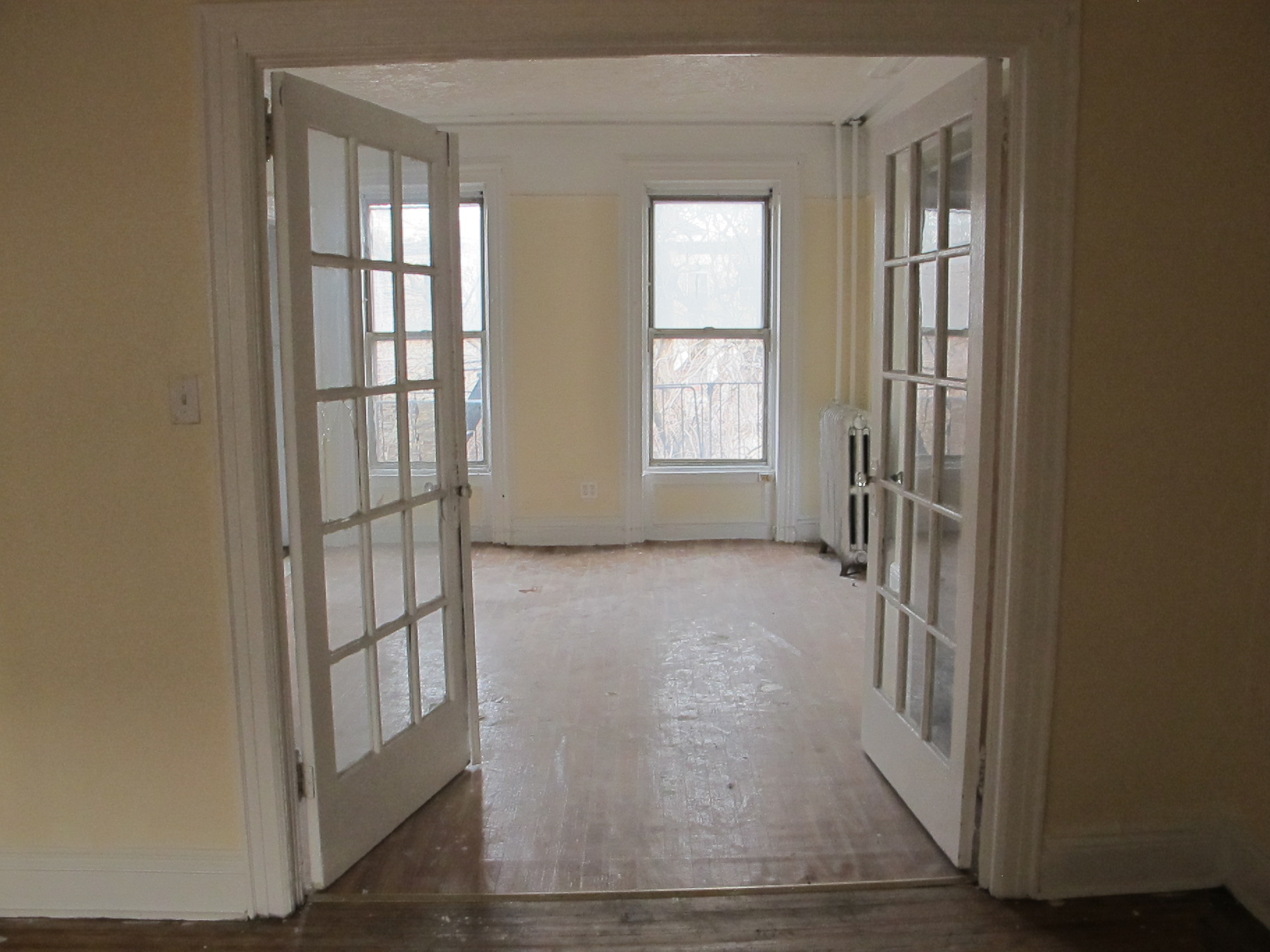
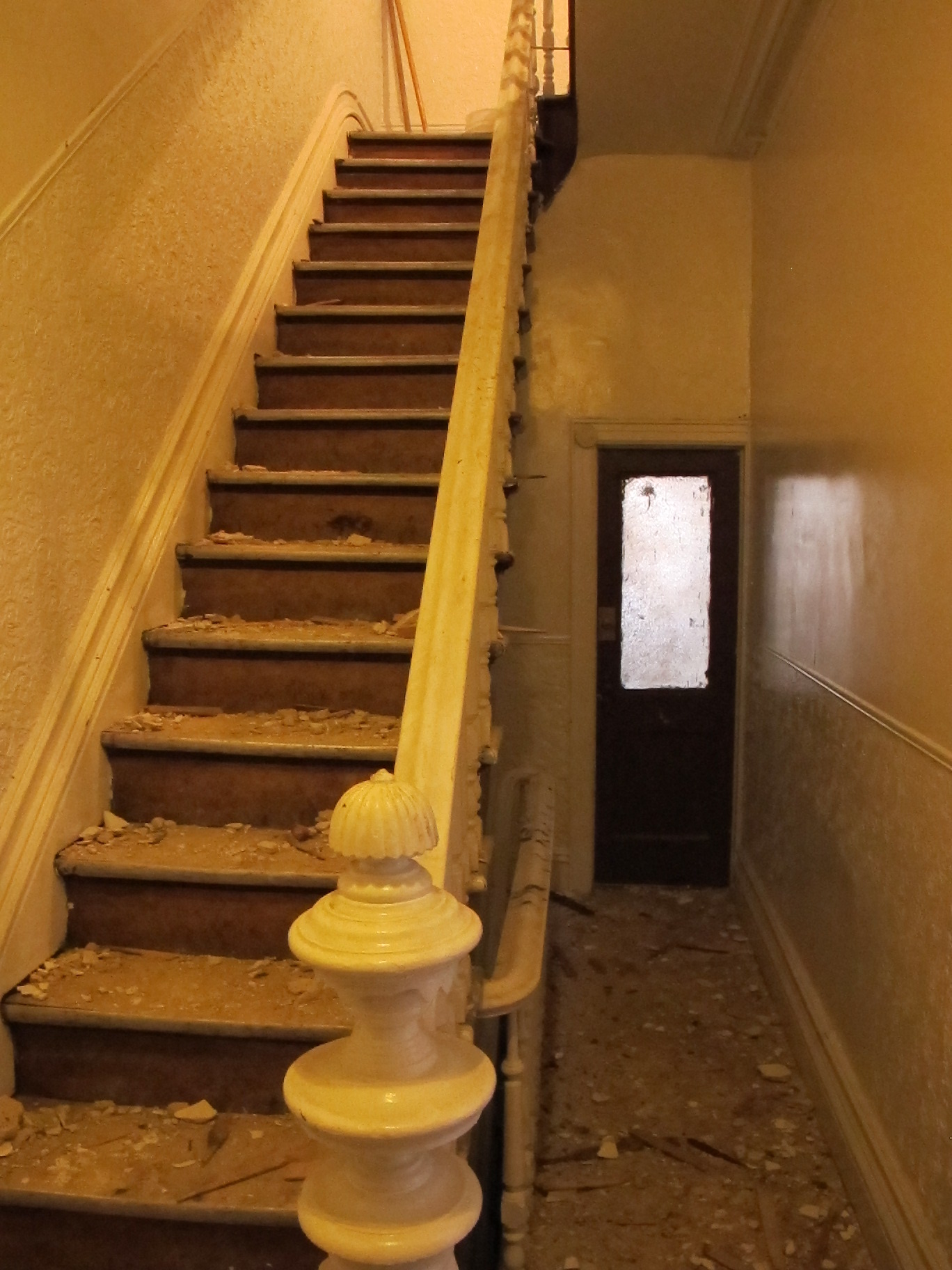
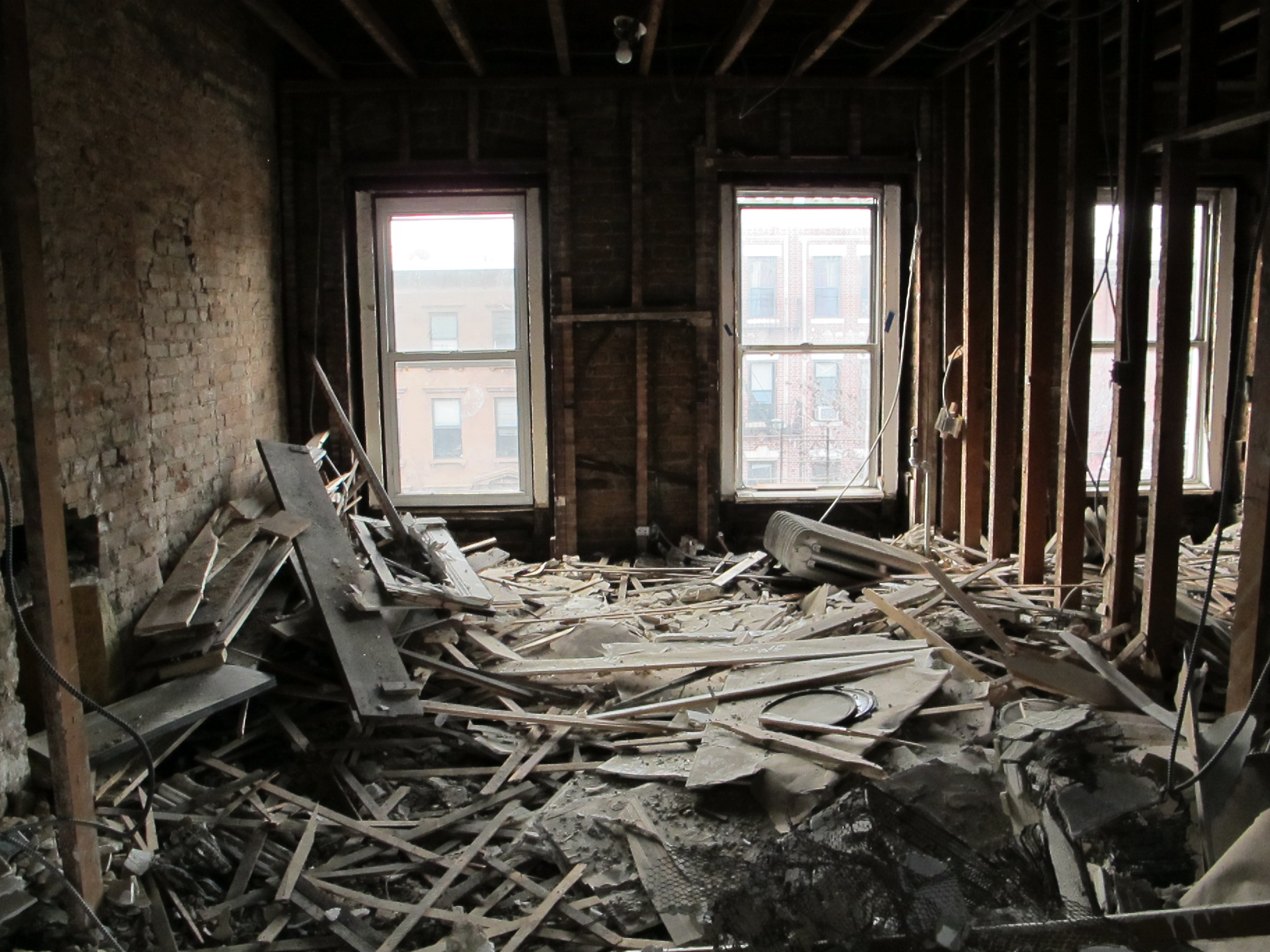
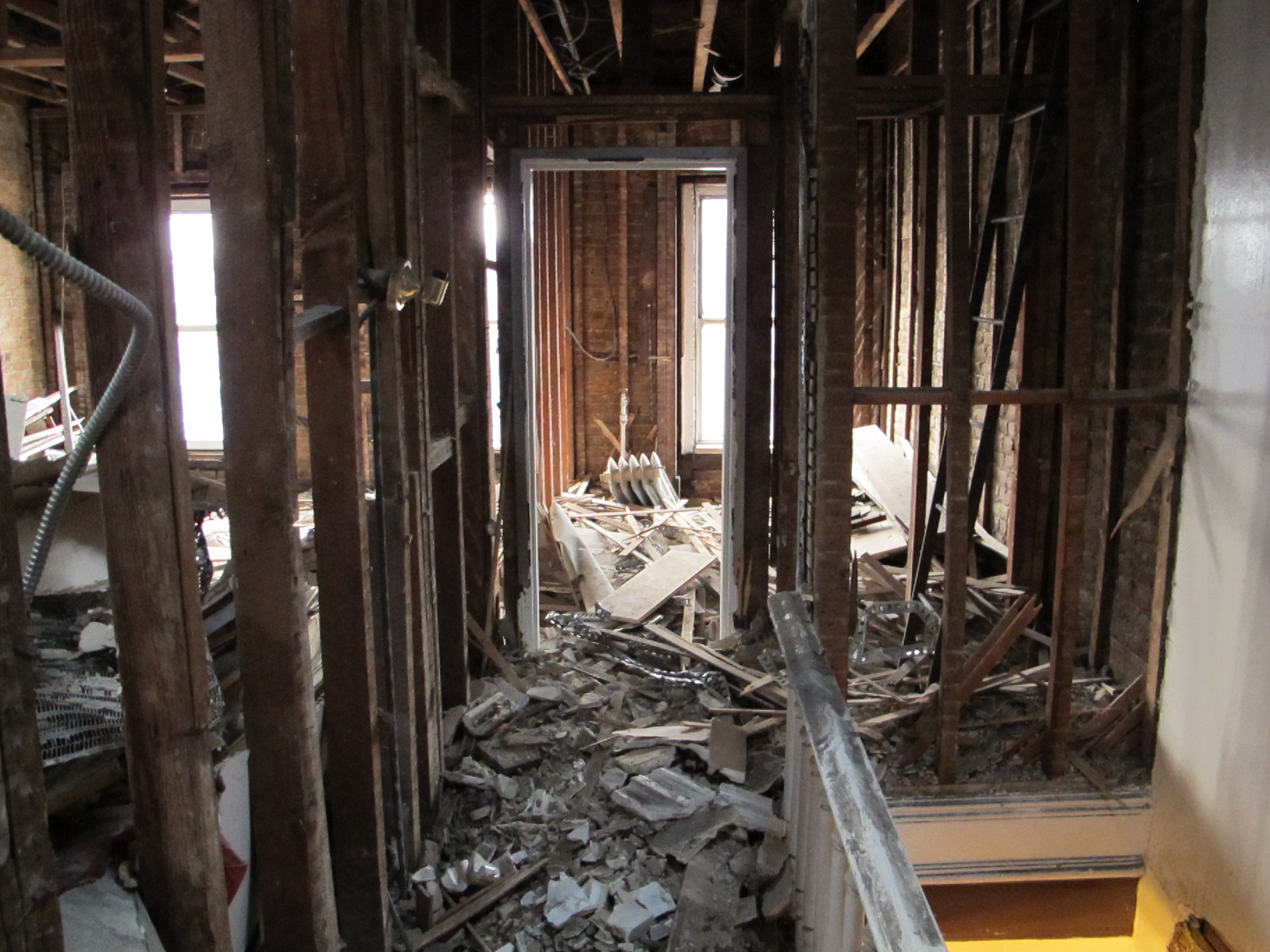
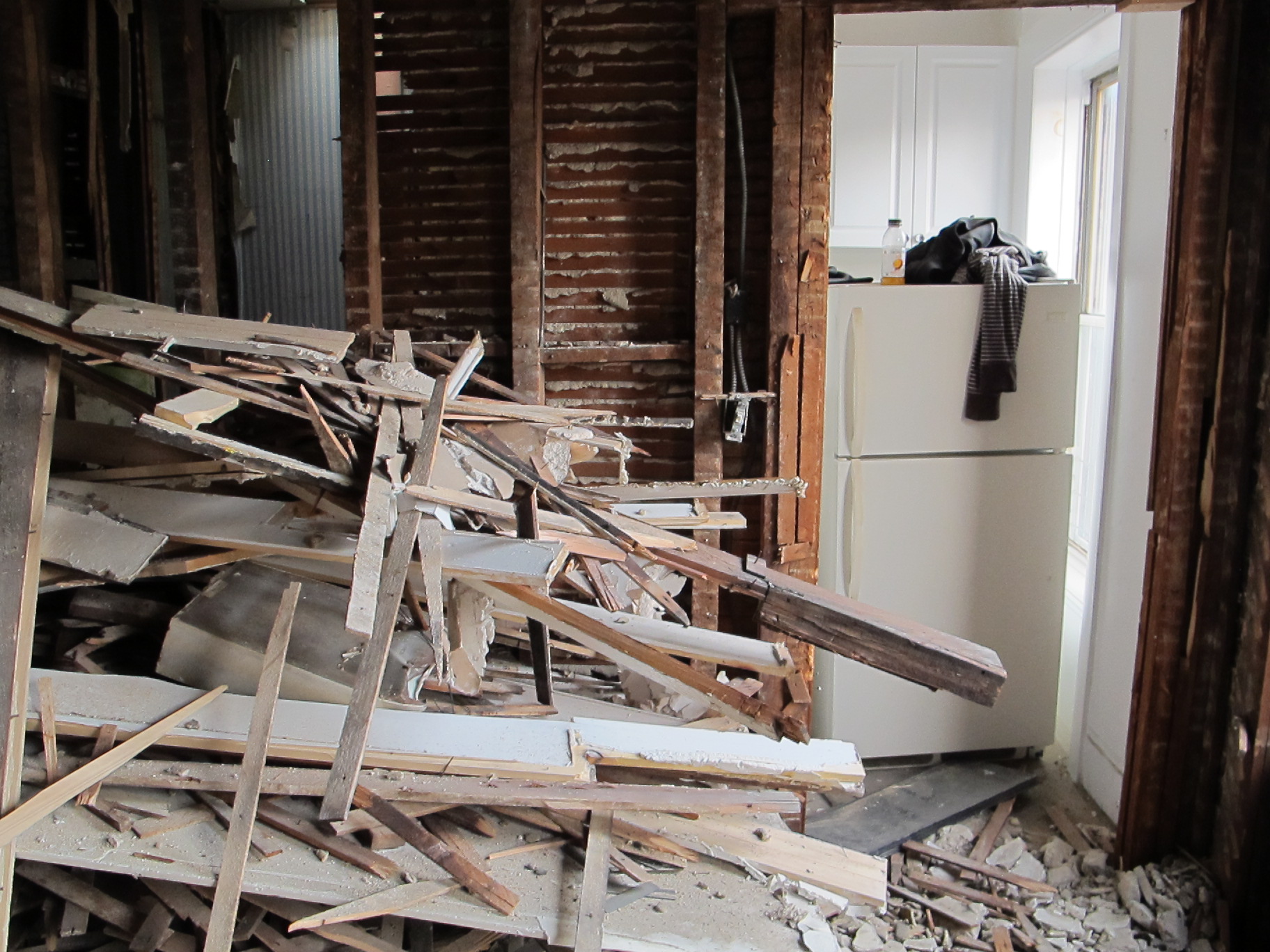
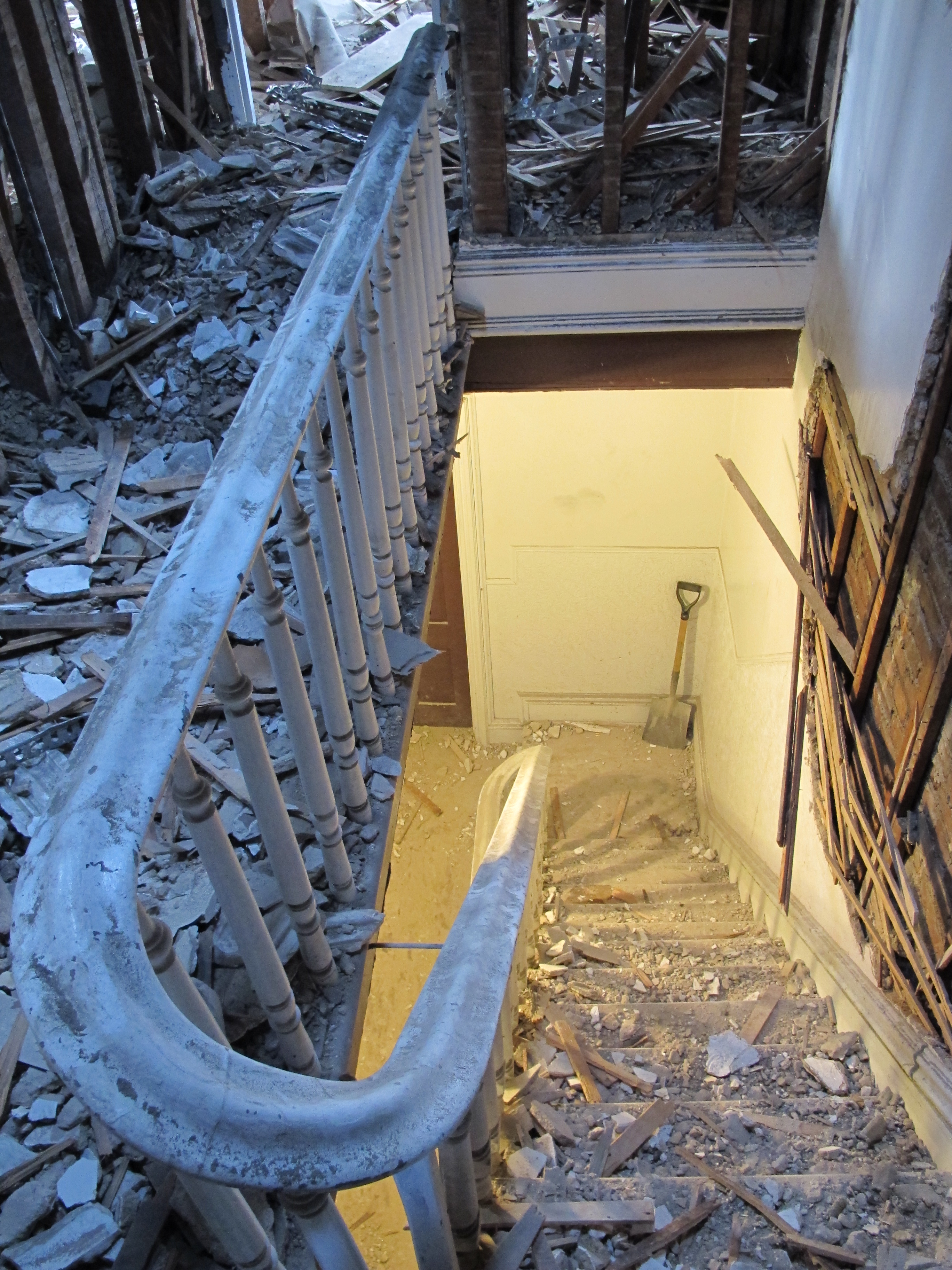
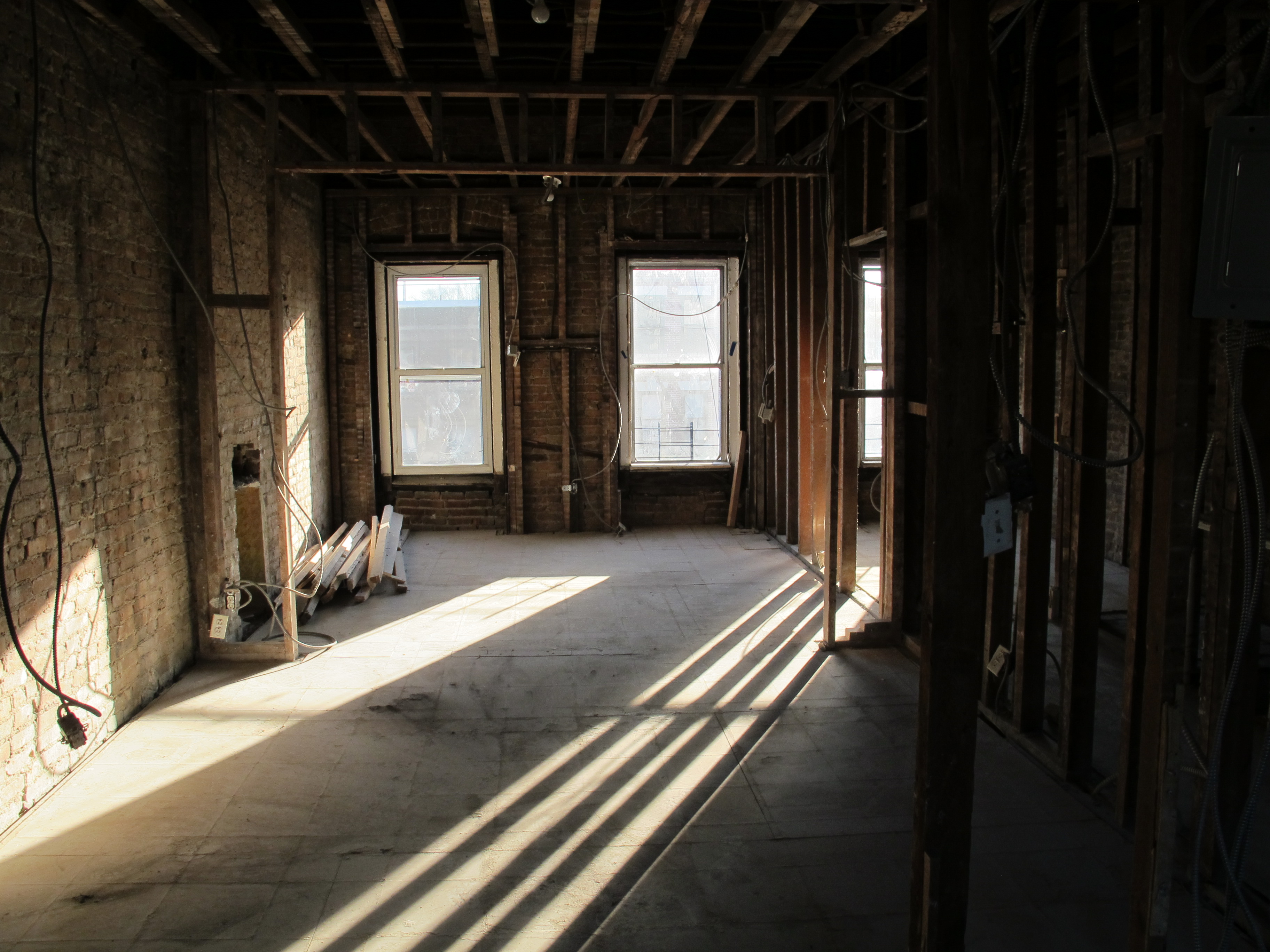
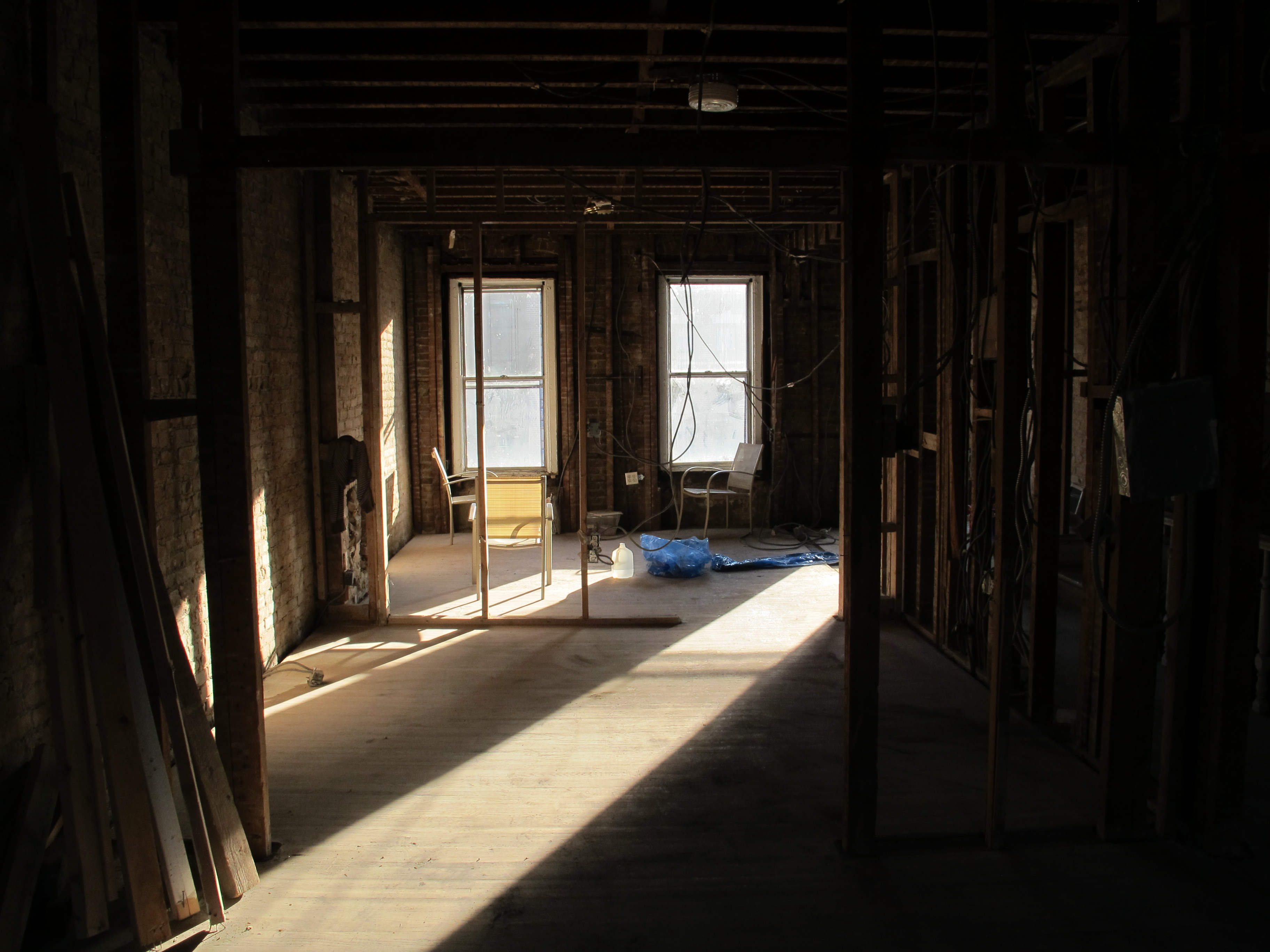
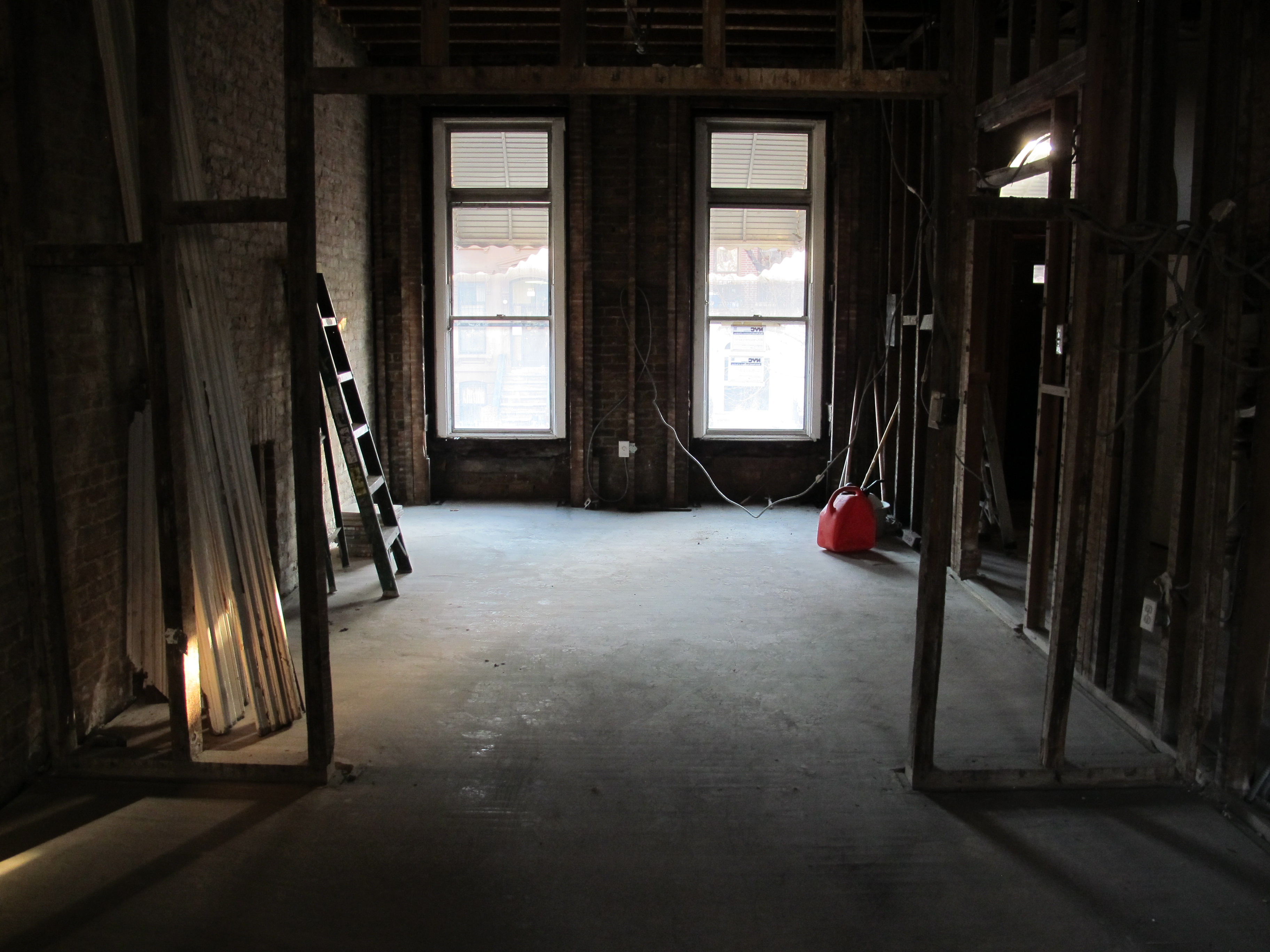
    Our task was to demolish a four story brownstone, meaning that we were to gut out the interior down to the structure. I initially walked into the house wanting to decry the waste of our modern obsession with continually reinventing ourselves, but the reality that I came to see, was that the house was a shithole.
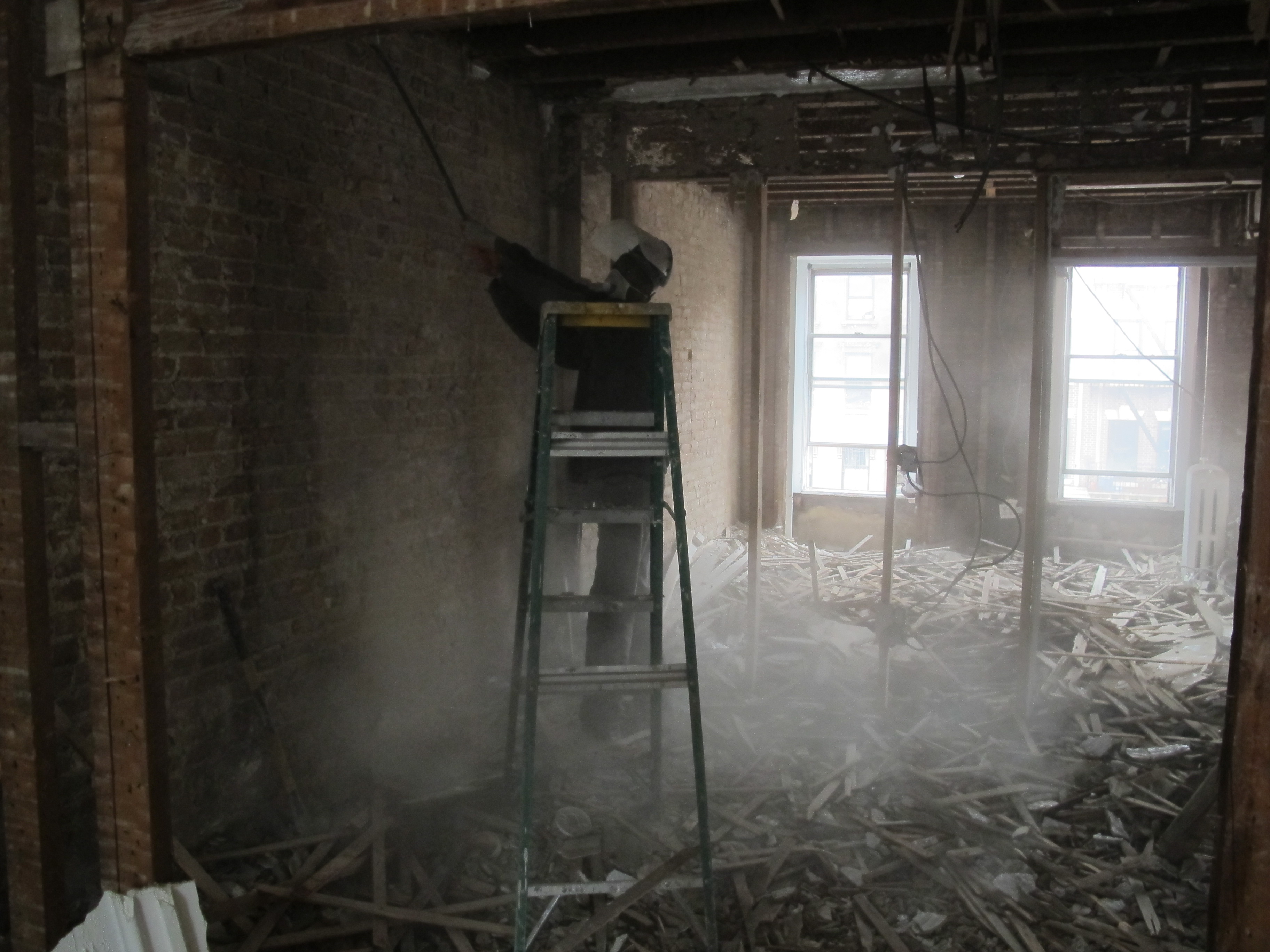
    On the first day, I grabbed a crowbar and a sledge hammer and set to work without much pomp or circumstance. I swung the sledge and softened the walls and then dismantled them with the crowbar. The drywall shattered, cracked, tore, pulverized. The wood cracked, splintered, screamed as it twisted and clattered dryly as it tumbled to the floor. It was not long before I was several feet deep in debris, panting, coughing in a cloud of dust with wires dangling in my face.
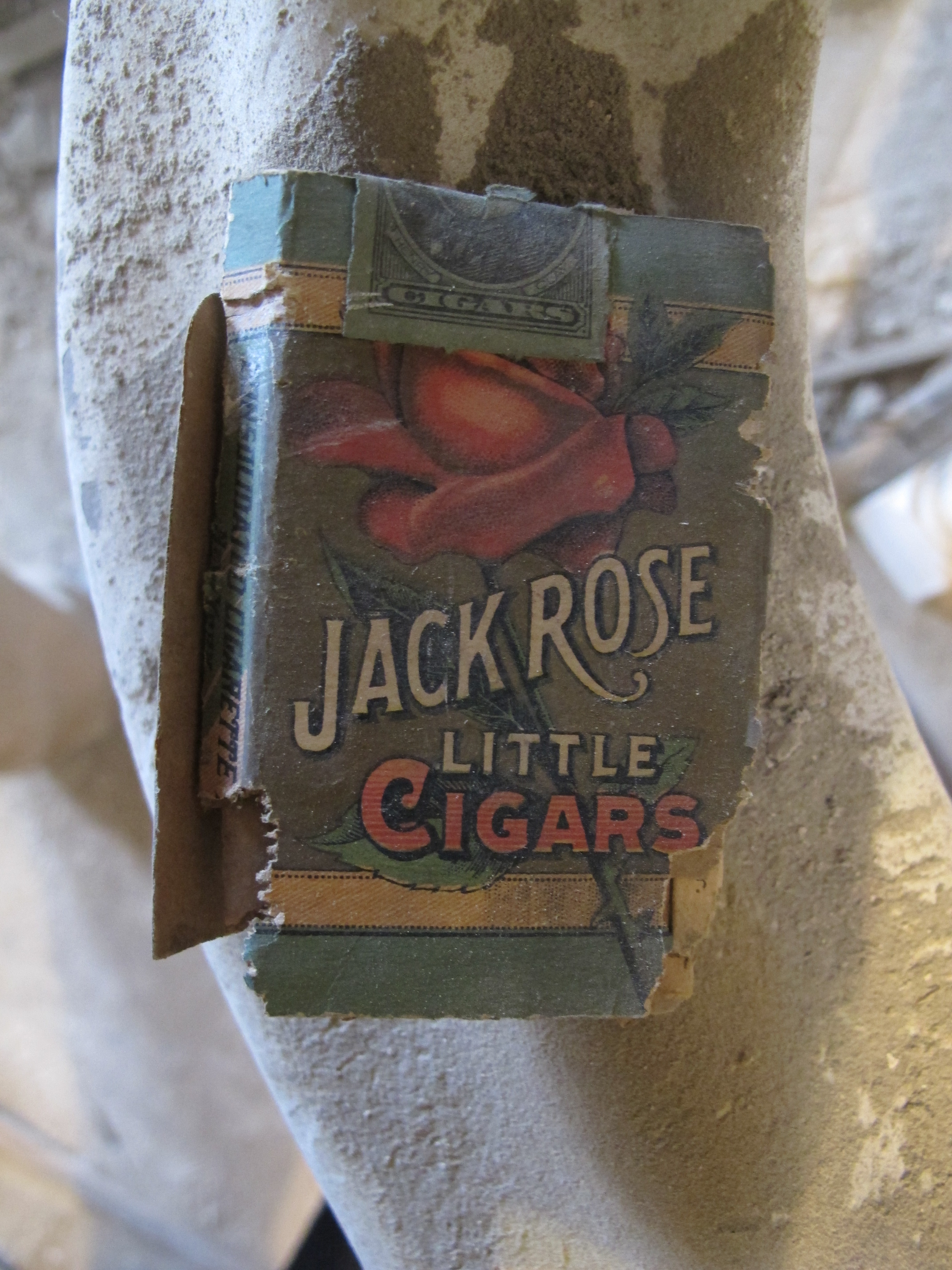
    As I pulled down the first of many ceilings, huge chunks of drywall shattered on my head and tumbled to the ground. Construction refuse, newspapers, and panes of glass all rained down upon me. A strange black soot that had accumulated over the past hundred years billowed from the ground after cascading down on my face and through my hair. Some chunks flew out the open window as I swung, tore, ripped, mangled, and mashed. I poked my head out the window and feigned concern for any onlookers, but only once.

    I ended the first day blackfaced. Ibra actually became whiter. We laughed at each other. The shower at home ran black and my eyes burned and my hands shook in exhaustion.
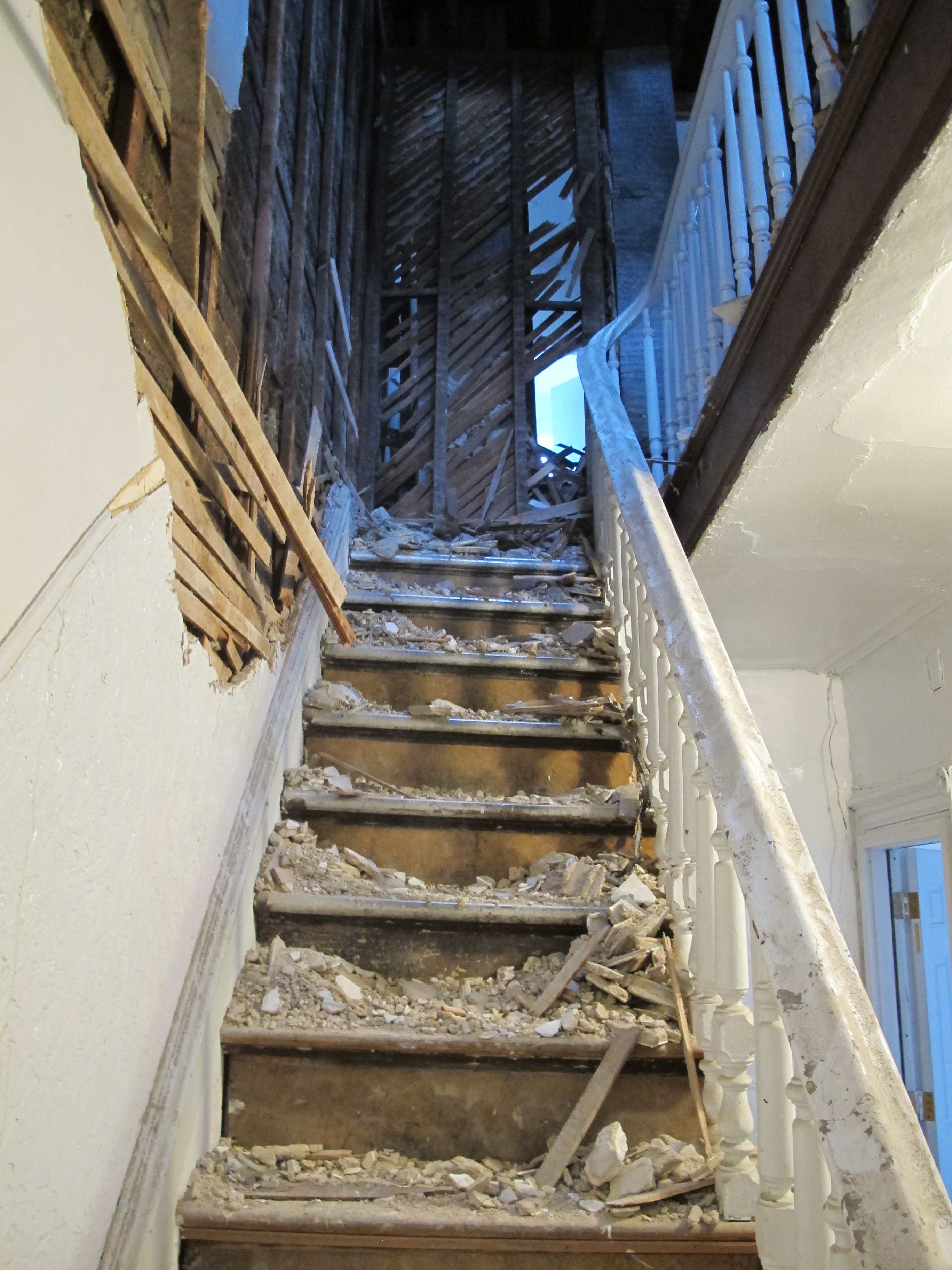
    As the days passed, we worked our way down from the top floor, breaking everything and then hauling it down to the truck that we fought to park. We loaded buckets full of plaster, hauled them down the stairs, and loaded them into the truck. We worked six days a week. 8 to 4:30 for five weeks. I initially thought about how much I liked work like this as I didn’t have to think. I just had to use my body and whittle the hours away. For better or worse, this left plenty of time to think about other things.

    Here are some things that I remember:

    Ibra constantly waved his cigarette in the air, using his hands to gesture, while indiscriminately intermingling French and English. On a seemingly hourly basis he stopped to chain smoke and lecture me on the perils of working too hard. We eventually warmed up to one another and I found myself intentionally prolonging lunch each day by asking questions so that I could sit in the warmth of the sun that streamed in through the window for a few minutes longer. Mate frequently recounted stories of atrocities from the wars the ravaged the Balkans in the 1990’s. The deaths of his friends at the hands of snipers, his sister nearly dying from a missle strike, ethnic cleansing, the massacre at Srebrenica.
    ‘Are you going to bring your wife over here?’ I ask Ibra in slow, patronizing English.

    ‘If I get papers.’

    ‘How do you get papers?’

    ‘I don’t know. There are ways.’

    Mate spoke up, ‘Most of my friends, immigrants from Croatia and Poland, got their papers through marriage. It is incredibly expensive now though. When I arrived five years ago you could pay a woman 4100 dollars, but now it is up to 12,000 dollars.’

    ‘So this is common?’

    ‘Oh yeah. It is good business. One person makes money and the other one gets papers.’

    ‘You have to find the right girl. I know one girl that my friend married. Always calling for money. Always want money. She is no good to this man,’ Ibra countered.

    ‘Some people are better than others. My friend has married three different girls for money. He went back to visit Serbia and fell in love with a girl. He was already married though and had to stay with that girl. So he paid his friend to fly to Serbia, marry the girl, and then come back with her.’

    ‘He paid his friend to marry a girl he was in love with?’

    ‘Yeah! And bought him a ticket home!’

    Another day Irba and I were looking out the window and I saw a man feeding his chickens food scraps.

    ‘Look….chickens.’ I pointed at them.

    ‘You know…Those are the first ones I have seen here in America. The first chickens.’

    ‘Really?’

    ‘Yeah. You only see dead ones. The meat, never the chickens.’
    ‘There are some here. My girlfriend has 28 of them.’

    ‘Now that is a good girl.’ He said this earnestly, but we both laughed.

    One day I sat in a patio chair in the half demolished living room of the first floor, transfixed by water cascading out of the ceiling  and spattering upon the dusty floor as Mate disconnected radiators.

    Sometimes, for fun, I used the sledge like a battering ram or swung the crowbar like a baseball bat.

    One time I stuck my head through a hole that I punched in the wall and twisted it like Jack Torrence.

    A dog pooped directly behind the gate of the truck. I stepped in it, Ibra stepped in it, I smeared the bottom of a trashcan through it and then Mate touched it with his gloved hands, I rolled the handcart through it. I dumped a small amount of drywall dust on it with the hopes that it would work like cat litter. I then giggled as Ibra saw me do this, thought it was a good idea and got carried away; he dumped his buckets all over the pavement making a massive mess.

    Most days our banter faded as we got into a taxing rhythm of work. In these moments I got unadulterated solitude to focus pointedly on my existence.
    One day I leaned over and tilted my face to look in the mirror of the truck and was greeted by two red embers staring back at me from a bearded and lined black face. It precipitated a strange reaction, the reagents of which were being stockpiled over previous weeks: Who am I? What are you doing? Are you crazy? What is all of this about? Am I a meth head and I don’t even know it? What am I going to do with the rest of my life?

    Each day I looked on as well-heeled couples leisurely strolled by and young people sat on stoops smoking cigarettes. Often they glanced at me and then averted their eyes. Who are these people? Are they smarter than me? Do they earn a fortune staring at computer screens? Manipulating numbers? Selling more products that no one actually needs by pandering to their innermost dreams and hopes?

    Pangs of bitterness coursed through me often. My thoughts whirled around myself: I have many talents and skills, yet this is how I was spending my days at age 29: demolishing the interior of a house on an illegal jobsite in unregulated conditions, sucking in my air through a mask tinged gray with dust as I hauled buckets of trash all day? Look at you now. Did I actually have any talents or skills? Am I just an idiot who cannot recognize his station in life? Like a goose that thinks it is a swan? Everyone else seemed so relaxed, moneyed, and secure.

    I found myself despising New York for all its glaring inequity and crassness. I cursed myself for coming here, for deliberately throwing myself into what is the antithesis of my values in many ways. I felt stupid.
    My rational brain frequently structured thoughts like this: If I was more _______, I would __________.

    I wrote this down: ‘This building is a bombed out hell.’

    Still, I tried to lose myself in my work. I used phrases that angry old men used to describe what I was doing like ‘putting my nose to the grindstone’ or ‘keeping my head down and working through the winter.’ I would also try to release the inner turmoil physically: I would I run at a wall and kick my boot through, trying my best to relish the explosion of wood and brittle plaster that resounds on the floor. I eviscerated the snaking conduit arteries within the walls. If you can imagine, the joy even evaporated from these antics.

    On cold days, I had to work even harder just to stay warm. I mused that maybe this was a forced labor scheme learned from my boss’s previous life in the former Yugoslavia.

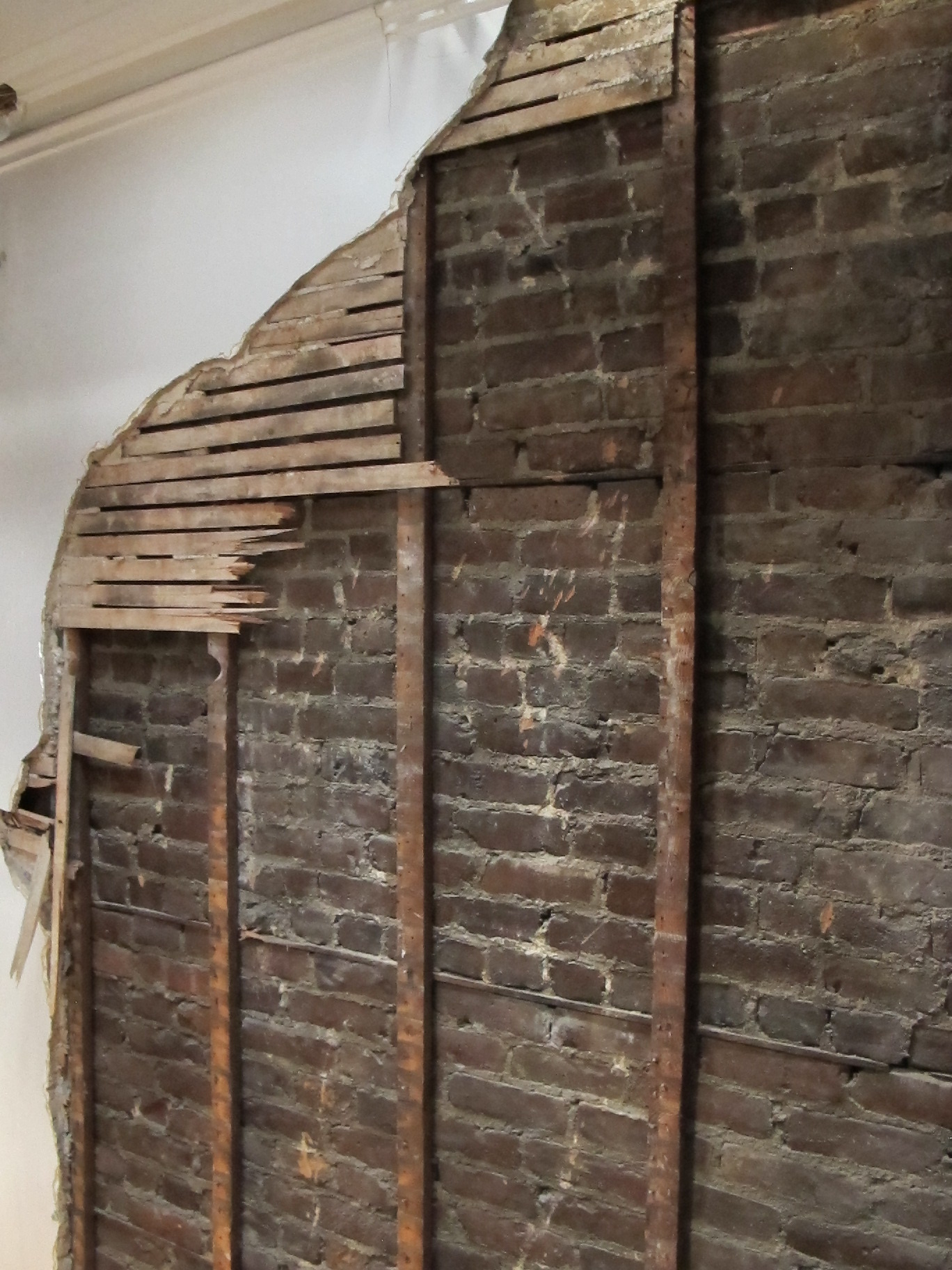
    The plaster covered brick walls were the worst. I broke them apart by starting a small necrotic ulcer in the center and assiduously expanding it outward with rhythmic hammer swings.
    I found  a slip of paper in my shirt pocket that I wrote one night while I was drunk that said the following:

    ‘Mate worked with several Natives in Canada in forestry. Many of them had spent time in prison and would unabashedly tell him about murders that they had committed or other strange stories. One day in prison, one of the men recounted, another inmate returned from a visit with friends or family. He sat down in a communal area, but quickly got up and began vomiting. One of the other inmates noticed that the vomit was littered with pills and immediately ran over and started picking them out of the vomit and swallowing them. In no time at all, a crowd of inmates swarmed and ate all of the pills out of the vomit.’

    One day Mate and I went to the scrap metal yards. I listened to the radio as we drove around in the truck with the heat as high as it would go. It was the coldest day of the year so far, the kind the radio described in sinister, ominous tones: the cripplingly cold Canadian air mass descended upon New York threatening the transportation system, our elderly, our children, our jobs. It was always there, the Canadian air mass, looming over us, waiting to descend. I hopped out of the truck to unlock the bed at the first yard, which was crawling with a bewildering diversity of mechanical beasts that roamed piles of steel that glimmered in the dim winter sun. I experienced a new sensation of being insignificant, of being too organic. The yard was frantic; it is open 24 hours a day, seven days a week. We were hurried through by men dressed indistinguishably from astronauts; even the people seemed mechanical.

    I was genuinely giddy when we returned to the house to pick up the cream of the crap: copper, brass, and aluminum. The allure of money for producing nothing draws hundreds of people living on the margins of society to scour the city in search of metal each day. They intruded and cajoled us at our job site regularly. They are like blue collar carnies. Before we arrived, we discussed strategy as Mate had done this a few times; we needed to give the impression that we were in the business. If you don’t do this, they will apparently take the chainmail right off of your back.
    We took the money load to what I would describe as a quaint community scrap yard, as if there were such a thing. The garage door opened to a few men huddled around a 55 gallon drum with flames licking out of the top. One man had a spider web, the center of which was on his nose, tattooed across his face. A pitbull sat in a reclining chair wearing a down vest, looking the most comfortable of all. The manager approached and helped us to sort the metal into piles. Spidey communicated in grunts and lurched around like a black frankenstein, staring me down if I look at him. We pretended that we knew how much everything was worth and that we wouldn’t settle for anything less than top dollar. The manager pretended that we had an insignificant amount of cheap metal that he was indifferent towards.

    ‘Where does all of this go?’ I venture to ask.

    ‘China. All we do here is bundle it and ship it out,’ he answers.

    $842. Raw materials from all over the world, manufactured in China, used in America, shipped to China, recycled in China, remanufactured in China by foreign owned businesses, shipped to America.
    Increasingly my mind churned about the limitations of growth, climate change, materialism, globalization, energy, the environment, inequality, the cognitive dissonance displayed by my countrymen, how maybe we should just commit to destroying the earth and ourselves, maybe we should blot out the sun with coal fire power plants operating at maximum capacity to power nothing but televisions playing pornography and Die Hard movies twenty four hours a day, dildos, and meth factories; start fighting human beings against one another with antiquated carpentry tools for sport; cut down every last tree; torpedo the whales; shit in our wells; have a Superbowl everyday; fire nuclear weapons at the moon; light the surface of the ocean on fire; rape everyone except for the elderly who we will leave to rot in the acid rain that falls from the sky; eat the vitamin D deficient children; and napalm the polar ice caps.

    I wished the anxieties and the stresses of each day would wash off just like the filthy mask that I wore each night in the shower, but they didn’t. I felt beaten, my levity lost.
    I read compulsively in every spare second. I tried to think my way out of the misery in which I was mired.

    My rational brain also liked to use these thoughtforms:

    Everything will be better when _____________.

    ‘All of those years that you spent laughing and enjoying yourself to the fullest were all for naught since they didn’t prepare you for the real serious world.’

    ‘You should go to grad school so that you can be a productive member of society.’

    I was walking to work one day and I saw a discarded tin can, that someone only bothered to half crush. I empathized with that can.

    One day, I rode the train home and several people saw the open seat near me, approached, and then shied away at the last second. It was alright though since they were merely crude automatons. I was enlightened because of my ability to perceive the absolutely purposeless cagelike void in which we found ourselves.

    Sometimes I held back tears as I hauled buckets up and down the floors of the brownstone.

    My mind can be a whirring maw that consumes everything and turns it all into shit as its gyre tightens around my own little miserable existence.

    I walked around overstimulated,  feeling constantly abraded. I didn’t laugh at the rats in the subway anymore. I walked with my head down. I thought rationally about sex.

    I descended down into the doldrums of purposelessness, stagnation, and confusion. I wallowed in a dark, deep pit. It was apparent that my mind was broken, completely dysfunctional. Day after day it went in loops about my life, about relationships, about work, about this world. I was stuck in some literal, rational mode, constantly analyzing, critiquing, and reacting. I lived in an algorithm where N goes to infinity. I found myself living in abstraction, all experience filtered through an artificial conceptualization of the world. Recognizing this is not the same as understanding it.

    I thought about how canaries that are put in mines might just die because they don’t want to live in a fucking dark and lifeless hole.
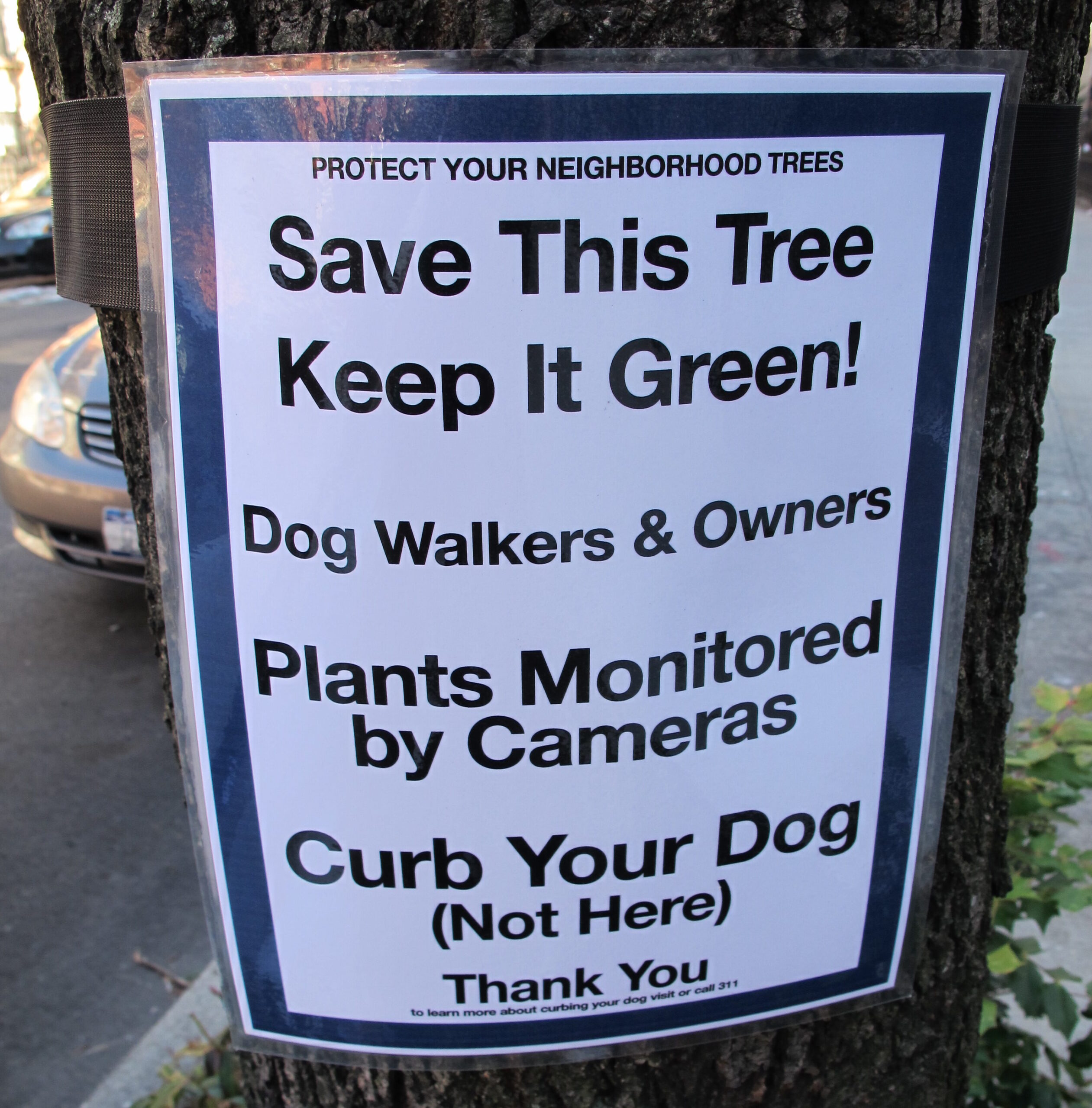
    It seemed like I would labor in a cold filthy brownstone forever, that was until my boss unexpectedly ran out of money and laid me off to wander the splendorous dog shit strewn streets of New York once more.

    One day as I sat on the couch, in the simplest terms possible, everything exploded into a dizzying particolored lollapalooza. There was suddenly infinite subtlety in the myriad of intertwined flavors of the chai tea that I sipped, in the plants that shimmered in the afternoon light and gently swayed in the heat rising off of the baseboard radiators, and in the multilayered music vibrating through the air redolent with all of the telltale smells of life in my apartment. I sat transfixed by my resplendent world. I saw it.

    I saw that the world is not the map that I created of it. A Euclidian, linear, limited variable perspective  is a vast oversimplification that ignores the inherently complex and chaotic order of nature and the interaction of limitless interconnected variables. It is a theoretical world assuming smooth planes, rational actors, continuity, and limited physical constraints.

    We will be forever unable to model or build a perfect facsimile, we will always be left with an approximation or an incomplete construction. Reality is nowhere but in the infinite recursive complexity of my bodily systems and in the vortexes of steam that twist and dissolve above my mug.

    The compulsion to make projections and see finality is just a failure of imagination. It is an abstracted way of viewing the world that ignores the infinite beautiful uncertain complexity that abounds.

    The unpredictability of existence means that our lives are a series of choices and actions, thousands each day. In doing this we create ourselves, our conception of humanity, and our world. There are many areas of life where we are unable to exercise choice, but we are wholly responsible for the realms in which we can.

    Life is no different than a work of creation or art. Each one of us stands in front of a canvas in the same stupefying confusion of having no idea how we got there or what is expected of us. There is a limited set of supplies that similarly has no provenance.  The background of the canvas has already been filled in before our eyes snap open. A work is created through an accumulation of choices and actions applied over time. There is no ideal work in the same way that there is no ideal life, there is only the one that exists. The bewildering beauty of life lies in the incomprehensible task of creating the completely subjective work that is ourselves.

    I am tumbling across a lightless undulating plain.

    I am swept onwards by forces that I cannot know.

    The terrain is nothing more than that which passes.

    Up, down, to and fro.

    There is no beginning or end.

    The darkness is vertiginous and lonely.

    A rational tempest swirls inside of me.

    I try to give sense to the senseless.

    I strain to discern form in the void.

    I conceive and am inevitably confounded.

    Then, I am startled from my reverie by faint music in my head.

    I suddenly feel the plain, although it passes no differently than it ever has,

    the hillocks and declivities of birth, death, love, joy, and sadness.

    I sit in quiet contemplation, admiring the melodic progression.

    The song is entitled: ‘I am a preposterous half rational half animal chimera stumbling through an abysmal eden hurtling agonizingly fast towards.’
  • Free Food for Thought

    I can never set foot in New Zealand again. I am not sure why I am writing this, although I guess I could say that about most things that I do. It is a compulsion. I also put on weird and different clothes when I sit down to write. Not anything too strange though, just a weird assemblage that seems conducive to whatever I am going to write. I am wearing a pink knit hat, two pairs of pants, a long sleeve shirt, and an unbuttoned dress shirt right now; all are grey besides the hat. I am going to tell one of those stories that many of us have, ones that have changed our lives irreparably, that we simply don’t talk about it. These are often sad, but grow in hilarity with time. Maybe a side of ourselves that is deeply unsettling was briefly exposed or maybe we simply hit our nadir? It seems inevitable and significant as I look back, although there is no one who actually knows exactly what happened, not even myself as the dissolute wretch who supposedly did all of these things. Certain events undeniably occurred, and regardless of how this night unfolded in its entirety.

    This is when my writing first began.

    There were many things that happened beforehand, years beforehand, that set the stage for what may be my most amazing of performances. I firmly believed that I was going to die young for a long time. I used to drink a lot and take drugs. I aimed for the sun.

    I had just quit taking Paxil, Wellbutrin, Trazodone a few weeks before we left on this trip, a cocktail that was the result of years seeking to fix myself that began with continually increasing doses of Prozac when I was a teenager. I had generalized anxiety problems. I had depression problems. I was a problem. These prescription drugs were the gateway drug for me. I was diagnosed as having a brain chemistry imbalance, something that needed to be addressed by ingesting things in order for me to function properly.

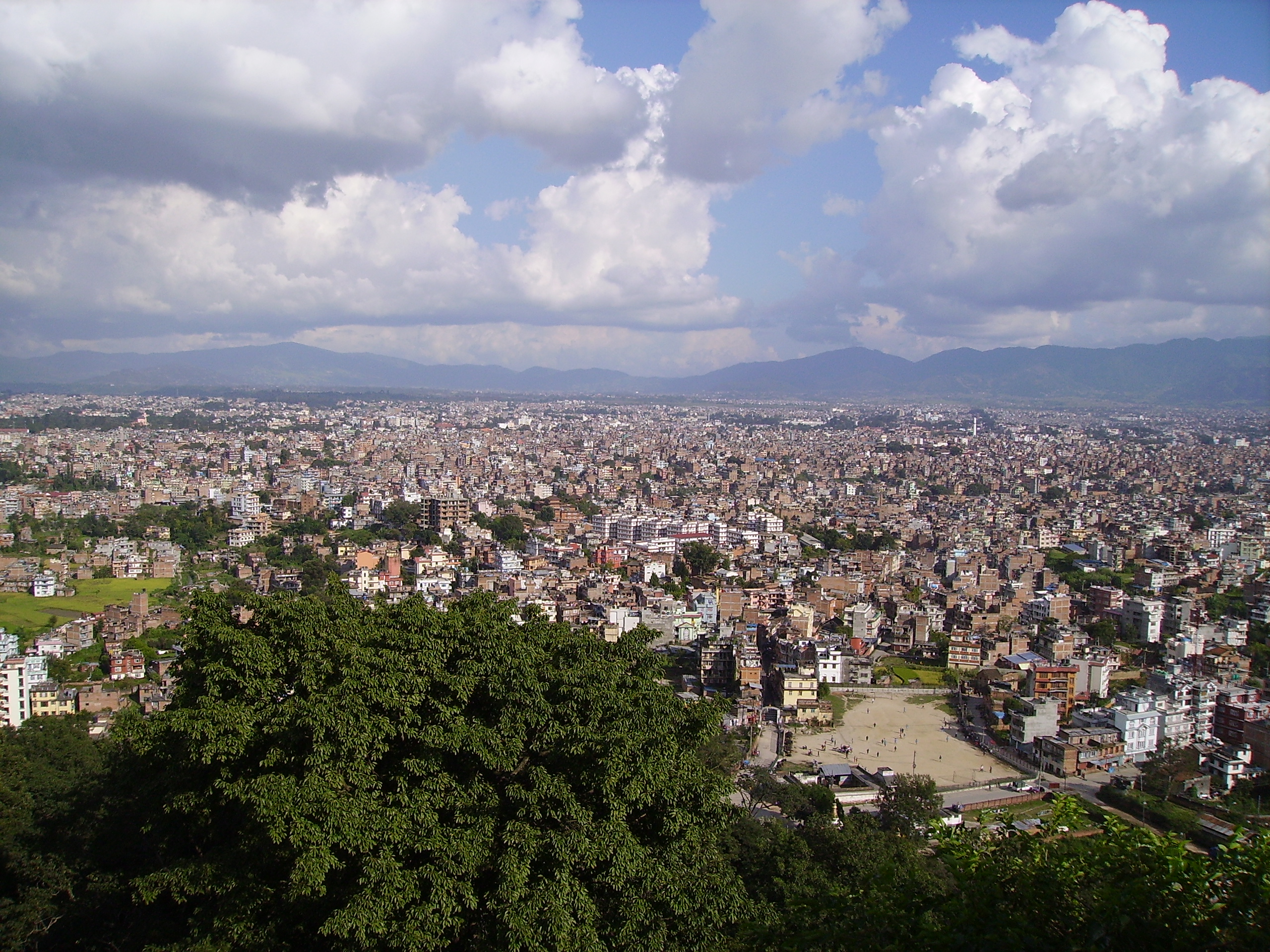
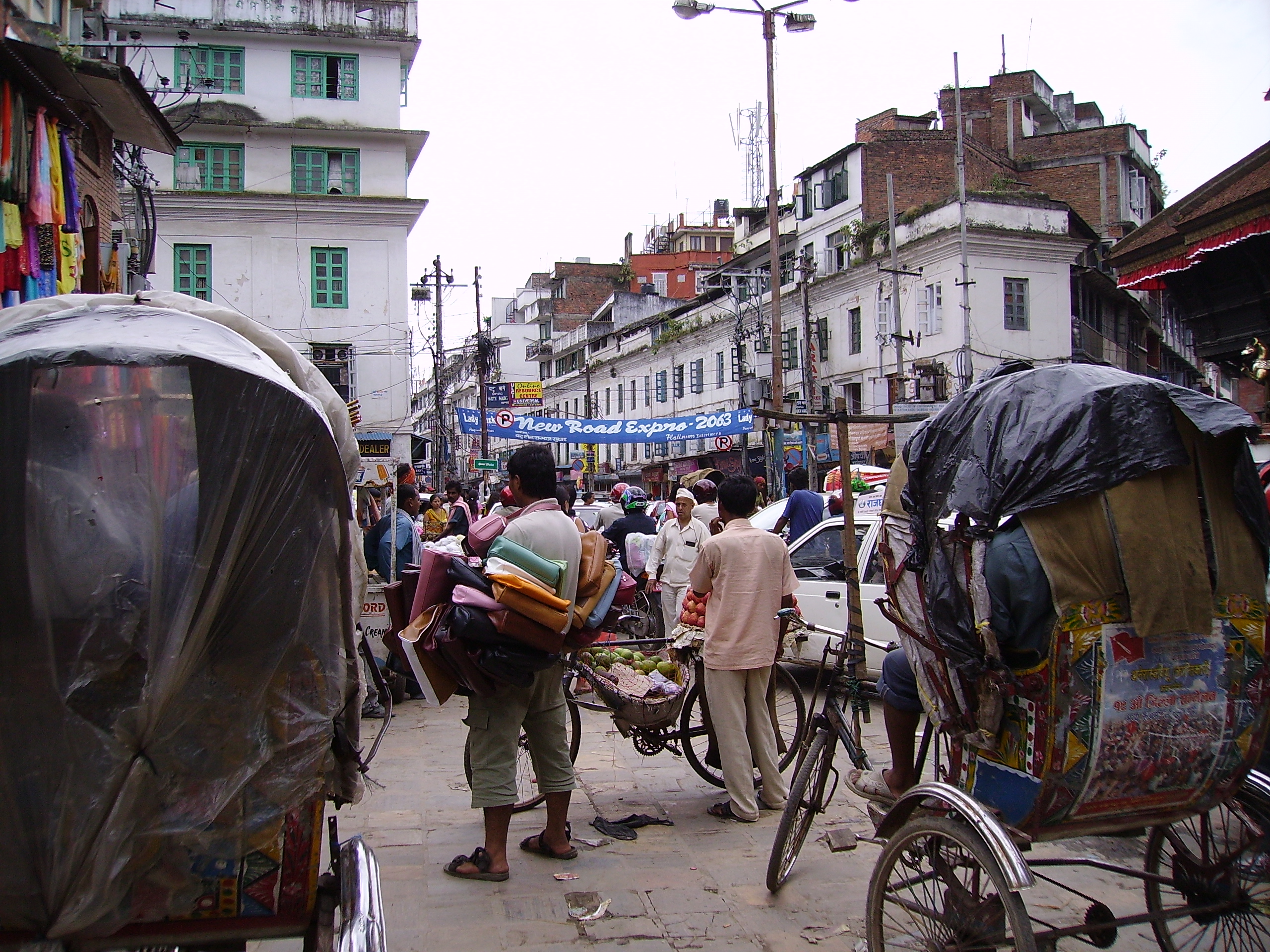
    Nepal was the first place that I ever bought drugs on the street. We arrived in Kathmandu and before we even had found our hotel I was offered hash by a man who smelled of urine and was swaddled in rags. I might have even initially taken this as an auspicious sign that I wouldn’t overpay. I handed my backpack to my friend Anthony, who I was traveling with, and followed the strange figure into a damp alley strung overhead with clothes lines. I am not even sure how we communicated as I look back, but I guess there isn’t too much to communicate. Hash, money, exchange. I passed over the money and then he reached into the rags near his waist, behind his back, and then his hand delved lower, reaching into the most foul of crevices to pull out a small tinfoil wrapped bundle. I thought of the owl pellets that we dissected in elementary school. The warm, moist bundle was deposited in my open palm. Out of some strange respect for this man, I did not throw it on the ground or make a disgusted face. Or maybe it was because I really didn’t care; I just wanted to get high. In hovel of a hotel room, I opened it and it even looked like a little black turd composed of small hand rolled droppings. I never smoked that hash. It could have actually been feces for all I know. I found a better supplier later that day, who kept the hash in a less intimate place.

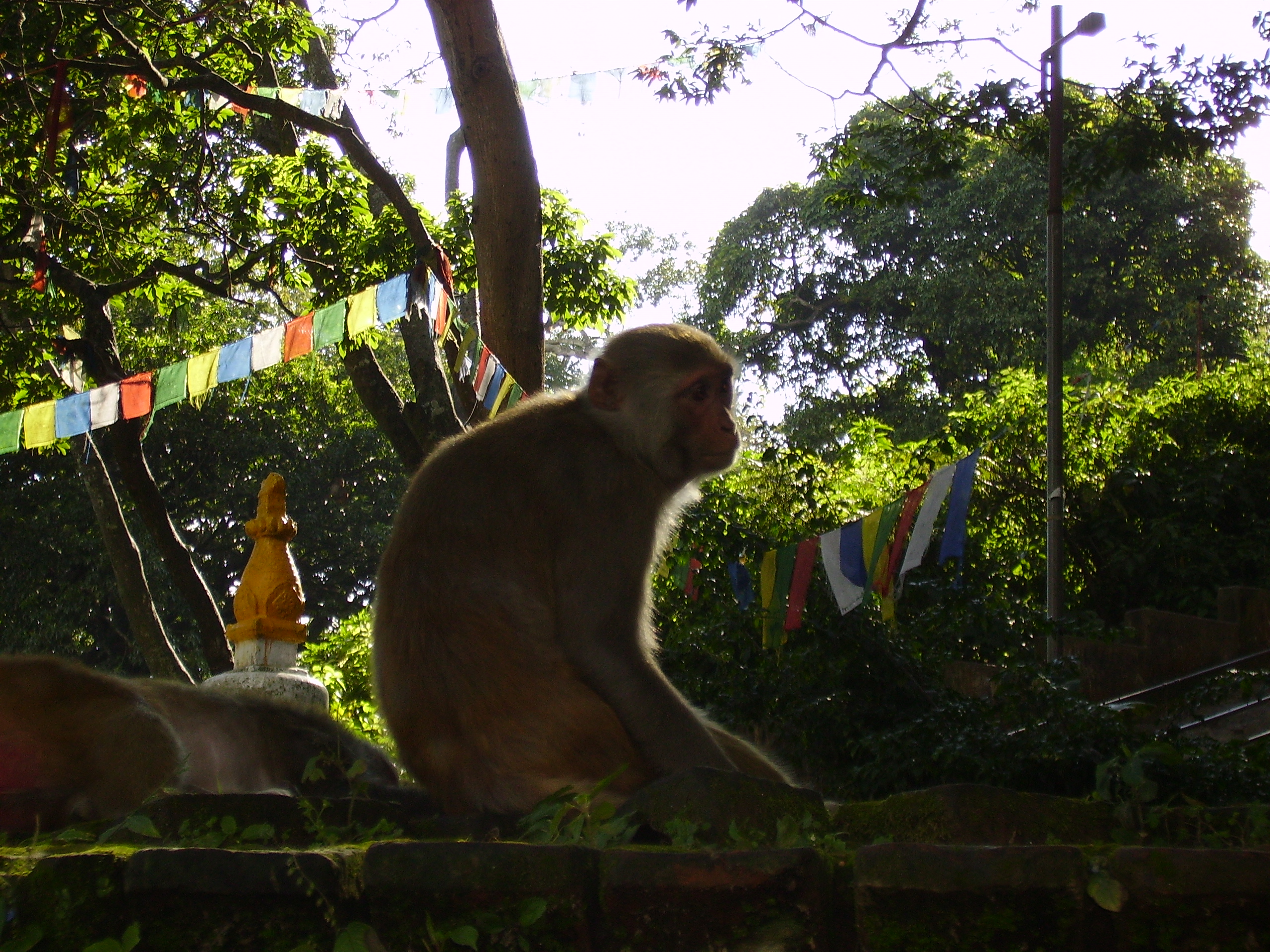
    I had money, time, and exploring the world was a time tested rite of passage. I would leave my white bread existence behind. I would grow spiritually, culturally, intellectually and I could do nothing wrong. Everything was novel and brilliant. I just needed to quell my broken mind, to keep it at bay. It only seemed right to start smoking cigarettes, but not the industrially produced ones, rather I would roll each one with my own hands. Smoking hash would allow me to break out of my square, humdrum perspective and take in the vast and varied expanse of the world. Going out drinking would let me see the underbelly of the city and meet new and different people. We did some cultural exploration, The Monkey Temple, Durbar Square, ect. But much of our time seemed to be spent in bars drinking or wandering about high on hash.

    We quickly became bored with this existence and planned to leave for the mountains to go trekking, but travel often makes people constipated and I am one of those people. My stomach was engorged with five days of dal bhat and momos. I decided to take some laxatives and clear myself out, something that I had not yet done as the thought of explaining what I needed to a Nepali pharmacist seemed embarrassing and difficult. In reality it was really easy: I did a phenomenal pantomime of taking a pill, squatting, making farting noises, and rapidly gesturing from my butt to the ground. The pharmacist almost fell on the ground laughing and I was handed some strange Nepali laxatives. They looked like little balls of tar, almost like the aforementioned turd nuggets of hash. I didn’t read the instructions and took two. Nothing happened that afternoon and we were leaving the following morning. I took two more.

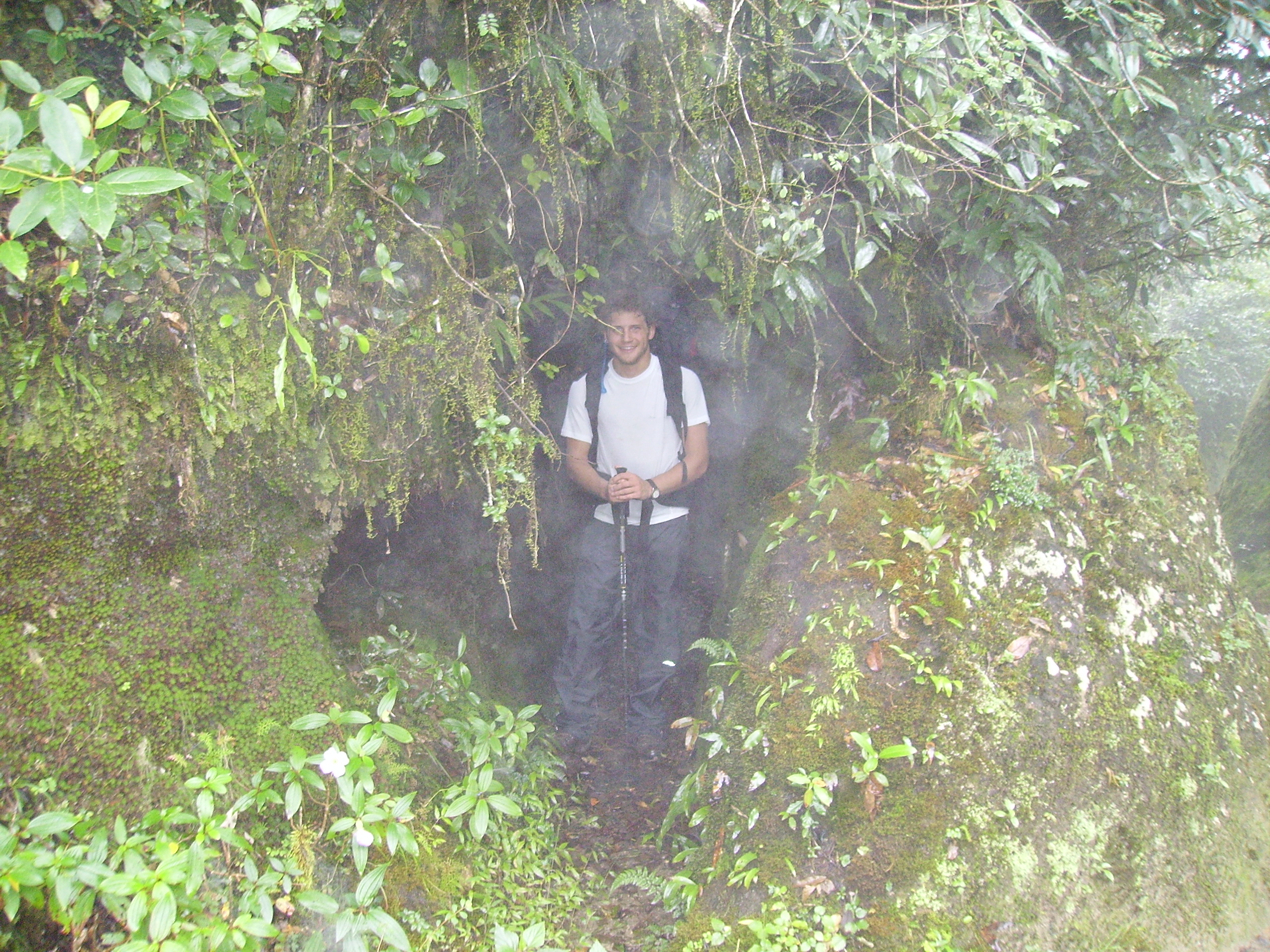
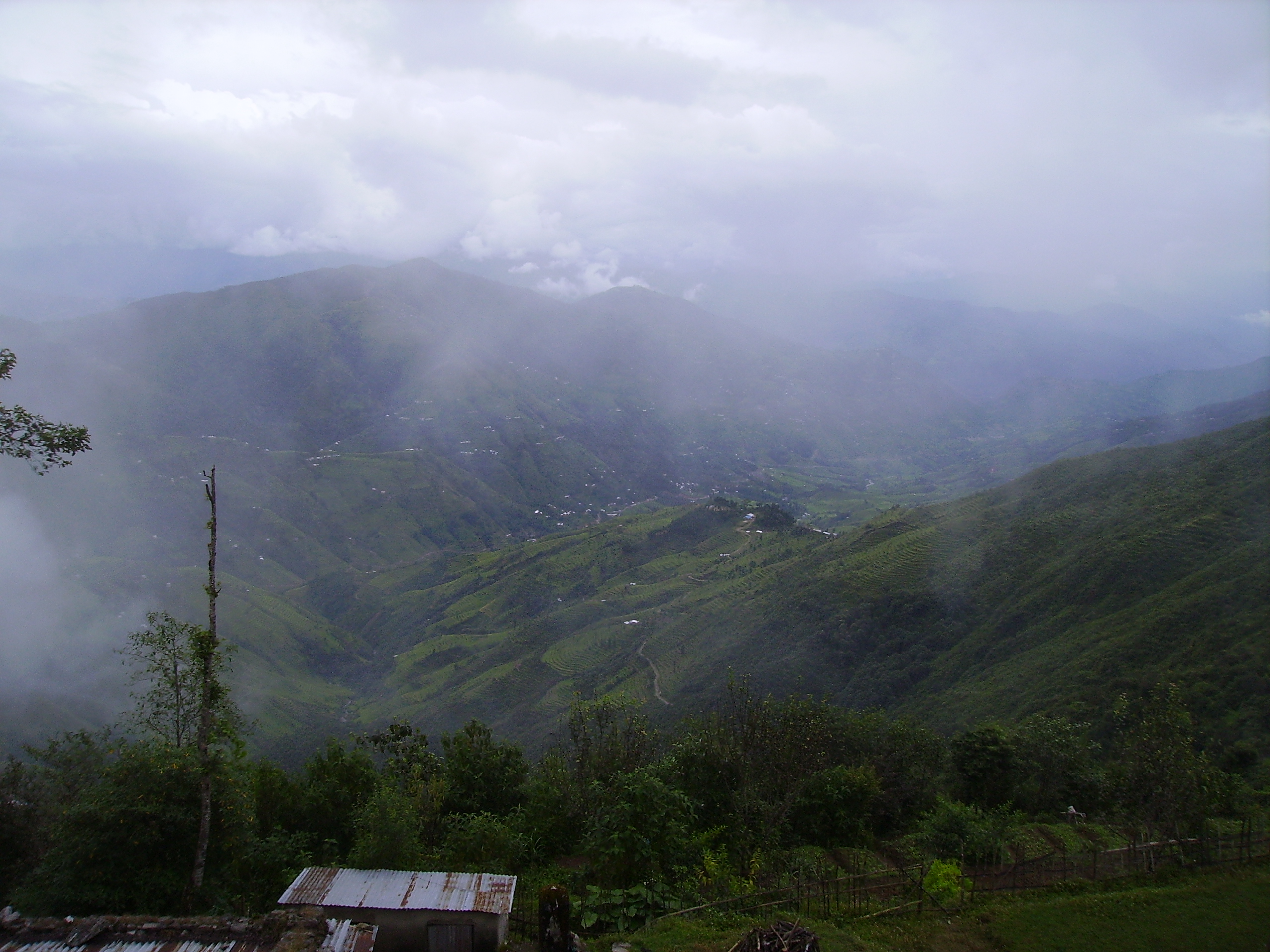
    We started out trekking under monsoon rains that should have dissipated weeks beforehand. It steadily fell down upon us and quickly crept in through our layers. There were trees full of monkeys that we taunted who jeered back. We walked through a few small villages that were carving out an existence on the steep mountainside. I remember vividly when the pills took effect: we were climbing an endless series of switchbacking stairs. Also: there were leaches, on the leaves, on the trees, on the shrubs, on the grass, everywhere. I ran into the trees in a deep seated Freudian anal panic and I pulled down my pants and the rain fell down upon my bare thighs, the leeches crawled onto my arms and up my legs. I pulled out the toilet paper and that got soaked. This was only break of the initial dike that held back the long pent up flood that flowed over the rest of the day. On two instances villagers giggled and laughed at me as I clenched my cheeks and ran, only to fall short of any privacy. A few days later we got lost in the fog and rain, hundreds of leeches made it to our skin, we pulled them off, their anticoagulant caused blood to keep running, and we eventually arrived at a hotel shivering and covered in blood.

    After the monsoons washed us out of the mountains we decided to head to India until the season passed. Our flight was delayed for hours. Upon asking what time the flight would arrive, I received the unperturbed answer of:

    ‘Today, sir.’

    ‘Where are you headed?’ A heavy English accent from across the way inquired. I looked up to see a shiny headed bald man in his early forties dressed in the colorful hippy garb of Thamel.

    ‘Delhi for a few weeks.’ I nonchalantly responded.
    ‘Why the fuck would you do that?’ His harsh tone took me aback a bit.

    ‘Oh… Well I guess since it is the capital city and we want to see some of India and the monsoons are still dragging on.’
    ‘Delhi is a shithole. You should spend one day there seeing the sights and then get out.’
    ‘Hah. Well, where are you going?’

    ‘I am doing a motorcycle trip starting from Delhi.’

    We talked for the next hour about our respective lives and travels. Mark was from New Castle, was newly divorced, owned his own company, and seemed hellbent on living out his lost years. We boarded the plane and headed to our respective seats when he proposed the following before walking away:

    ‘You should come along with me on the trip. It will be unlike anything you have ever done in your lives.’

    We sat in our seats and don’t say too much at first, both of us pensive.

    ‘That guy is a little crazy, huh?’ I broke the silence.

    ‘Yeah. That trip sounds cool though.’

    ‘Definitely. I wish we could go, but it really doesn’t make any sense.’

    We continued talking around the point for a bit.

    ‘It would be really incredible. Maybe we should think about it. Do you know how to ride a motorcycle?’

    ‘Yeah, but not a proper one. I have ridden dirt bikes quite a bit.’ This is an outright lie. I had never been on anything with two wheels other than a bicycle.

    ‘Me too, I used to always ride my dad’s motorcycle around the neighborhood.’

    ‘Well, let’s just talk to him and see what his plan is. We don’t have to commit to anything.’

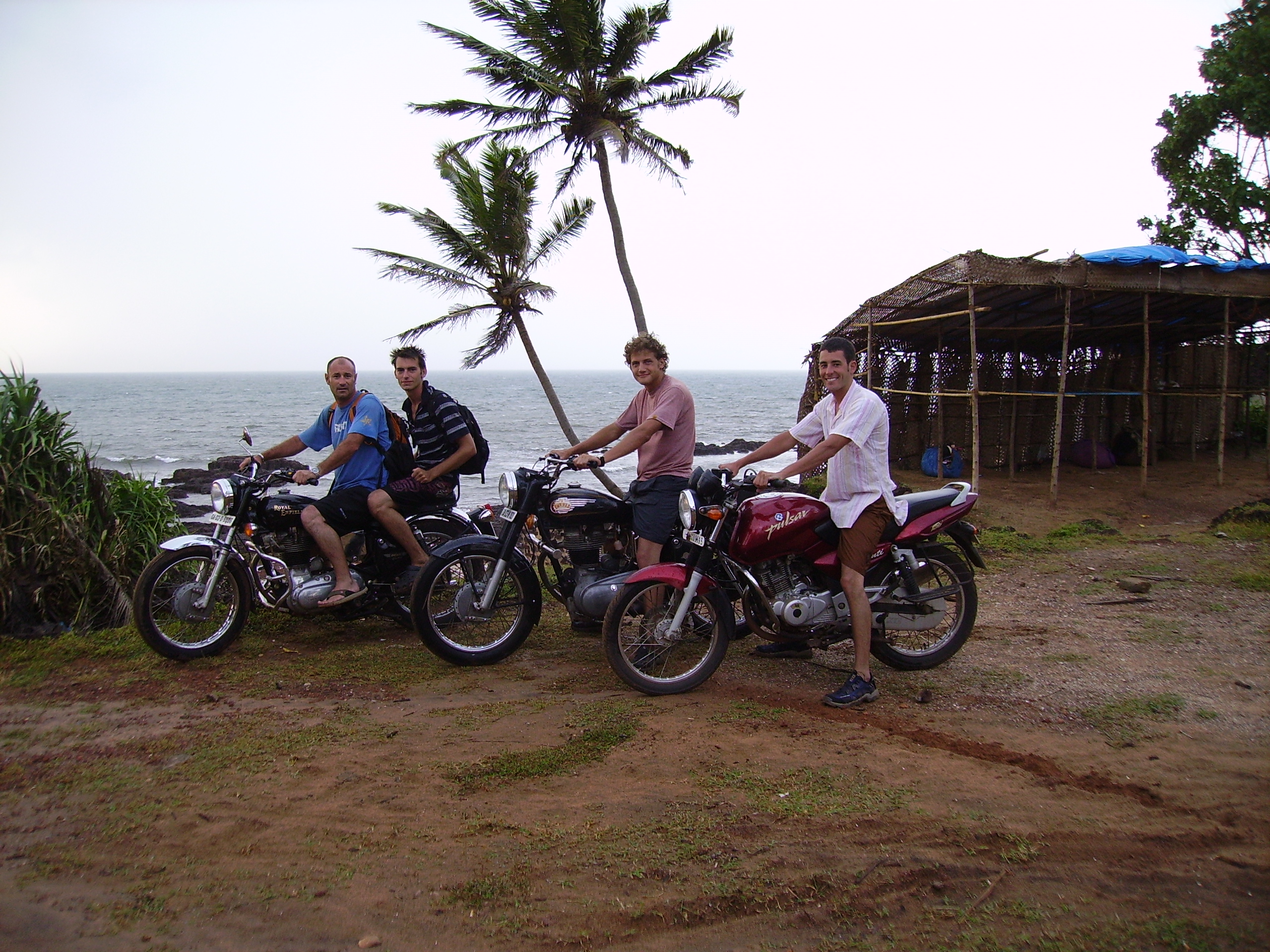
    We rented motorcycles that night in Karol Bagh as the days light turned deep red in the smog. I did not know how to shift a motorcycle, nor brake. Anthony and Mark rode their motorcycles back to the hotel, but I said that I was uncomfortable riding in the rushhour traffic of Delhi. I paid one of the guys from the bike shop to ride the bike to the hotel while I took a cab. I made a plan.

    ‘What time are we getting up tomorrow?’

    ‘Seven’

    I woke up at 6:40 quietly and snuck out to my bike. I quickly familiarized myself with it and then rode it around the parking lot a few times before riding it around the circles of Connaught Place. Mark and Anthony woke up and we started riding. Within the hour I was weaving between cars, laying on my horn, dodging cows, swerving around trucks headed the wrong direction on the divided main artery of Highway 1 as we rode towards Amritsar.

    Every day for the next few months as we rode around India and Nepal seemed scintillating. We were riding a high that we kept pushing on our travels. I drank and smoked and drank and rode. I blew through police roadblocks, I got beaten with a nightstick, I got thrown out of a Bollywood party, I toppled over my riding my motorcycle drunk and high through sand the night before some Englishmen intended to accomplish one of the strange and meaningless feats they do for bragging rights: loading a motorcycle on an elephant and riding it across the river, nearly killing myself countless times, getting thrown out of Gandhi’s grave/memorial… It goes on.

    I awoke on the morning of the day before my 22nd birthday in Bangkok, in a minimalist, blindingly white hotel room in Khao San Road. The time we had spent in Bangkok was a much welcomed reprieve from months spent dirtbagging around India and Nepal. I was living life. I was walking the face of the earth living out the life that I had been denied in all my preceding years, the life intended for me. Unfortunately, our arrival in Bangkok seemed to illuminate the impending end of the trip. This served to fuel my wanton desire to do something, for something to happen. I never knew what, but going to seedy locals and badgering my mind with substances seemed to be the conditions that I determined would be fortuitous for it to happen. I just didn’t want the wave to crest.

    We boarded a Thai Airways flight to Auckland that night. My birthday arrived at midnight and the airline had a policy of free cocktails on all international flights. I made the flight attendants aware that it was my birthday and they fed me whisky at  a rate befitting of this momentous occasion. I passed through customs in New Zealand, indifferently answering questions regarding what environs my boots had tromped through, what microbes that they may be carrying.  They were not concerned about my current state or where I had been, what malignancies were growing within me.

    Auckland assailed me as the jet lag set in and the drinks wore off. The day passed in a frustrating blur of expenses and uncertainty about our plans. Anthony had been sick with stomach parasites for some time and was weary of continuing on. I did not like this place. It was hostile to my bohemian lifestyle. It impinged on my craven consumption through expense and customs that were more clearly articulated in my native tongue. The drinks were too expensive to get properly drunk. An old proper bitch of a lady informed me that I could not enter her restaurant wearing sandals. My freedom currency was not good everywhere.

    Anthony and I found a place that believed that as long as we had money, we had class. We drank and ate. We amassed a proper tab before our night even began. I needed to rein in my spending. I had brilliantly bought a fifty or so Xanax at a pharmacy in Bangkok in anticipation of an event such as this or the potentiality that I would need to sedate myself in response to any one of the intrusive strains of thought that challenged my current form of existence. This is called ‘anxiety.’

    I washed down one Xanax, then two with gulps of cheap, golden whisky. The pint was gone before we left for the night. We set out for a place called World Club, some backpacker hotspot. Bottles of champaign were only $20 or so. I ordered one and drank it straight out of the bottle. Anthony felt sick and did not want to accompany me on my journey into oblivion. I indifferently let him leave the bar, thinking that it was his choice if he wants to miss out on what was sure to become the most spectacular night of my life. The stiff collared patrons seemed timid, unwilling to listen to my riveting stories from the other hemisphere, and revel with me. I needed to get this party going, kick things up a notch. I was twenty-fucking-two years old! I was fucking traveling the world! I ordered another bottle of champaign and set foot on the dance floor. All of the girls were strangely dancing with men who were not me, something that I had to change through gratuitous exhibition of my dance moves. I moved quickly and unselfconsciously. They were coy. I drank more to relax a bit and seem more approachable. My memory started to relax at about this time as well.

    Then I was standing out on the street. It seemed strange to me how lively the streets were in such a backwards country at this late hour.  I stood on the curb contemplating a variety of options in my dulled brain. Maybe I can get a drink somewhere? Or maybe I should go to bed? Where is the hostel? What is its name? Where should I go?

    Oh.

    A boxy old bread truck suddenly pulled up in front of me to drop bread at a convenience store. The driver hopped out, grabbed a palette out of the open back door, dropped it off in a convenience store and then got back behind the wheel. The back door was still open. As he pulled away, I ran up behind and swung in using a handrail through the cloud of diesel smoke.

    There were so many people on the streets. The lights streamed by. I was likely the most intelligent, interesting, and controversial man on earth. The people that we were passing on the streets seemed to look on expectantly with hungry eyes, likely in need of sustenance at this hour. I had hundreds of loaves of delicious, fortified white bread at my disposal. I also had an arm like a cannon, which I never employed in sports out of a deeply ingrained disdain for the brutality and degradation of the human spirit that resulted from such competition. I was not opposed to using it for benevolent purposes though and this seemed like a propitious occasion. I would be a modern day Robin Hood, both despised and revered. I cocked my arm with a loaf loaded in my right hand. I released the first loaf with perfect timing at a couple at we balled past. They were amateurs and failed to received the pass and seemed confused rather than grateful. No thanks, no wave.

    I began indiscriminately distributing loaves. I wasn’t in this for the praise; I was doing it on principle. Teenagers. 12 loaves. A couple with their arms locked. 17 loafs. A man in a tuxedo. 24 loafs. A couple of girls laughing and stumbling about. 27 loafs. A derelict. 31 loafs. A car suddenly appeared close behind us. Perhaps he would like a loaf. There was a windshield between us, but it is the thought that counts. I aimed a loaf right for the figure behind the wheel. He showered praise upon me with the golden lights that sat upon his car. The bread truck slowed. It stopped.

    I giggled, hopped down, and began teetering away. There was yelling behind me that quickly descended upon me with blows. I obstinately resisted; my lizard brain was alarmed. Who dared to challenge my right to free living? There were two hitting me and then there were more in uniforms. I fought back and then everything went black.  I was just trying to…..

    I awoke with a start. There were alarms going off in every part of my body. The walls were white. My bed was nothing but a stainless steel shelf attached to the wall. My clothes were shredded and I was covered in blood. I had no clue where I was, but luckily I could lie on my bed and kick the steel door. Guards arrived and warned me to stop. I continued. I wanted an explanation as to why I was in this box and in this condition. Where was I? What happened?

    I was finally led to the desk of the arresting officer. He filled in a few gaps, memories began trickling back. I was charged with theft of 32 loaves of bread and assault. I tried to explain that I didn’t steal the loaves, that I gave them away. I explained that I was then forced to defend myself as the truck driver and I had different perspectives on private property. These were halfhearted attempts as we both knew the condition that I was in the night before.

    ‘Well, where do we go from here? What are my options?’

    ‘You basically have three options. One. You plead not guilty. We take your passport until your trial and a verdict is rendered. This could take a while. Two.  You plead guilty. This would be quicker. There is a chance that you would receive community service, which could take several months to set up and complete. If you don’t complete it, we would put warrants out for your arrest. Three. Your pretrial hearing is in a week. You book a ticket to leave the country before your trial and enjoy your last week in New Zealand. We will put out warrants for your arrest if you miss your trial and you will be arrested if you return.’

    ‘Which option would you recommend for someone in my position?’

    ‘The last one.’

    The wave crested and I washed up back on the shores of reality. I arrived back home in a sorry state a week later and began fighting to regain myself. I had walked one path to its destination and it was time to start down another one. I would no longer just loaf my life away.

  • Posterior to the Paroxysm

    It was called depressing back then to write like this, nobody wanted to hear it. It went against the culture of make believe and eternal optimism. I lived in New York during those years, a place that for a century was held in popular esteem as a beacon of hope, as the manifestation of the greatness of the ideology that took root after the world wars ended, a place where materialism and its culture reached new heights. There were more cars in the Unites States than people. We used machines and energy to perform most of our daily tasks. We were able to eat tropical fruits in the dead of winter and eat meat on a daily basis. We regularly took trips to other climates to find reprieve from harsh Northern winters. We had incredible hospitals offering extremely complicated procedures and body modification. We regularly threw out perfectly good clothes if they were not of the same style being marketed currently. Overconsumption of food, alcohol, drugs, and tobacco were the primary problems with which our society struggled. The Western world had embarked on a journey to ameliorate conflict through growth and a more equitable distribution of its spoils, a distinctly materialist philosophy that was intended to supplant or transcend the divisions hewn by religion and ethnicity.

    There were periods of ostensible tranquility, although maybe the violence just took on another form. There assuredly was extreme violence against the natural world to which our destiny is inextricably linked. There was also a more subtle war against the individual, against the human spirit. Later on conflict over resources began to occur.

    It took many decades, but the economic and political machine was taken to its apogee by rational thought and it began to groan and occasionally falter. There are problems with the idea of perpetual growth; we live in a world of limits. The resources were bound to begin to feel the strain and we were forced to search ever farther, scouring and scarring the globe as we did so. The productive machine required an ever expanding resource and energy base to feed an ever expanding population that expected an ever increasing quality of life. It was required to work even harder to try and hold back forces that worked against it assiduously like friction or gravity against a perpetual motion machine.

    We all wanted to believe that we had created the perpetual motion machine though, that we could continually invent our way out of problems and continue on this path. That was how it gradually became a marketing game, a game in which statistics and studies were produced to inform us about our ever improving quality of life, unprecedented freedom, expanding resource base, essentially that everything was the best that it could possibly be.

    When those of us who lived through those times look back upon them though, we all felt the discord deep within ourselves. We knew what was going on as our military roved the world ‘freeing’ oppressed people, opening up their markets and resources; we all knew it as the air, water, and soil became increasingly polluted and unproductive; we all knew it as excess housing was built and then millions were forcefully evicted, we all knew it as record profits were trumpeted as 40 million people lived from government handouts during those years. Those who experienced this discord too overtly and were disillusioned as to the nature of reality, were often diagnosed with mental illness and left to fend for themselves. Addictions and escapism ran rampant.

    Politically and economically everything became more precarious with each passing year. The social safety net and the legislated equality that resulted from the war years were dismantled starting in the 1980’s and more inequality was created than ever before to preserve the illusion for the few.

    Our politicians and business leaders deemed it necessary to strive at all costs to maintain the status quo. Interest rates were perpetually slashed and legal constraints lifted to remove some of the friction constraining the perpetual motion machine. Our government at the time, or really everyone, just kept borrowing against a future that was incapable of actually paying all of the debts with which it was being saddled. Economic bubbles swelled and burst, often several times in the same decade as the dream machine took itself too literally. It became necessary to preemptively address any threats. Our calls and internet usage began to be monitored by a vast information gathering network with no clear purpose. Drones first began to appear in the skies over our heads. More citizens were imprisoned in a vast and ever expanding network of prison complexes run by private companies. Some were held without trial.

    The paragons of our society at this time were the manipulators, the ones who created nothing but an illusion through numbers that did not correspond to reality and reaped fortunes similarly denominated in numbers that only existed in computers. Most of society had a vested interest in maintaining their slice of the imaginary pie. The politicians, the businessmen, the academics, and the bankers largely merged into one ideologically cohesive group to trumpet the perpetual motion horse on which they had staked their money. We had a president who exhorted us to ‘go shopping’ days after thousands of people died in an attack on the physical pillars of this ideology in New York. A mood familiar to all of us as individuals took hold on a national scale, one of repression, denial, and a grasping for the comfort of childish ignorance.

    The ground upon which we stood was undergoing tectonic shifts, yet we refused to adjust to this reality. No one at the time knew what was to come and we consciously avoided thinking about it. You have to understand that we couldn’t countenance what this said about our culture, about our country, about ourselves as inextricable cogs in this vast machine. It would have all fallen apart overnight and we were terrified by what alternatives existed. It was all that we knew. The established order tried to assimilate all threats and challenges. The problem is that the shifts were of an order of magnitude that could not be managed, like trying to hold back a glacier or cap a volcano.

    Wasn’t there a way to have reached a more moderate, more just, more humane outcome? As we look back upon and teach about this era in world history it is clear that the seeds of this dissolution had been sown long before we ever became conscious of the growing problems. It seems axiomatic now that the perpetual motion machine would eventually succumb to natural forces and that change is the only constant, but this experiment had to run its course for us to now understand. At that time for anyone who did see the problems, there was nothing to do anyways but wait for the first contraction signaling the birth of the future.

  • Fishing in Lesotho

    I arrive in the early morning, after driving all night from Terre Haute in the wood paneled AMC Eagle that serves as both transport and my residence currently. I haven’t been to the city in fifteen years, not since I had been drawn to a place that even its denizens described as the ‘armpit of Indiana.’ It appeared during my years of exile there that there was no shortage of competition for this degrading title and that Hoosiers had contentious debates regarding this matter. The university where I worked had to put up signs around the dormitories exhorting students not to defecate in the shower and try to stomp it down. This helped maintain Terre Haute as the forerunner in my mind. I pull off of the Brooklyn-Queens Expressway onto McGuiness Boulevard and stop to get gas. I try to quiet my mind as I watch the numbers climb on the pump. Didn’t we start a war to deal with this?

    The car won’t start as I try to pull away. I am chastised in broken English before several other strange foreigners materialize to push the car while I guide it into an empty parking space. I feel like it would be pointless to ask them where to get another starter. I debate asking them to help me push start it, but I am deterred by thoughts of the barrage of irritated protests that would emerge. I crawl under the car and bang the starter with a tire iron, but it dawns on me that someone else needs to be trying to turn over the engine as I do this. I grunt and worm out and set out on foot towards an area that I remember from many years before as having a preponderance of mechanics shops and warehouses that seemed to deal in nothing but piles of disorganized metal trash. I walk West towards Williamsburg. I skid my boot through yellow dog poo on the sidewalk. I look for some leaves of grass where I can wipe it off, but everything is fenced or paved. I walk to Bedford Avenue.

    The prostitutes and drug addicts are gone, but what remains? The poverty still seems palpable in the cacophony of competing buskers that occupy each block. There appears to be little work as men and women alike lean against buildings exhaling smoke. Young men listlessly shamble through the streets wearing pubic beards and tattered clothes. Several women pass me with a radiant pallidity and muscle tone that leaves me thinking of color inverted National Geographic photos from the fringes of the Sahara. Many enter and exit blighted industrial buildings that do not appear fit for human habitation.

    I overhear two striplings speaking a barely intelligible language.

    ‘We went to this new space that just arrived in Gpoint. It has no name and they aren’t even on yelp yet. It is called 455 Noname. It is an orgogastropub with walls decorated in flea market fare and artisanal art. Standard, right? But every night there is a different band playing Tuscan Noisegrass.’

    I see piles of cars in varying degrees of disassembly – most of them similarly from the late seventies and early eighties – inside a rollup garage door in an old warehouse. My Eagle is an ’84 and I figure this bodes well. There are rusted parts littered everywhere and an overwhelming smell of gasoline.

    I approach a counter and am greeted with a glare from a man with the hair shaved off of one side of his head and a veritable suit of black leather. He drums immaculately clean nails on the counter top. I am strangely obsessed with hands. Bitten nails, dirty finger nails, calloused hands, scars, knuckles shaved by a slipped wrench…soft supple office hands.

    ‘Uhm… I am trying to find a starter for my AMC Eagle.’

    ‘We have Americanos, macchiatos, breves and lattes. It is all microroasted.’ I struggle to hear him over the grating electronic music.

    ‘Yeah… I just need a rebuilt one from an AMC, a pulled one, anything to get it out of the gas station on McGuiness before someone steals the fake wood panels for firewood.’ I am confused, so I just repeat myself and hope that will smooth things over.

    ‘You can get a tall, venti, or grande.’ He rolls his eyes.

    ‘Do you know where I can just get a normal starter for a 1984 AMC Eagle?’

    ‘No, look you are holding up the line.’ He moves his tapping fingers from the countertop to a small handheld computer. There is nobody behind me.

    I walk back out onto the street and find myself stopping in front of a strange piece of graffiti that hooligans have made advertising Rayban sunglasses.

    ‘Where did you get those patches?!’ I turn around to see a guy and his girlfriend staring at me.

    ‘Uhm… at an outdoor store. I slept next to a fire and some embers burned holes in the jacket.’

    ‘Amazing. It is beautiful. I don’t do any camping, but I love outdoor fashion. I shoot men for a living.’

    ‘Oh…..Hah…Yep.’

    ‘Can I take your picture?’ Some light is shined on the previous sentence at this moment.

    “Can you stand with your arms crossed? So I can see the patches better. Oh amazing!’

    I walk on. I realize that I haven’t eaten anything in hours and look around. I had seen half a dozen natural, organic, whole food type markets in the past two blocks and I find myself serendipitously standing across the street from a leafy green neon sign that reads ‘Natural Organic Land.’ I cross the street and enter through the chrome doors.

    The isles seethe with shoppers, eyes roaming and scanning for edibility. I feel self-conscious as ravenous eyes greedily survey me. I am not sure where the checkout line begins and the shopping ends, nor what I would like to buy. I wonder if there a natural disaster looming? I grab a few items swaddled  in plastic and stare at labels proclaiming pastoral simplicity, wholesomeness, and naturalness. Boutique Brazillian coffee syndicates, Belgian chocolatiers, pink seasalt evaporating schemes, black pepper merchants of Malabar. While stuck in my reverie, a few shoppers repeatedly elbow and ram into me, ostensibly on purpose, while muttering apologies. I begin walking in a rapid frenzy to simulate what the other shoppers are doing; I am trying to exude purpose and importance. Mindlessly I grab a box of Monkey O’s and get in line. The box informs me that 10% of the proceeds from each sale are actually directly handed, in cash, to Marmoset Monkeys in Madagascar to recompensate them for habitat destruction.

    I breathe deeply as I exit the frenzy and quickly ram my hand into the box of cereal. I absentmindedly stuff fistfuls into my mouth and walk until a massive pile of junk catches my eye. I enter through the gate of a boarded up, rusted out rat den. There is a sure to be a starter that would work amongst the scrap heaps that loom on either side of the path as I walk towards the entrance. A cheap one. I see a man welding a gas lamp onto a 35 foot tall penny-farthing while wearing a vintage brass scuba helmet. He looks up as I approach and opens to door of the mask to greet me.

    ‘Hey. Osiris. What do you need?’

    ‘Uh.. yeah… I am Alex…. I am looking for a starter for my 1984 AMC Eagle? I thought maybe you could help me since it looks like you have a pretty good junkyard.’

    The curls of his mustache burst forth as he raises the helmet over his head. I think of the circus.

    ‘Wait is it a real AMC Eagle? Or is it a replica?’

    ‘It is definitely real and really not starting right now.’

    ‘It has the original PlastoPine panels?’

    ‘Yep. Hopefully they are still there when I get back.’

    ‘I need to make a call real quick. Gimme a sec.’ He walks around behind a what appears to be a small zeppelin that is connected to a tank of hydrogen. I can barely hear his conversation as it bounces off the bricks and iron.

    ‘…Yeah… Yeah…A real Eagle… He looks like a vintage dealer. He has some pretty nice threads and definitely knows what he is sitting on.’ I am wearing my dad’s jacket that I found in his apartment after he passed away, and an old pair of corduroys.

    ‘Look…I’ll give you ten.’

    ‘I just need one.’ Repetition seems to be the key with these difficult people.

    ‘Ah… Oh… Nobody has one of those anymore. It is a such a time piece. It is moving art.’

    ‘I do and I don’t even want to imagine myself in it.’

    ‘Alright. Twenty thou.’

    We went back and forth, me wanting a starter and him wanting the car. Eventually we came to an understanding and I sold the AMC Eagle that had served as my home for the past few months. I used the money to buy a house outright in Detroit where the Eagle was produced thirty years ago. Osiris wrote me a letter thanking me for my generous support and letting me know what became of the car. He installed the car in a gallery in Soho, without even cleaning the cigarette butts out of the ashtray, before selling it for $200,000 to an investment banker who made a fortune betting heavily against the Lesotho deep sea fishing industry.

  • As Seen From Without

    I pass many of my days walking the streets and exploring the parks. The weather is capricious, oscillating between sunny warm day when the only hint of winter is manifest in the long Southern light that disappears behind the buildings far too early and grey days with a humid chill that cuts through my greasy down jacket. The squirrels are fat and indolently ascend the skeletal, naked trees. It is as if the air is different here, as if there is something constantly pending, something waiting, a chill that doesn’t subside indoors. It could drive me mad.

    The city seems surreal to me, the style and structure unintelligible, yet intriguing. Everything here comes from somewhere else and exudes an overall feeling of impermanence to me, it seem precariously poised. Maybe this explains the desire to create permanence through impressive structures and the constant search for authenticity. I walk through the Metropolitan Museum of Art and see the works of hundreds of civilizations whose course could be represented by the shape of a parabola.

    Anyways, Lauren and I meet a friend of hers from school at a restaurant in Williamsburg for brunch. She greets us with her boyfriend, Doug, and his son, Mitchell. Lauren and Caitlin catch up, while Doug and I talk about bicycle touring and sailing. Not more than ten minutes pass before Doug casually offers what amounts to a break from the omniscient pressure:

    ‘I am going to sail a schooner that the owner of this place just rented down from Maine to New York. If you have any interest in coming, I could use a hand.’

    We quickly made plans and exchanged numbers. Doug anticipates that it will take us roughly three or four days to make the journey. After years of writing my present location in my journal, I was so certain that I would be in New York for a lengthy, continuous period of time that I debated giving up the practice. I am not sure why writing three letters would have been too much for me at the moment; I think of it as an amusing manifestation of my level of resignation to this place.

    We go shopping the following day with the restaurant owner, who ranges the grocery store in defiance of the shopping list. I chortle as he argues contractual semantics with a thick accent while frantically loading the cart with cookies, mini muffins, brie cheese, olives, pickles, butter, hummus…. He is on an inspired spree, something that seems inappropriate to interrupt.

    I wheel my bike out the door the following morning and am greeted by a flurry of white lashing my face. I haven’t seen snow in two years. I pedal hard across the Pulaski Bridge as cars howl past. I stand under the outcropping of a loading dock jumping up and down as my hands thaw. Manhattan lays across the East River, its phallic phalanx ejaculating steam skyward. Everyone else slowly begins trickling in. The restaurant owner, who seems perplexing and curious in the way that I always find wealthy people to be, plies us insistently with an armload of pita bread, a gallon of ketchup, a garbage bag of indiscriminately intermingled beef and veggie burger patties, five pounds of salt, and a pound of exquisitely marbled pork belly before we set out.

    We begin unknotting ourselves from the turnpike tangles. So far we are five, but we will pick up four more along the way. In the 15 passenger van, the talk centers around the only perceptible common ground that we share at this moment: sailing. I cannot blame them for assuming that this was somehow a shared passion or skill amongst all of us. I furtively downplay my scant experience on sail boats; I am not sure how frank I should be. I have been on a sailboat once before, albeit I was working as crew for five days on a crossing. I have never seen the Atlantic Ocean before. I have never been to any of the other states that we will be passing through/along. I have known Doug only three days. I don’t even know where we are going, having neglected to look up Eastport, Maine on a map. I really just want to start talking about Moby-Dick and whales, but I suppress this urge.

    I imagine New Jersey to be full of overweight teamsters. I imagine Connecticut to be a bastion of snobbish dilettantes. I imagine Massachusetts to be full of pugnacious drunkards and pale pedants.  New Hampshire brings forth neither negative nor positive, aside from their respectable state motto. Maine could simply be a gigantic Red Lobster. We drive past Kennebunkport, Harvard, turns for Boston, for Cape Cod… All are loaded with strange literary and pop cultural associations.

    Greg sits in front, occasionally turning around to squint through his glasses and rant in short overwhelming torrents about his work in IT marketing.  His bodily movements are evocative of a terrier. Stephen thankfully keeps the conversation in the realm of sailing and living in New York.

    We pick up Carlton, Joan, and Bill. They graciously feed us before setting about finishing their pack. Stephen and I are looking at old maps of New York State in the living room when Joan interrupts.

    ‘Is the van loaded?’ She sternly asks.

    ‘Uhm… I am not sure.’ I stumble in response.

    ‘Well, we are all waiting on you guys.’

    I stifle an impudent laugh.

    In the van she continues:

    ‘Stop at exit two, I need to use the restroom.’

    ‘Okay. How about this reststop?’

    ‘No. I want to go to a gas station.’

    I am pulling off at exit one after I see a sign advertising two gas stations when she cuts in again.

    ‘Where are you going? I said exit two. There are better gas stations there. It is a more developed exit.’

    Nobody says anything. A more developed highway exit?

    ‘I guess this will be fine.’ She capitulates.

    We pick up Simon on the dark roadside in Maine in front of a sign for a farm that produces Maine wildflowers.

    I warm to Joan as she tells me a story about a juvenile delinquent rehabilitation program where she worked many years ago. The program ran authentic horsedrawn wagon trains, pioneer style, down the East Coast to Georgia. The troubled youths would walk alongside. Tepees were set up and broken down in roadside fields each day. In typical wagoneering fashion, many teenagers got pregnant during the voyage. Life did not stop. There was a wagonmaster who would regularly beat the children, hospitalizing several of them during the course of her time working there. The wagon train rehab approach was lauded by popular media and received widespread accolades, although this faded as the sanctions for neglect and abuse mounted. Individual kids could spend over a year on various different wagon trains that bizarrely ranged the East.

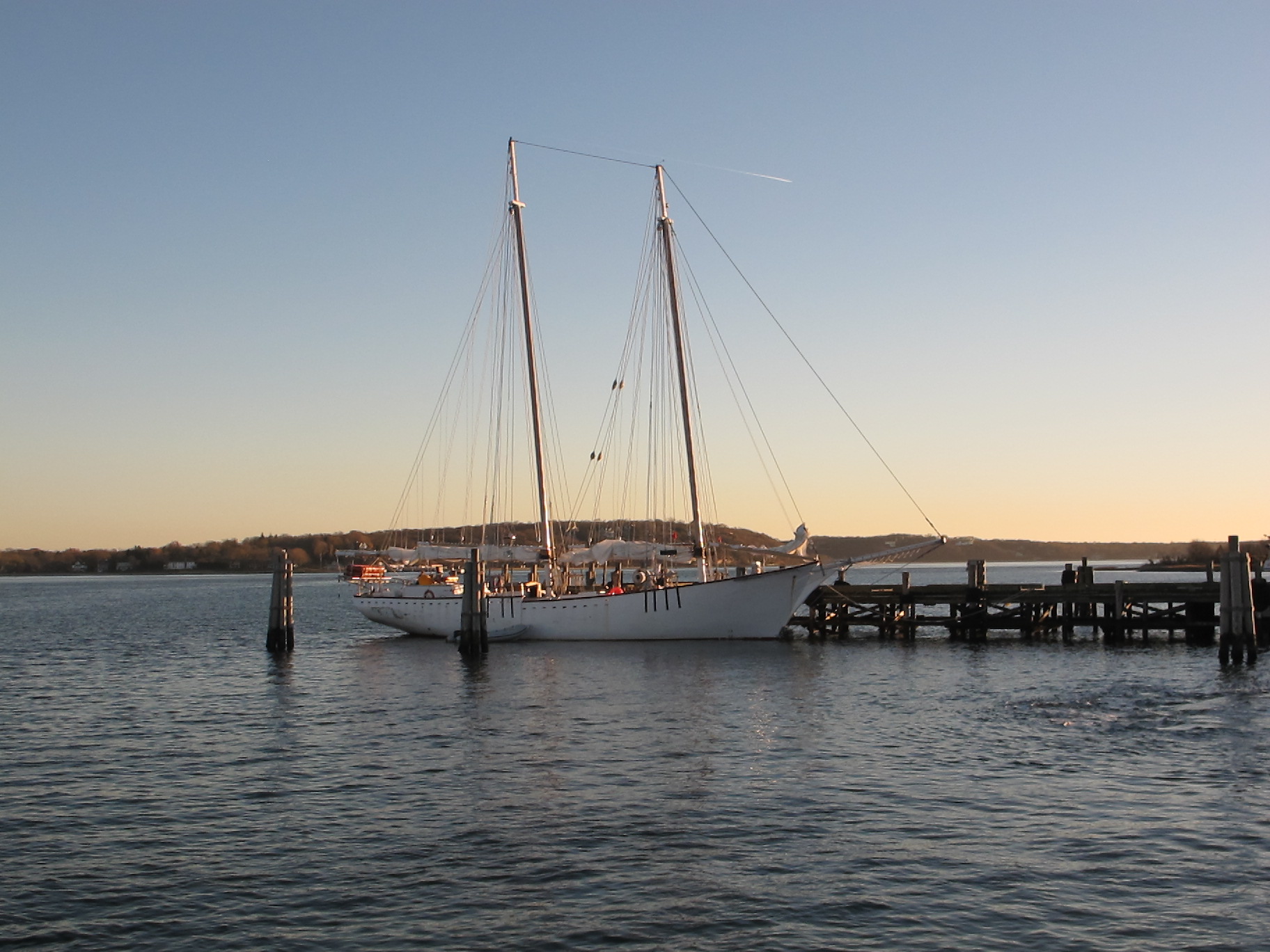
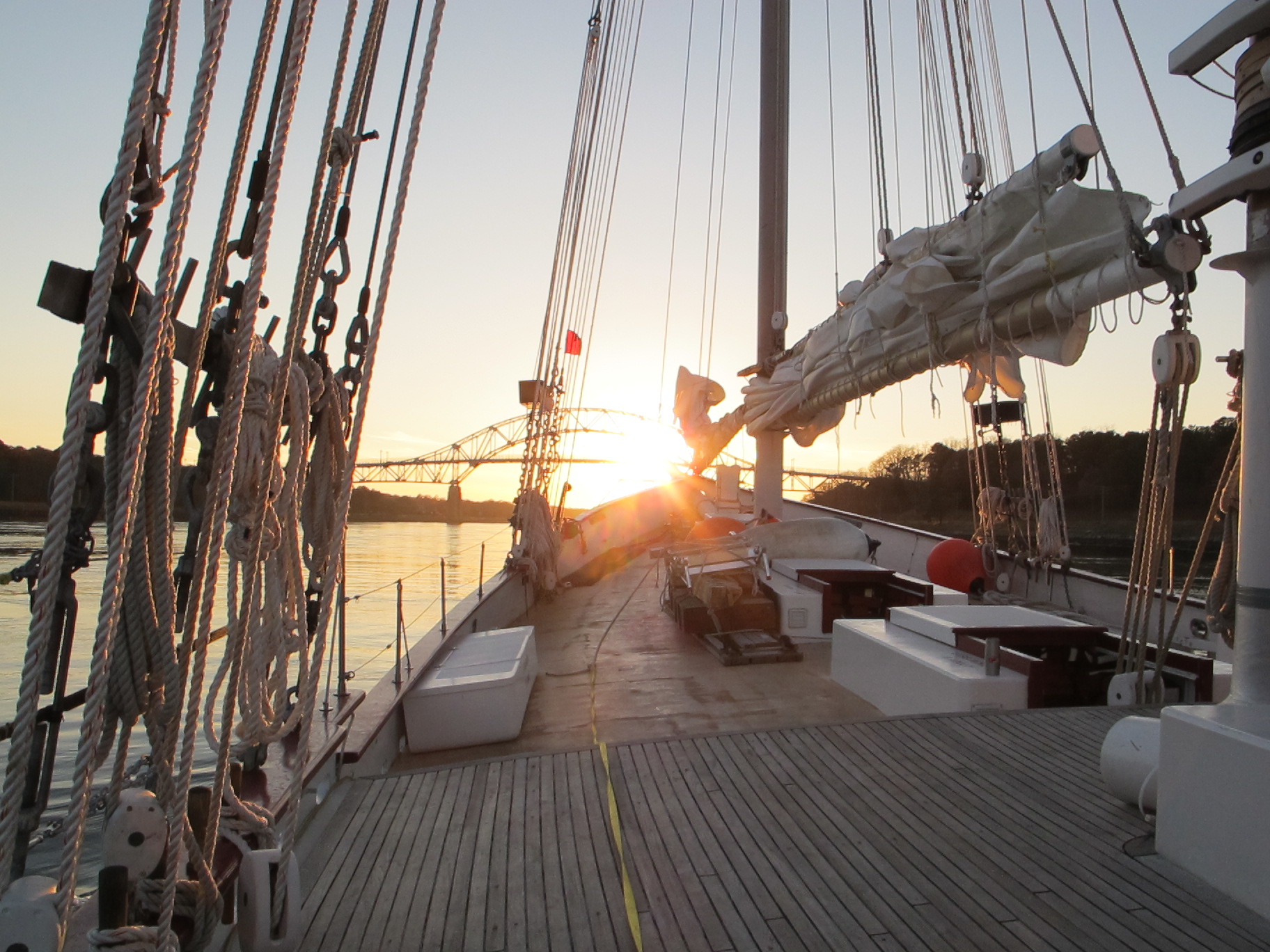
    The schooner in Greenport, Long Island.

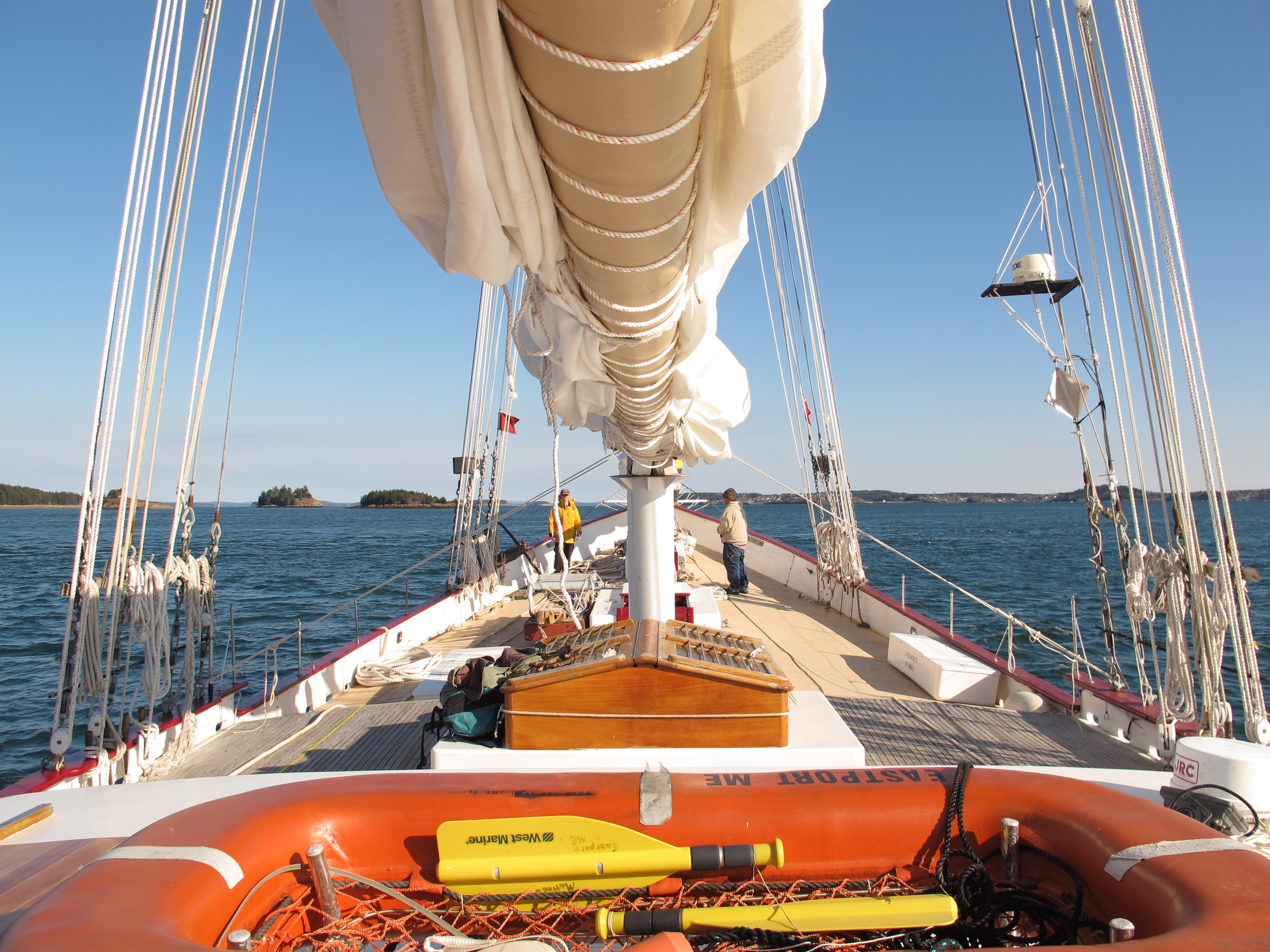
    The wind carries a stiff chill with a breeze off the Bay of Fundy as we unload at the pier in Eastport. I look out upon the brilliant stars and savor the redolent stink of cod and salt water. We arrive at low tide and the twin masts of the schooner are all that are visible from behind the pier that towers out of the water. The Bay of Fundy holds the impressive distinction of having the highest tidal range in the world with an over 40 foot differential. We lower our gear on ropes and quickly find a place below deck to get out of the cold.

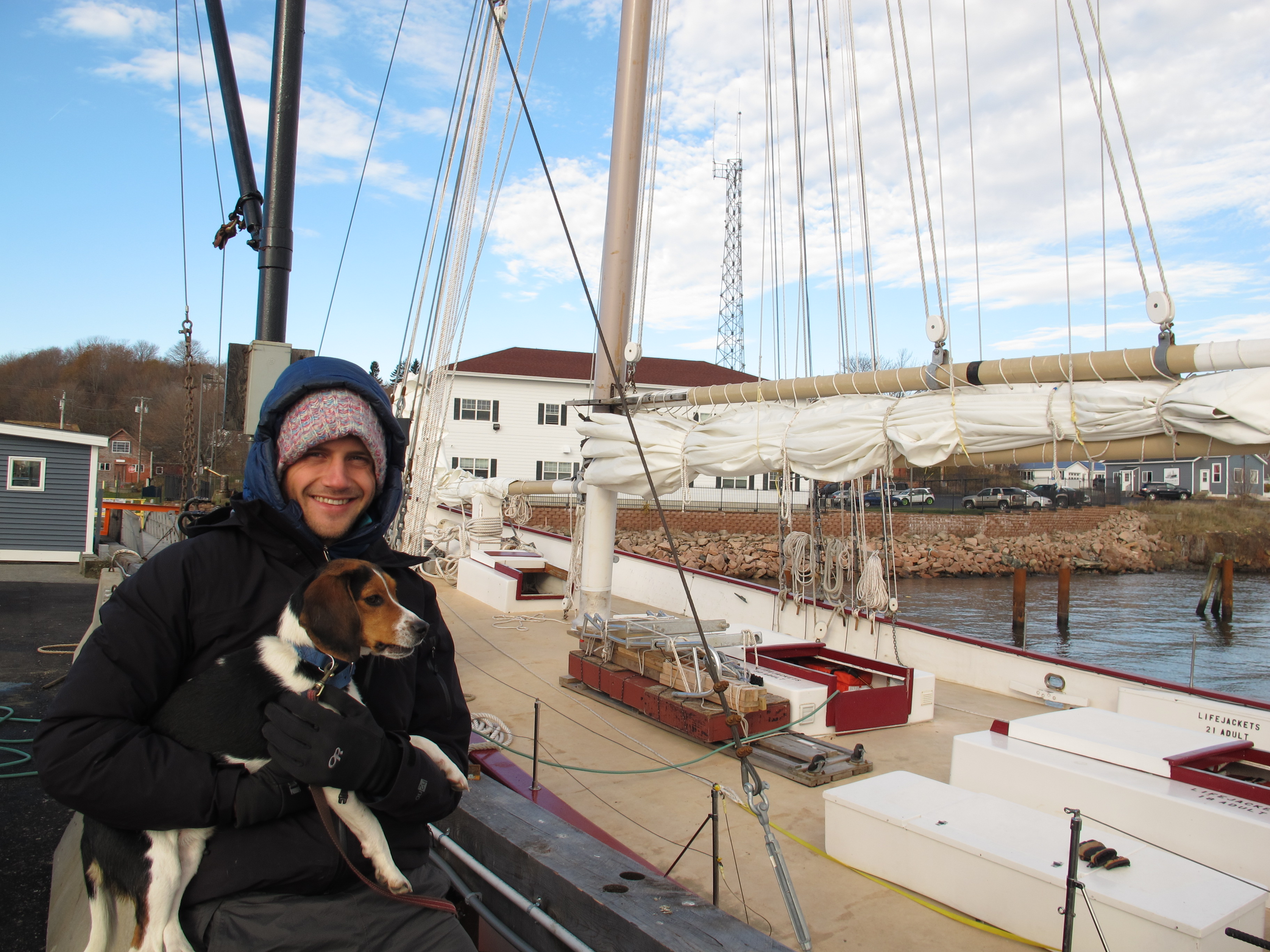
    Our challenge becomes apparent as we check out the galley. The ship is in disarray with many projects left unfinished, despite assurances to the contrary. Pat, the engineer for the ship over the past few years, stands holding his beagle in his arms while discussing the condition of the ship. I overhear phrases like the following:

    ‘If there is a fire, don’t stand there as you will get sprayed with water that will electrocute you.’

    ‘The radar is not installed. We will try to get to it tomorrow.’

    ‘The screen on the chart plotter isn’t really working, it is scrolling and flickering.’

    ‘The generator is currently being run out of a five gallon bucket, so we can’t run it long.’

    I put on all of my clothes and jackets before crawling into my sleeping bag.

    Eastport, Maine

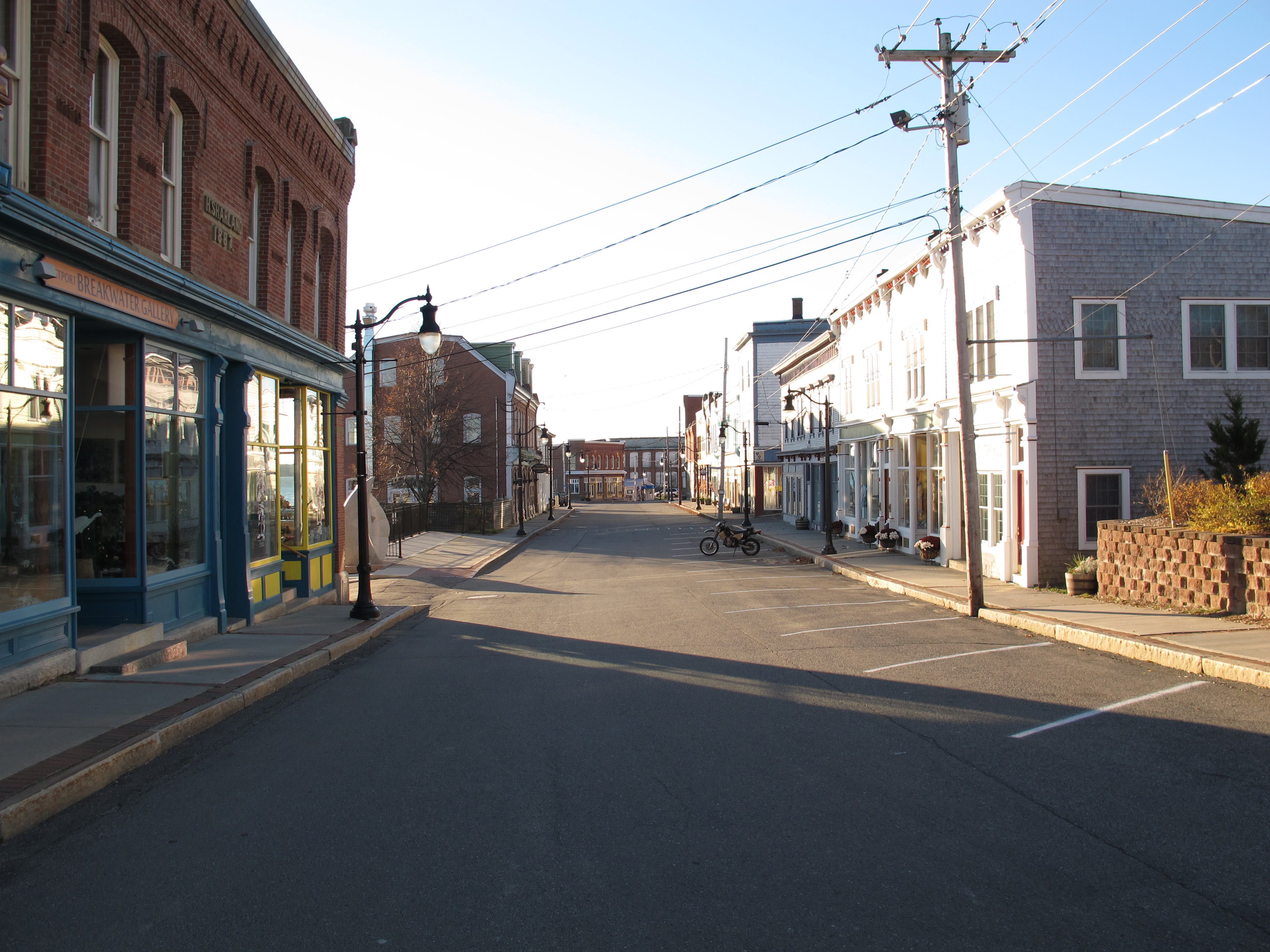
    The following morning I get up at sunrise. It is too cold to do anything but go back to sleep or start moving. I set out into town, the ship having risen enough at night to allow me to step right off the hundred plus feet of fiberglass onto the dock. Nobody is about; this is why it is the best time of the day. I wander through streets and homes built with pride with an eye towards longevity. Winter has crept in here.

    The morning is strange. Joan, Carlton, and Simon seem to be on the verge of mutiny. They are all genuinely vexed by the lack of communication and the general disorganization. I sit equanimously weighing their remarks, not feeling the same level of concern for some reason, possibly out of sheer ignorance. Their concerns and criticisms words do not amount to anything later on.

    We fill the boat with 800 gallons of diesel fuel. It takes a fuel truck an hour at least to fill the boat. Think about that for a moment. I organize all of the food; Joan comes through later and undoes everything that I have done. I snicker when I notice.

    Burton and me.

    We divide the rest of the tasks. Bill and I undertake the job of attaching the stay sail in front. This simply involves wrestling unwieldy canvas and tying knots with frozen hands while precariously balancing on the bowsprit above the icy water of the Atlantic. Bill seems elsewhere; he handrolls cigarettes and carries on a curious conversation that seems to be altogether independent of me.

    Dinner is an affair. The crew is already divided along strange lines with me in the typical position of not knowing where I fit in. I am generally indifferent though. We have fresh live lobsters, twelve of them. Stephen balances one into a headstand with its claws outstretched, a position it unwaveringly holds. The lobsters are lowered into boiling water head first, a death that I watch with horrified intrigue. It is definitely not ‘painless’ or ‘instant.’ I assuage my guilt by acknowledging that this is what grows here, what is fresh and readily available.

    I crack and crunch. A torrent of green pours forth and mixes with the butter on my plate to create a delicious soup. The toilet in my cabin won’t flush. I lie in bed as Pat’s radio plays strange music on one side and Carlton and Joan moan on the other.

    Leaving the Bay of Fundy.

    We ease out late in the morning, catching the last of the ebb tide that we hope to convey us down the coast. I watch the mysterious currents swirl and surge as the glide across the Bay. We discuss the watches: I will work with Bill and Pat from 8pm until 12am and 8am until 12pm. We will have three watches of three people, each working two, four hour shifts each day. Everyone disperses across the deck and into the cabins once this is determined; we only see each other in passing for the rest of the voyage.

    I sit on a bench midship pondering the pitching and rolling that are building in my stomach as the waves build. I am utterly silent as I try to ignore the rising pitch of the complaints from my body; it is like trying to ignore a fire in the corner of a room. My hands begin to strangely tingle as time goes on; I can focus on nothing other than the sensations that are assailing my body. It is unlike anything that I have ever felt before. Burps arise that promise to ameliorate the discomfort, but they always fall short with great risk of unanticipated projection. Hold it together, with enough focus you can stay in control.

    ‘If you need to feed the fishes, go port side since it is downwind.’

    Someone says this and I am involuntarily running with the phrase ‘feed the fishes’ echoing in my head. I brace myself against the railings and let loose thick, viscous streams of particoloured organic matter. The stream twists and moprhs as it falls towards the churning water.

    Pat grins at me and tells me, ‘You look a lot less green.’

    Off the Maine Coast

    All of the tingling is gone out of my limbs. I vomit another time, curl up in a ball, vomit some more, shiver on the floor in the fetal position, go to my cabin, get up, vomit in the toilet that doesn’t flush and is already filled with smelly urine, eat some saltines, drink some water, vomit, I dry heave, I have completely vacated my stomach, irrational fears and nightmares taunt me in my delirium. My body is revolting.

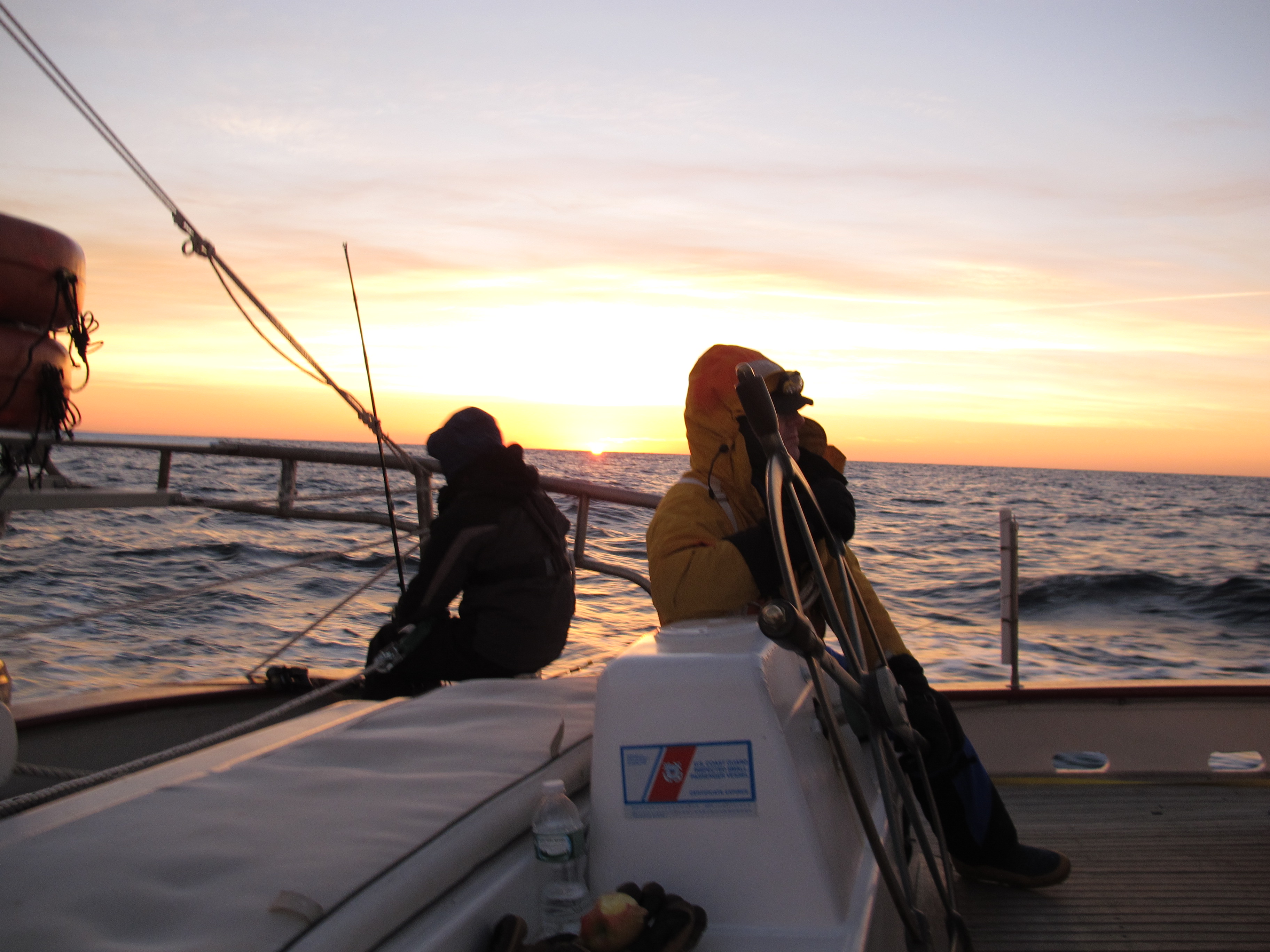
    I get up for my watch and am greeted by a clear sky, the waxing moon painting a chrome stream across the water’s surface. We navigate by the stars, using them as fixed reference points. I steer the boat, initially cutting sloppy zigzags across our source as I get a feel for the rudder, the sails, and the motor in the rolling sea. Steering helps to take my attention off of the sickness.

    Bill says virtually nothing during our hours on watch. I am relatively confident that he is drunk.

    The radar on the boat failed to work, so we brought a second radar system, which subsequently failed to work. The boat’s primary steering compass has failed. Nobody knows how to operate the chart plotter properly and I vomit whenever I stare at the screen.

    I eat an apple and a pear, which counterintuitively make me feel better. I again fall asleep in all of my clothes. My cabin smells like a truck stop men’s room. I pity myself and laugh as I lay a seaman stained blanket that I found in the cabin over myself. I roll with the boat.

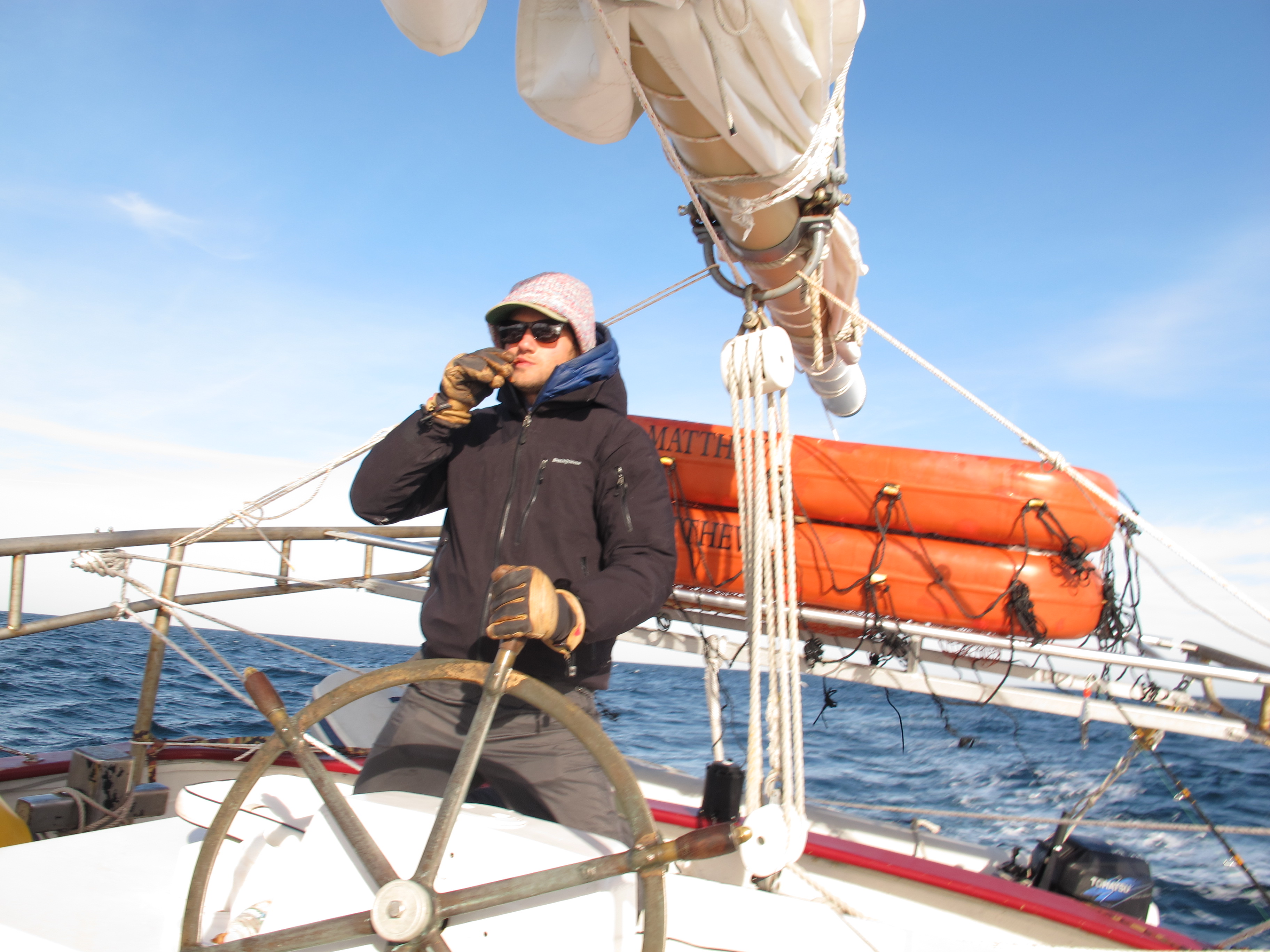
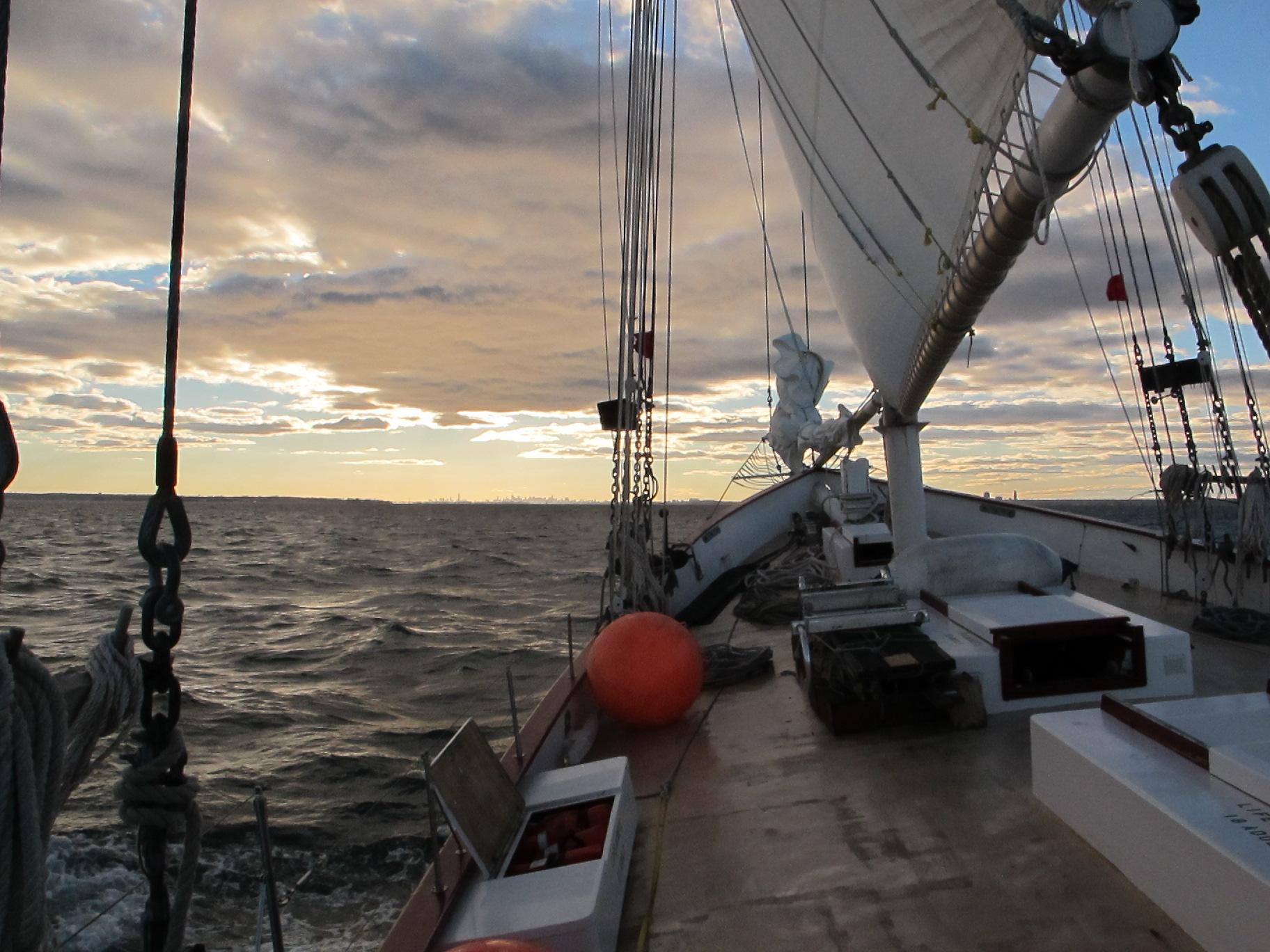
    Me at the helm.

    I wake up in time for sunrise and sit on deck, the cold seemingly in my bones and my brain nonfunctional from privation. The coastline is out of sight and the sea remains vibrant. The wind has shifted though, despite forecasts to the contrary. It comes straight over the bow from the Southwest, stilling progress. I repress an urge that I have to talk about sailing disasters stories. We could easily be drinking our own urine and be admiring the flesh of each other inside of a week if we let ourselves get blown off course.

    After my daytime watch ends, I lie in bed unable to sleep, hallucinating strange shifting shapes and cityscapes. The organic melding with the linear, with the artificial, throbbing with life, expanding, wilting. Night watch is tough; it drags on as I sit huddled against the breeze.

    In the morning I struggle out of the windowless cabin to a beautiful day. Pat and I pass our watches telling rambling, loosely connected stories. One summer day I looked out into the yard with my sister, climbing up on the counter to see what was going on outside as our dog Belle ran in front of the kitchen window tossing what looked like a black ragdoll up and down. Our foray into rabbit raising ended the moment that my sister screams resounded through the kitchen upon realizing that it was her rabbit Poco Diablo.

    Most of Pat’s stories begin with ‘We just went out for a few beers…’ Getting woken up to a cop toeing him with his boots in a public park, waking up cuddling a napkin dispenser, getting offered to buy crack and guns, beating his friend with a tire iron after an argument erupted as they were stealing hubcaps off a VW bus, doing whippets with Mormons as cases of whipped cream were on sale for $10, He talks extensively about his friend ‘Gay Norm’ who has at least three stories that end with ‘…and then they beat me and left me naked under an overpass.’ Pat shakes and doubles over in laughter as he tells these stories. He is frank and brash in a way that is both repugnant and refreshing.

    The chart plotter fails. We are now navigating via handheld GPS and paper charts. I look over the starboard side of the boat and see a spray emerge from the water, a whale repeatedly vents into the air before turning its tail and diving. Porpoises jump in unison alongside. We quickly arrive at the entrance to the Cape Cod Canal, just in time to catch the strong current of the ebb tide.

    I am at the helm as we enter the canal. We radio the canal authorities who give us permission to proceed with the warning that there is a large barge coming our direction. Half of the crew is on deck. The banks are lined with serene trails peopled by pedestrians and cyclists enjoying a lovely day. Many stop to take our picture as we pass by and admire our good fortune.

    Everything suddenly goes quiet; the motor cut out. I continue steering while we get the motor restarted. I can feel the tension start to build as the starter turns for a two, five, ten, twenty seconds to no avail. Our momentum begins to die and the rudder becomes useless; the current begins to direct us.

    Doug calls the canal authority to advise them that we have lost power and to ask for assistance. The Coast Guard hears our distress call and scrambles a boat. We begin to spin in the canal and move rapidly portward with the force of the current that was a boon only moments earlier. It is not difficult for all of the people who line the banks to realize that something is very wrong; they begin taking pictures for a different reason. Everyone runs around the deck, a flurry of ineffective motion.

    We drop the dingy and Stephen begins attempting to push us away from the portside –although it is no longer portside as we are spinning- steel bulkheads and pylons. I am giddily terrified as there is really not much that we can do and it seems like a collision with either the bank or the barge that is bearing down on us is inevitable. The Coast Guard arrives with a small boat, realizes the sheer size of our predicament and returns with a large boat just as we are nearing the steel I-beams. I grapple with a strong desire emerging from nowhere in particular for the ship to crash, wreck, catch on fire, sink. Some part of me secretly craves destruction and disaster. Unfortunately, the Coast Guard comes in fast, forcefully ramming us on the stern starboard side to straighten us out; a move that buys us a few seconds.

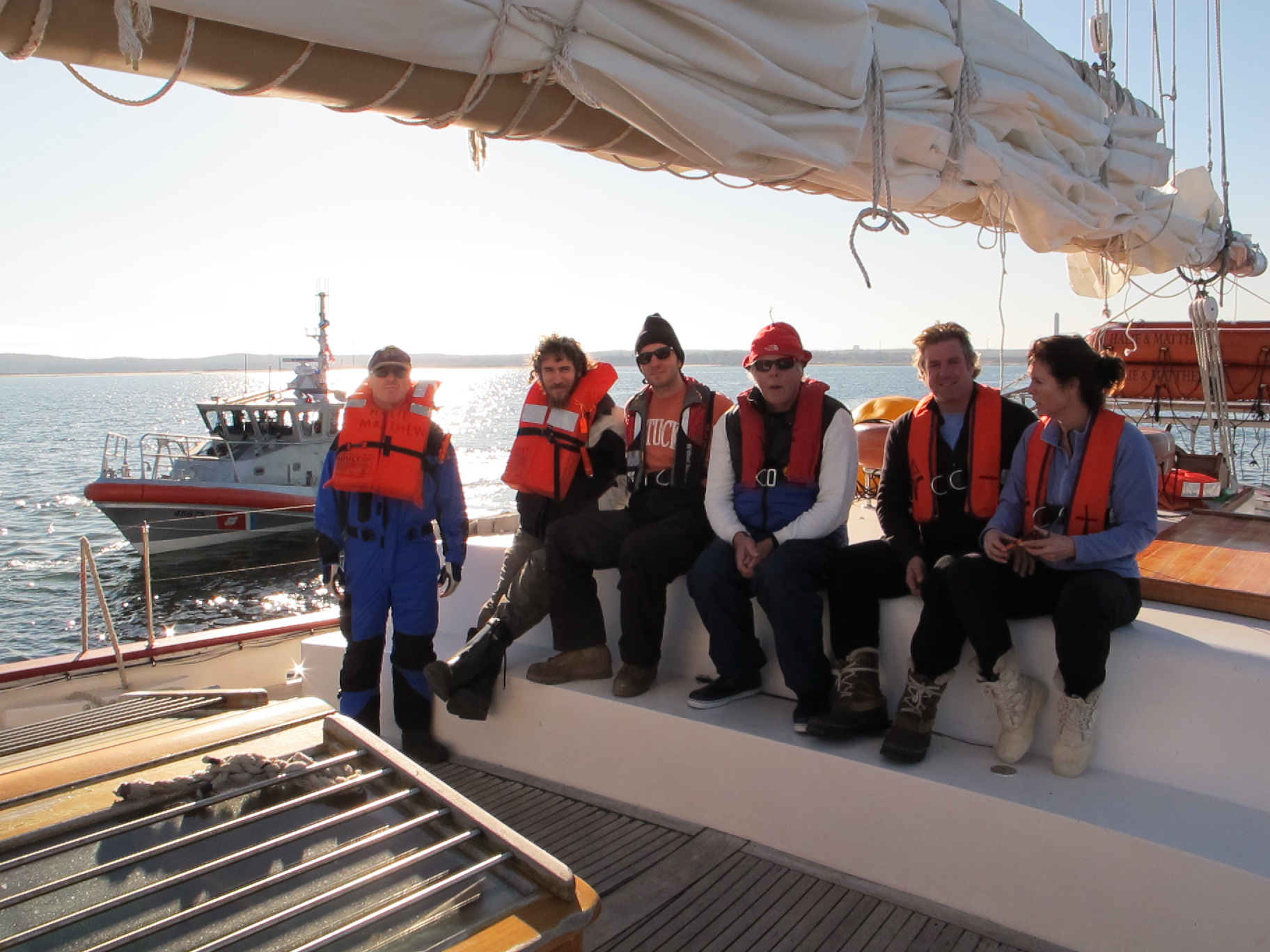
    Being inspected.

    Commands are quickly shouted and a rope is tossed onto our deck. We scramble to secure it and then yell for them to hit the throttle as we are nearly broadsiding the canal. I stand in wonder at how quickly this has spun completely out of control. We manage to get the motor restarted at this moment, but we are now in tow and at the Coast Guard’s mercy. The problem was a bubble in the fuel line from switching over the fuel filter just before we entered the canal. Pat remedied the situation by bleeding the injectors. We are ordered to put on life jackets and stand by as we are hauled an hour out to sea. We are boarded, inspected, and quickly sent on our way.

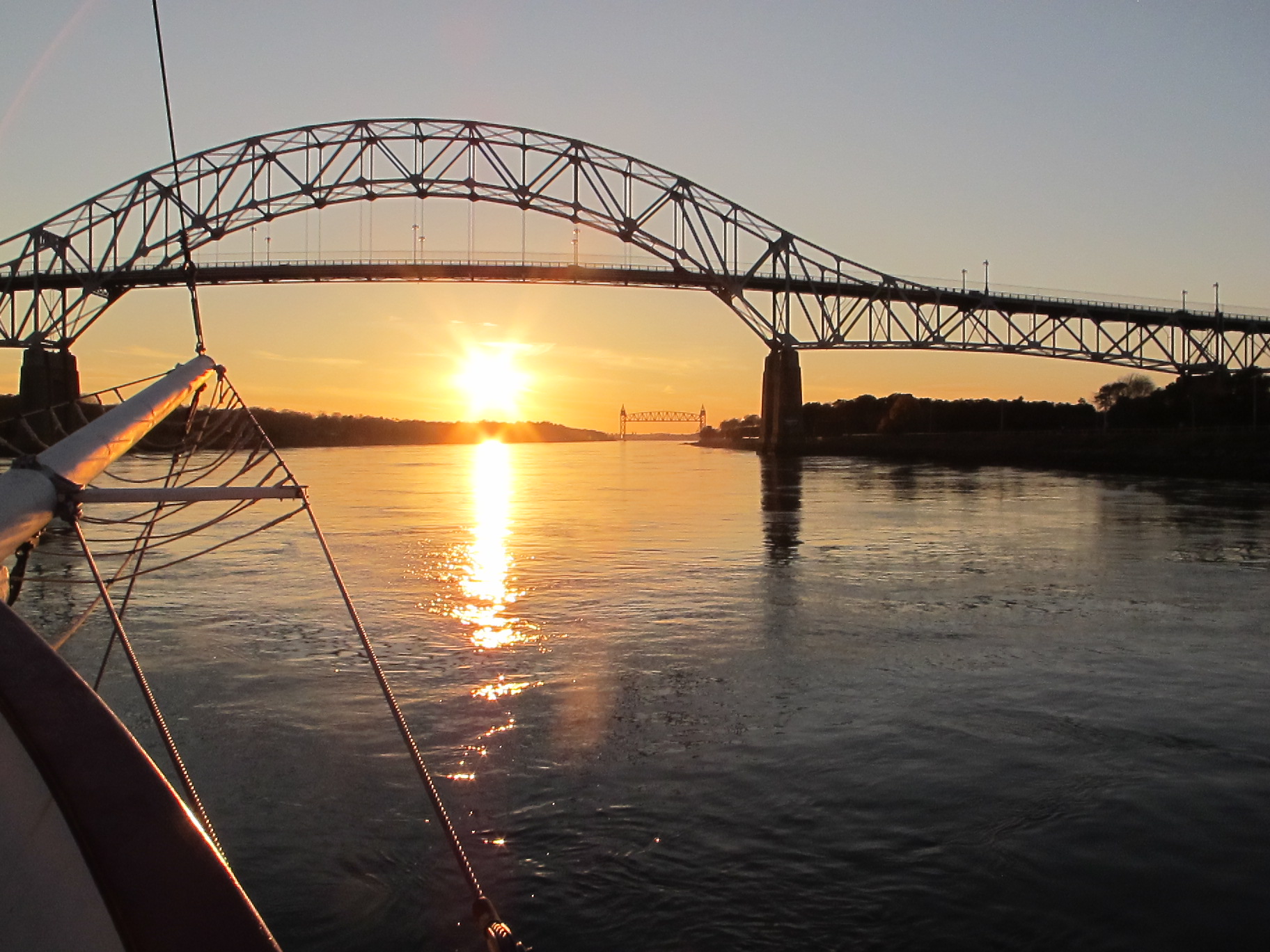
    Cape Cod Canal

    We miss the ebb tide and find ourselves fighting our way through the canal as the light wanes on the vacation homes and trees that line the banks. As we exit in the darkness we are taxingly navigating by buoy, getting close enough to each one to see the number and verify it on our charts. The fixed lights of shore seem to never move. I stare at the Newport

    Cape Cod Canal

    Bridge for hours. The sea has calmed, although the dancing inky surface still seems equally menacing. The dark, cold sky and the gaping maw of the sea leave me feeling lonely as I steer. I wonder about the people in the warm, comfortable houses in Newport. I imagine pastoral simplicity and tranquility. A nostalgic desire for home, for warmth, for family rises.

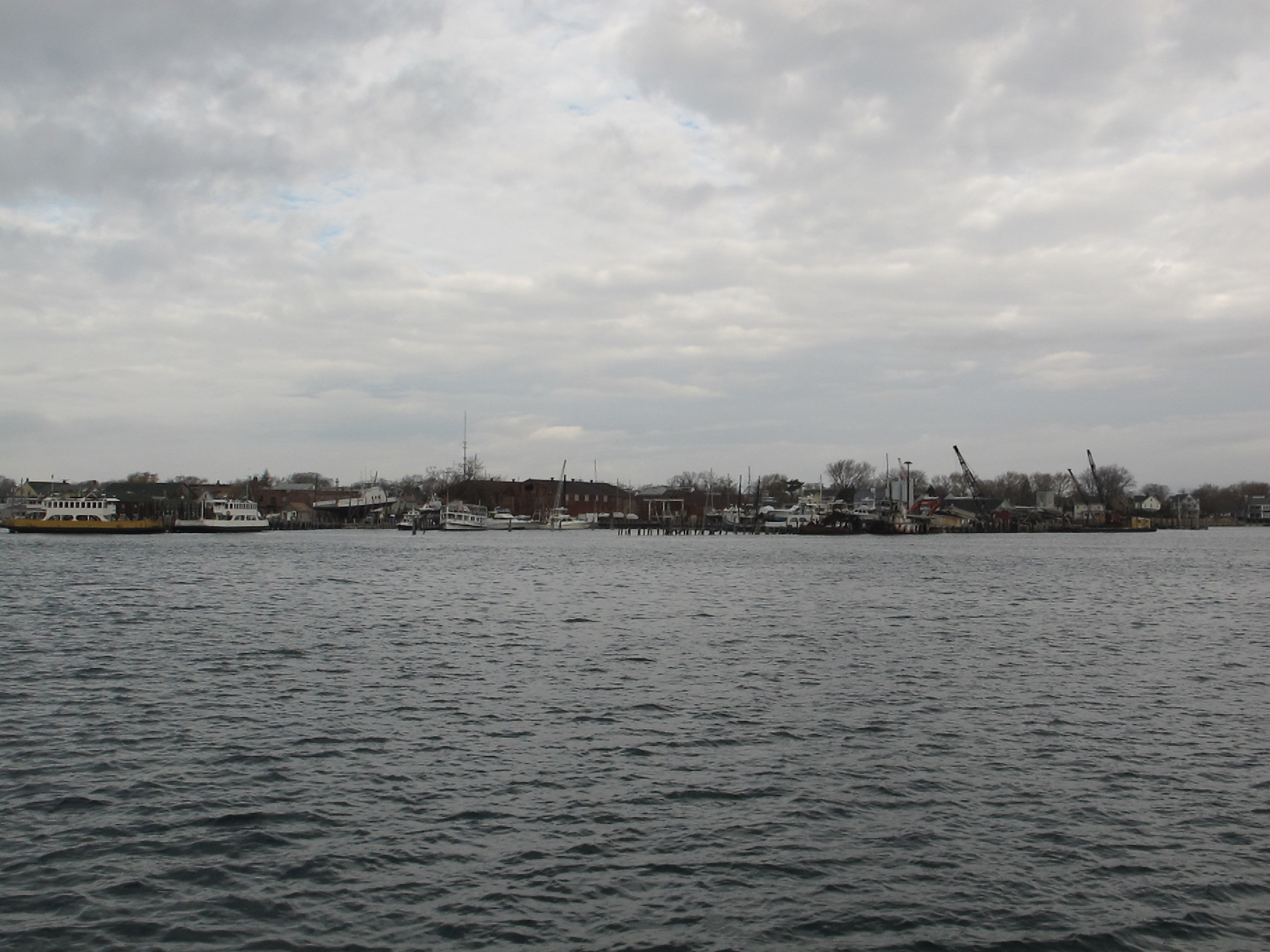
    Greenport, Long Island

    I wake up with land in sight the following day. The leaves of Oak trees float below the surface and the air smells of fall. Greenport, Long Island. The 800 gallons of diesel turned out to be insufficient. We begin our initial approach on the dock, with the dingy serving to assist. We nearly hit one dock before realizing it is the wrong one. We reposition and make another attempt with 95 tons of boat moving directly at the dock. The harbormaster is screaming as we approach with the boat in full reverse. I once again find myself consciously striving to repress a desire for the boat to smash through the dock, toss the harbormaster in the water, catch on fire, lay over on its side, spread its flames to the kitschy crab shack restaurants and explode.

    The bowsprit hits a streetlight that lines the dock, bending it over sideways as the old man runs around yelling irately. Doug calmly mans the controls, making everything seem fine. We toss dock lines and pull her in.

    I get off the boat on sea legs; everything seems slightly askew like in a funhouse. An old man stops me wearing similar garb to what Colonel Sanders would wear on a Sunday; I just dismiss him as another East Coast relic from a bygone era. I think it is supposed to convey affluence and evoke respect. He talks about the massive schooner that he owns and the various ‘tall ship events’ that he has attended. I feign interest until he parts with the following words that seem incongruous with his appearance:

    ‘Be careful here, there are a lot of guns and drugs. This place is fucked up!’

    Joan, Carlton, Bill and Simon all depart as our arrival in New York is now uncertain. We need more fuel and the weather looks questionable. Stephen cracks me up with stories of accepting jobs for which he is woefully underqualified. He accepted the job of head chef on an Atlantic crossing, only to be flown home before the long leg after oversalting meat and undercooking pasta. He was the general manager of a 200 million dollar bar in Manhattan for three weeks. He has been a sommelier in Nantucket with no real knowledge of wine other than having watched a movie about it. He has been a bartender, jet ski guide, model, bouncer…..

    It begins to spit on us and a thick fog settles in. There seems to be a 65% chance of stabbings.

    The winds howl over the boat and gently rock us against the dock. I lie in my windowless room in the early morning listening to the cacophony of clanking, whipping, rubbing, battering, jostling, tapping, lapping..

    The fuel truck arrives in the afternoon and I walk out to meet it. I see the old man who looked like Colonel Sanders the previous day walking towards me. He is wearing another stunning outfit: a woman’s widebrimmed gardening hat, boating loafers, and a white knit sweater with an American flag boldly placed in the center. He grabs my arm as I try to greet him in passing.

    ‘Is that truck for your boat?’

    ‘Yep.’

    He draws in close to me, giving me a weird conspiratorial head tilt.

    ‘The DEC is watching that truck right now. They are watching you.’

    I receive this deadpan as I don’t know who the DEC is. I assume that this is not a good thing from the manner in which I am being informed.

    ‘Oh…’

    ‘Do you have a fuel skirt?’

    ‘I am not sure.’

    ‘Are you the commanding officer of this vessel?’

    ‘No.’ I laugh as this comes out. Doug is walking past.

    ‘Hey Doug! This guy wants to talk.’

    ‘Gimme a minute. The fuel truck is here.’

    ‘It is about that.’ I am taking on the weird, furtive tone of this old man for no clear reason. Do they have one of those long distance satellite dish headphone setups? I almost want to cover my lips. Can these people from the DEC read my lips? What does the DEC want? What should I be saying to please them and throw them off my tail?

    ‘I need to go get this going.’ He responds sharply.

    ‘Sir, it wouldn’t be in your best interest to disregard me.’ The old man angrily barks.

    Doug seems slightly taken aback. ‘Oh..umm… What can I help you with?’

    He draws Doug in and I huddle near, intrigued by all of this.

    ‘The DEC is watching you. You cannot fuel here; the Coast Guard will confiscate your boat.’

    ‘We have permission from the harbormaster to fuel here.’

    ‘You can’t. Look, why don’t you just come over to my dock at Claudio’s and fuel there?’’

    ‘Oh I see. We pay you to use your dock or you call the Coast Guard?’

    ‘No! Sir, I am trying to keep your boat from being confiscated! I am your friend.’

    ‘You are not my friend. I don’t even know you.’

    ‘Yes you do. I am the owner of the ship Lynx.’

    The entire thing is surreal; I am riveted in amusement. This dialogue seems strange because it genuinely was. The fuel truck driver hears all of this.

    ‘I ain’t fuckin’ fueling nothing if there’s gunna be any fuckin’ problems with the DEC.’

    Doug calmly addresses him, ‘We have permission to fuel here. I am going to call the harbormaster right now.’ He places his phone to his ear and then turns to the old man.

    ‘What is your name?’

    ‘Mayor Nice.’

    The fuel truck driver stands on the periphery and sprays chewing tobacco out of his lower lip as he shouts to no one in particular. ‘I’ve lived here my whole life an’ der ain’t no fucking Mayor Nice. Ain’t no fuckin’ Mayor Nice! That guy ain’t no fuckin’ mayor!’

    Doug chats with the harbormaster and then hands the phone to the old man. He feigns an inability to hear and hangs up the phone. I start laughing in disbelief at this charade.

    He pats Doug’s shoulder and ominously says, ‘Just fuel your boat sir. It will be alright.’  It seems like some sort of knowing blessing or curse. He steps into a beat up old cab and we put in another 350 gallons of diesel.

    We sit around laughing later as a few locals explain that he is just the crazy old town drunk.

    Doug has a friend come up to give us a hand; his name is Rand. As we walk around town he, without provocation, feels the need to make explicitly clear his disdain for all things organic or locally sourced. This is the mere sprout of something much deeper rooted. It slowly becomes apparent, as his vitriol becomes more targeted, that Stephen and I are gentrification personified. I head to bed early as the predominant form of discourse amongst Connecticutians and New Yorkers appears to be arguing and pontificating with special points awarded for shouting down the other person or not allowing them to speak at all.

    Pat is stomping around the deck at 3am, waking all of us up. We sit in the cabin drinking coffee as an intimidating gale howls outside. We depart nonetheless into the darkness and begin our fight through the Long Island Sound. As the sun rises, the wind and waves do as well. The front of the boat rises and plunges, smashing and vaporizing the steep wind driven waves. The spray whips over the deck and dries into a blurry sheen on my glasses. We raise the jib and stay sails to catch a few more knots from the Northerly component of the stiff wind.

    Long Island Sound

    Everyone is tired and nobody has eaten as we sit braving the chill and stare at the horizon, conditions that are not exactly conducive to congenial conversation. Rand starts in again and it ramps up quickly.

    ‘You can take all of your locally sourced organic bullshit and shove it up your fuckin’ asses! All of you hipsters from flyoverthefucknowhere need to stop coming to Brooklyn because you heard it was cool and cheap! It isn’t fucking cheap and you are driving everyone else the fuck out with your parents paying your fucking rent!’

    Tower of Babel

    I am not sure how this got so out of hand, but the stress that I have felt in recent weeks reaches a crescendo as well.

    ‘Well where the fuck are we supposed to live? Where do people like us who can’t afford to live in Manhattan go?’

    ‘I don’t fuckin’ care. Just stay the fuck out of my neighborhood.’

    ‘How is gentrification my fault? Why are we the ones to blame for all of this? Do you think that we want to pay all of our fucking income on rent? Who ever told you New York was going to be cheap? What in the world ever made you think that real estate separated be a couple of subway stops from the most expensive real estate in the world would ever be cheap?’

    Tower of Babel

    ‘No families can afford to live in their communities anymore. I have watched all of the black families on my block get pushed out by a bunch of fucking hipsters that don’t give a shit about the community. All the local stores are gone and converted to businesses to serve them that are too expensive. It’s fuckin’ out of hand!’

    ‘Look I am just tired of being made to feel unwanted here. It isn’t right for my girlfriend to come home nearly in tears because she was yelled at and made to feel as if she is the problem, as if she is the white oppressor. Why as individuals are we the problem?’

    ‘Because you guys are willing to pay these fuckin’ outrageous rents because it is hip!’

    ‘Once again: where the fuck are we supposed to go? What about the real estate investors, the businessmen, the crooked politicians, the broken system, the banks?’

    There is no solution, although there may have been a slight catharsis through our venting. This is the cage: perpetual insecurity.

    Tower of Babel

    The city appears on the horizon, emerging out of the mirage that shimmers where the sea meets the sky. It grows as the day fades; it swallows the sun. The city rises around us and similarly swallows us into its glow, into its concrete web, into its madness. We enter the Bronx on the pulse of one of the main arteries, flowing in through the back entrance to the city. The air smells of asphalt, of sewage, of acrid chemicals, of exhaust. Sirens wail in the distance.

    At night you can feel it the best.

    It is in the decaying buildings and in the trash swirling in the cold wind.

    It is in the clatter of metal and rasp of tires on concrete.

    It is in the barred, the locked, the shuttered.

    We silently pass each other;

    your face tired and eyes downcast in the artificial light.

    It would be too terrifying to ask what you are doing here,

    because of what it would say about myself.

    I finger the keys in my pocket and quicken  my pace.

  • This is my life though….

    I am moving to Brooklyn in a few weeks. This is the end of my Southward travels. My bike is sadly disassembled in a box. This abrupt shift in life plan has led to some very poignant questions: What do you do for a living? What are you going to do with your life? What is your thirty second elevator speech?

    Well, to begin with, I haven’t been in an elevator for several years.

    I need to revise my resume. Who am I? What have I done in the past few years? I would probably be listed as itinerant or destitute by most federal agencies. I would definitely fit into the category of ‘disgruntled worker’ in an economic census. I have virtually no physical manifestations of what I have been doing with my life.  It helps to look back. This is what I was doing on this very day in recent years:

    I wrote the following in my journal on a motorcycle trip in India seven years ago on October 16th:

    “Left this morning after an okay breakfast. We cruised some beautiful mountain and coastal roads with no idea where we were going. I have finally gotten a real good hang of banking the bike around turns, which is a blast.

    Finally we got to highway 17 and we were forced to blow around a police roadblock. It was a thrill. I am now sitting in a beach villa writing since we cannot return until later due to the police roadblocks.

    Leaving later had no effect on the police presence, which lead to us blatantly blowing through about 3-4 police roadblocks. The force was apparently stepped up due to the once a year unveiling of the ‘Infant Jesus’ in Culver, which draws people from all over Goa.

    Blowing through one police roadblock I actually made eye contact with cop as he stepped in front of my bike and clearly motioned me to the side. I motioned to him that I was pulling over and started pulling to the side, and then hammered down on the throttle and took off.

    After consciously avoiding police several more times, we made it back to Baga for the night. We were delayed since Anthony suffered a front tire blowout. We had to go to a shady shack in the woods to get it fixed. The guy there guessed we were from the states right off for the first time, but I believe that it is due to the fact that we were smoking Camels. They patched the tire, but the power had been out all day, thus they said they could not fill it. The power miraculously switched on and off we went.

    We got back to Baga and checked in at Traveler’s Guest House. We ate and went out for drinks since it was our last night together.

    We were playing pool at the bar and getting pissed, it was a blast. We were the only customers thus the bar tender felt free to produce a hash joint which I promptly smoked with him. I feel asleep after sitting at Maioka for a while again.”

    Five years ago I was living in the Central Yucatan in a small village called Xpujil where nobody spoke English and I spoke a modicum of Spanish where I wallowed in post-graduation confusion.

    Here is some of what I wrote as I was hitchhiking through Chihuahua two years ago on October 16th:

    “We decide to hitchhike to Recusarare Falls and start our walk South out of town to hitchhike from the rotunda. It is a beautiful morning and there are cottonwoods with their leaves changing. We get to the rotunda and there is virtually no traffic; I am worried that I am going to look like an idiot for pushing this plan forward. We are chatting with a local guy after waiting for 30 minutes or so and a family in a pickup rolls by and throws us in back with a brand new big screen TV. Miriam and I have shit eating grins on our face for the whole ride. Once again, the best way to see the world is from the back of someone else’s pickup.

    We get dropped off and start our hike down. We are going along a creek bed and through lush stands of ponderosa pine. There is a group of donkeys grazing in one meadow where two small streams converge; I try to pet them but they will have none of it. The trail winds into more rugged terrain and there are many Tarahumara women about, all industriously working on artisan crafts: baskets, scarves, belts, bracelets. All of it good quality. They are selling it, but will not say anything to us but a quiet, muttered ‘buenos dias.’ All with the most piercing black eyes that the indigenous people of Central America have and bright dresses.

    After laying out on the rocks in the midday sun to warm up, we head down canyon through a boulder choked canyon with blue pools in between. Everything is mossy and lush, yet littered with the remnants of globalization in the form of Coke bottles and Frito bags. All of this requires a lot of jumping and bouldering. Miriam says in English how doing this makes her feel alive; I couldn’t agree more. I find a super creepy dolls head and put it into my backpack. We finally reach a pretty tricky point and decide to turn back.”

    A year ago today I was training to ride my bicycle South.

    Eight months ago I arrived in Guatemala and randomly met a girl named Lauren in Guatemala who had taken a four hour car ride with my mom at one point before deciding to travel to Guatemala after hearing about my adventures.

    Seven months ago I decided to quit my job, break up with my girlfriend in Utah, and stay in Xela, Guatemala after staying up all night watching a volcano erupt.

    Two weeks ago I was training and prepping to ride North through Mexico with Lauren.

    Ten days ago Lauren received an email from a friend regarding a job opening that was essentially her dream job.

    Seven days ago she accepted the job on the condition that we move to Brooklyn within three weeks.

    Here are some excerpts from conversations in the past week:

    ‘Dad. I wanted to let you know before anyone else that Lauren accepted a job in Brooklyn that starts in a few weeks. We aren’t going to do the bike trip anymore and will be home in a week or so.

    So you called to tell me that you are becoming a barrista?’
    –
    ‘I spent a summer living there once. To succeed, to survive, you need to be angry. Don’t worry though, you will become angry just by living there.’
    –
    ‘The East Coast is weird. People there care where you went to highschool, what your parents do for a living. I had a boyfriend’s dad ask me my SAT score the first time that we met, apparently he does it to all of his kids partners.’
    –
    ‘How are you going to live there? How do you have any money left? I think I should explain this to you since you have been in Guatemala so long: having three figures in your bank account shouldn’t make you feel rich.’
    –
    ‘You could probably get a job cleaning the building where Lauren works or maybe making tortillas. Cuatro por cinco!

    Yeah…. I am going there like an immigrant with everything that I own strapped to my back and no clue as to the future. I am like a cockroach though, I know how to adapt and survive.’
    –
    ‘I saw this movie with Michael J. Fox where he went to work for a publishing house in New York, something you could do since you like writing, and he rose up to editor from copy boy. He did it by snorting mounds of cocaine and staying up all night.’
    –
    ‘Don’t worry, there are plenty of weird people like you there. Everyone is doing something interesting.’
    –
    ‘Hahahaha. I can’t imagine you there. Good luck adjusting to the sedentary life!’
    –
    ‘I get self conscious when I am there. There are literally flocks of supermodels roaming Manhattan. Flocks of them!’
    –

    Yesterday I was vexed with anxiety over what I am going to do in Brooklyn, over where I am going with my life. I have not built my life around work like the hypertrophied, ravenous, career professionals for which New York is famous. I have traveled extensively, met incredible people, learned another language, read hundreds of books, and discovered more about myself and humanity than I ever could have imagined. How do I reorient all of this to sound like I am a valuable and diligent worker?

    How am I qualified for this position? Honestly, I am probably not.

    Today I am reflecting on my life. I have chosen the path that I walk, over and over again, yet all too often I look back in frustration at its sinuous course. I navigate through life with my values as a compass, often leading myself in directions that are confusing to others and myself. I don’t really know where I am going, but as usual I feel good about it. I haven’t had a boring chapter in a long time and I am sure that this one will be no different. It is just a continuation of the adventure, of my life.

    The coyote called today from Juarez; he wants the money before the month is out. He threatened the milpa in San Pedro Matagallinas again. The farm isn’t worth anything anymore; the rains never come on time and we can only grow maize. The seeds and fertilizer are expensive. It is home though. Carlitote and Josephinita need new school uniforms, they need books, they need a future. I need tortillas. There is not enough work. There is the rooster though, The Gallo de Oro.

    I promised him a peaceful life in the North as we waded across the Rio Grande. It cannot be though; there is a greater fight. He will strut under the lights of the ring once more, squaring off against a sleek, bowled cockerel with filed talons raised behind a bodega in the Bronx. The Gallo de Oro is hard and lean from the free range; he has fought in Hormigas, in Hermosillo, in Tecpatan, in Cholula, in Nogales, in Juarez. The pluck has seemed to have gone out of him with his departure from the ring; he was meant to dance. And so it will be. I am the Gallo de Oro.

    I enter the fray, no limit to my potential other than my own ambition. I am working in an office with my face against my palm as the fluorescent lights bleach my soul. I am stressed; my teeth hurt from grinding them at night. I stand up to shovel Chinese food into my mouth as I peer out on the shimmering lights of the city from an office building, exhausted from a frantic night of scribbling out the nonsense that is in my head onto a white board, only to be interrupted as someone taps me on the shoulder to hand me a comically oversized check. I twirl in Time Square, reveling in the brilliant light of the utmost manifestation of the material dream. I see Thomas Pynchon cross the street in front of my car; he is just another human. I read ticker tapes that reflect my prudence and intelligence of my investments, numbers that hint that I may be able to get a little place in the Hamptons someday.

  • White and Blue

    Small slab I undercut on Coalpit Headwall.

    2010-2011. It started to snow in early October and did not cease until the following summer; the storms were relentless and were drawn to the Wasatch mountains in Utah from the Southwest, from the Northwest. At this point in my life I did very little other than ski; I spent five or six days a week working as a ski patroller and every other moment I could in the backcountry of the Cottonwood Canyons. I skied all but a few days between Halloween and Easter, trying to take advantage of a once in a lifetime winter. The amount of snow that fell can be quantified in the number of cups of coffee that I drank per day, which topped out at roughly 12 before I decided that I had a problem. I would wake up before 5am for both avalanche control and days in the backcountry; I tried to keep going, always knowing that it was bound to stop at some point. But there were so many lines and chutes that I had been lustfully eyeing for years, waiting for the right moment to approach.

    Monte Cristo, The Hypodermic Needle, Mount Dromedary, Thunder Bowl, lines off Mount Superior; memories of deep powder shimmering under a blue sky, of hours of trailbreaking, of stable conditions, of standing atop monochrome monoliths remain as pleasant, but hazy recollections.  Although there is one foray into the backcountry that has endured as it is of a different character; it has a tinge of danger and disaster. The mind understandably works this way; its self preservation instinct is better served by searing threats to life and limb into the memory than the tranquil and pleasant.

    The Northwest Couloir of the Pfeifferhorn. Steep. Narrow. Classic. An hourglass shape, the upper end of which feeds you into a constriction that terminates with a cliff, typically requiring a rappel, before opening into a vertiginous apron. The line consists of a 1000 foot descent with an average pitch of 50 degrees. The approach to the remote 11,326 foot peak is long and committing. The couloir itself is noted for its often treacherous conditions, something that I hoped to avoid by skiing it after the right storm.

    In the middle of February a storm was approaching that promised to drop a significant amount of snow on top of what was a stable snowpack. My friend Joel and I had decided that we were going to make an attempt on the Pfeifferhorn the following day; for me this meant calling in sick to work, something that I didn’t lose any sleep over. Joel and I had undertaken a few different adventures together and our demeanors were well matched. Joel has a love of skiing that is matched with fearlessness and intelligence, despite his Australian origin. His ability to carefully navigate the perilous backcountry with savvy can lead to nothing other than thoughts of a snowbound version of Mick Dundee.

    Pfeifferhorn in the background.

    I woke in the morning darkness to take a look at the weather stations around the Wasatch and the avalanche report; it looked like it was going to be a perfect day. The Northwest flow had dropped a foot of snow without any terrifying wind or other irregularities from what we could gather.

    We parked in Little Cottonwood Canyon and started skinning towards Red Pine Lake in the predawn glow, slowly making our way upwards with our headlamps aglow. We broke trail through the fresh light snow, sweating despite the morning chill. The surface began to shimmer as the sun broke over the crest of the range, the pristine blanket covering every surface took on a blinding pure whiteness. We assessed the conditions perpetually; everything seemed stable and lacking in spatial variability. The peak was within sight, intimidatingly looming over us, growing with each lunge forward.

    Looking at Mount Dromedary

    Touring in the Wasatch gives me a feeling of remoteness and peril despite the hum of cars in the canyon below and the thunder of Howitzer artillery up the canyon. It is a different world beyond the road; it is harsh and unforgiving.

    There is a very little that I remember from the approach despite the many hours that elapsed; I often go into a strange meditative state as I step and breathe. We bootpacked the shoulder before standing on top and peering out upon the rugged and serene landscape as a gentle wind swept over and chilled us. It was noon. We put on our harnesses. I prepped my daisy chains to clip into the anchors, and checked the rope.

    ‘Do you feel good about it?’ I asked Joel as we looked over the seemingly vertical precipice that lay in front of us.

    ‘It looks a little icy and scoured, but I feel good about it. You?’

    ‘Yeah, it just looks like the entrance to any couloir.’

    ‘Who is going first?’ Joel asked me.

    ‘Uhhhmm….I’ll go? I’ll back off if it gets sketchy.’ These moments are always strange. You are putting yourself up against your own judgments about the conditions. The first person is the canary.

    Joel turned on his helmet cam and I cautiously stepped into the couloir. Adrenaline coursed through my veins, a temperamental chemical that can either go the way of fear or focus; I channeled it as I moved out towards the right shoulder of the couloir to check its condition. The sound of my edges grinding against the icy surface filled the air as I cut across; it was slightly terrifying. I stopped to take a deep breath at the shoulder, which held some snow, but I decided to traverse back and forth across the couloir rather than trying to make turns. There was nothing that a normal human being would identify as skiing yet.

    The slope got steeper and the walls began to close in. The couloir at this point consisted of nothing but sheer ice, something that is typical in the upper end of couloirs. I meticulously worked my edges on the surface; I tried my best to keep my doubts and concerns at bay. The anchors were within sight, as was the powder field below. The cliff did not look substantial and a fall, as long as I didn’t hit any rocks, would mean nothing but landing in the soft cushion of fresh snow that covered the lower end.

    I worked my way down into the choke point, moving with slow deliberateness. I muttered gratefully about how sharp my skis were and yelled my plan up to Joel. As I neared the choke point my ability to hold an edge was progressively compromised by its concave shape, I was only holding an edge with my tips and tails.  I committed too far before realizing that I was precariously balanced above a cliff on ice, unprepared to take a fall. Moments slipped away as I held my edges at a ridiculous angle perpendicular to the 50 degree slope and stared at the anchors that were several feet beyond my grasp, with a rope someone had left behind strung through. My legs started to burn and quiver as I schemed to get out of this predicament. There was no boot packing or side stepping back up; the ice  and shape of the surface made these options out of the question. The cliff was just an icy ten foot waterfall and there should be perfect snow below. There seemed to be only one option; I quickly thrust my hand out for the rappel anchors and rope, hoping to quickly clip my harness in after I got a grip. Ice is best understood from a tipping point perspective, you have purchase until you don’t; it isn’t something that is gradual or forgiving. I felt the tails of my skis give out as I reached forward over the tips of the skis. The rope was doubled over through the anchors. I only managed to grab one end.

    I didn’t have enough time to fully appreciate what was happening or I was simply to disoriented by the way in which it happened. As my tails lost their edge I fell backwards, meaning I was on my back with my head downslope as I went over the icy, rocky chokepoint. My arm ricocheted off of several rocks as I tumbled and gained speed. The whiteness that I had appraised from above as comforting, soft snow received me with the harsh thud of blue ice. I began to gain speed, feeling the irregular surface of the ice below me grating against my back. I tried to stop myself with my skis, tried to catch an edge, but they simply exploded off my feet. My head remained downslope; I starfished outwards, swinging my arms and legs wildly in an effort to create friction.

    I tilted my head backwards and saw myself headed towards rocks at a speed that I would place at around 30 miles per hour. My mind didn’t panic as there wasn’t time. Huuuuuuuuuuu Ahhhhhhhhhhhh Huh huh Huh Oh I remember making some guttural animal sounds as I continued futilely flailing.  Everything unfolded rapidly, but with an intense and clear focus. The last thought I remember: I never thought I would actually see my own death or that it would be so easy. The rocks came near, but contour of the couloir cradled me, carrying me safely past. As soon as this disaster was averted I found myself rotating through the air, white, blue, white blue. I hit a wind lip built up on a minor fork in the lower portion of the apron headfirst. I cartwheeled nearly to the bottom of the ski line before stopping. I remember having some sort of strange moment as absolute silence enveloped me; the world had stopped turning. I slowly stood up and looked in fascination at the hundreds of feet that I had descended in seconds. There were no alarm signals yet, just shock. I looked down to see red slowly spattering the snow below me; blood was running off of my arm that stilled griped the rope that I pulled through the anchors.

    I didn’t have time to look at where the blood was coming from before the panic set in. Joel! The shape of the couloir meant that he was only able to watch me disappear over the lip from his vantage. I needed to get within ear shot of him; I needed to let him know I was alright and that he shouldn’t descend. I was gasping, fighting to get enough air as I kicked my boots into the ice, adrenaline pushing me upwards.

    I caught sight of him standing at the choke point; he had gotten ahold of the anchors. We shouted back and forth, although I don’t think we were close enough to understand one another. Suddenly he jumped off the lip of the cliff and hit the sheet of ice. He had a Black Diamond Whippet Self-Arrest ski pole that he drove into the ice with his weight until it was ripped from his hands. I stared on in silent horror as I watched him gain speed, taking the same ride that I had just miraculously survived, and pass within a few feet of me at incredible speed. There was no sound other than the roar of his synthetic ski gear over the ice.

    I found myself running down back towards the same point where I had found repose. Joel had managed to pass another 20 feet beyond my mark and lay in a heap with his avalanche airbag deployed.

    ‘Are you alright?’ I shouted down.

    ‘You need to go get my ski.’

    ‘Where is it?’

    ‘It is stuck in the choke point.’

    I accepted this gravely and started upwards without asking any other questions. My arm began to stiffen and get cold from the blood that ran down it. My lungs and legs burned as I tried to work quickly under the assumption that Joel had probably sustained some kind of injury. I was running on nothing but adrenaline at this point, although I started to shake with a freshly conditioned Pavlovian fear  as I approached the cliff once more, carefully toe pointing as I went. I grabbed Joel’s whippet that had been ripped from his hands and then began ascending the blue ice below the cliff.

    I saw the ski jutting out from a crack in the rock above my head and understood why Joel jumped. I kicked out and carved handholds to ascend the final icy pitch to the ski. I carved out a sturdy handhold as I stood perched over the icy abyss and began to swing the ski pole at the ski to try and dislodge the ski. On my third strike it broke loose and began a chattering bouncing ride downwards towards Joel. I yelled in vain with the hope that it would miss Joel.

    I began my descent, working my way across slope to recover poles and skis that were incredibly separated by hundreds of feet. One of my skis had come down vertical and with such force, that only a few inches protruded from the snow and ice. I eventually reached Joel again and collapse into the snow next to him.

    ‘Holy shit! Are you alright? What’s going on?’ I let out in release.

    ‘I am good, but I am not sure if I can move my knee, I think I tore something. We need to get out of here though, get me that ski and we will see what I can do.’

    I finally looked at my arm. It had swollen to what seemed like twice its normal size and had a significant injury exposed at the elbow from hitting rocks that managed to rip through three layers of clothing. I was convinced it was broken, but accepted it with calm resignation. Everything was not all seriousness though; we were laughing hysterically within minutes, lost in shock and adrenaline.

    ‘I cannot believe we are alive. Did that really just fucking happen? To both of us?’

    ‘Are you jealous that I made it further than you?’

    A significant amount of time had elapsed in this whole episode; we were well into the afternoon. We still had a run out down Maybird Gulch that was not short or simple. Joel tried moving his knee and had some range of motion and not too much instability. I helped him into his skis and watched in gratitude as he was able to carefully begin working his way downwards. An inability to ski would have likely meant spending an evening out.

    Joel, with an injured knee, skied with skill that left me astonished. We reached the car in the twilight, both shivering and drained, mentally and physically. I took off my gloves and looked on in horror at my bloody hand and the pinky finger that was completely black and waxen with frostbite.

    ‘Whoops!’ I hold out the claw to Joel and start laughing.

    We descended the canyon and recounted our respective stories over a pitcher of beer, looking haggard and talking manically, oblivious to the other people in the bar. We realized what had been our undoing: the storm system had arrived from the Northwest, the direction that the couloir faces. It had come in slightly warm with brief rain that had served to bond the fresh snow to the existing snowpack everywhere else. In the Northwest Couloir it had frozen rapidly, due to the direction of the couloir and the wind, and merely created a sheet of ice that attracted no snow. Joel clarified another part of the story, he had lost one of his skis as he tried to kick his ski into the sheet of ice to get purchased; it chattered down the couloir and became lodged in a crack midway through the cliff. Joel decided to jump and try to dislodge it with his ski pole before taking his downward journey. He realized that we needed that ski to get out of the backcountry and there simply was no decent way of getting it.

    Joel had to go to the hospital the next day and found out that he had indeed torn a ligament in his knee. I returned to work and tried to continue on like nothing had happened despite my inability to move my elbow joint. I had no insurance, so going to the hospital had to be avoided. I hid my broken wing out of fear of getting caught in my lie and out of a certain degree of shame over what had happened.  I did not want to recount the tale, but after a few questions from people on my patrol team, I spun the tale with a grin. Stories eventually just become a piece of you, telling them helps the process along.

    I have since developed a deep seated fear of slippery surfaces above precipices; a fear that I find to be completely rational. I have been on an endless summer since that winter finished. Joel has gone on to more ridiculous feats, including supporting his ski habits through the practice of law.

  • Emergent Earth

    On Emergence

    I remember that there was a point in my childhood when I believed that the president was in charge of a country; that he directed and was consequently responsible for its course. As the years have passed I have been progressively disillusioned and my role has been inherently complicated as I have realized that course of the world is nebulously steered by all of us and we are all eminently human. We are not in a vacuum, although as an individual it is difficult to fathom the varied and complex impacts of a decision, they nonetheless propagate through the world. We have entered, with the increased interconnectedness of the world made possible through communication technology, a time in history where we are able to view humanity from a meta perspective made widely accessible. We are able to see what emerges from six billion of us; we are able to watch as we commit very human atrocities and mistakes of the past, but with no one to blame but ourselves. What are we doing?

    Emergence is the way complex systems and patterns arise out of a multiplicity of relatively simple interactions. The observed intelligence and order that arises within ant colonies or bee hives is a good example, or the incredible interconnected vast network of knowledge and information comprised entirely of ones and zeros that is the internet. In the same way that these systems arise, the complex consciousness that wrote this and that is currently reading it arises out of the incomprehensibly vast interconnected combinatory network that is the human mind/body. Our perception, our emotions, our ability to reflect, our ability to exercise impulse control, our ability to create, to understand, to learn all emerge from this interaction.

    We have scarcely explored  the labyrinthine depths of our minds and bodies. Our brains define us within the animal kingdom; they are the height of evolutionary complexity refined over billions of years. The spread of our genetic material around the earth has been catalyzed by the incredible adaptability of our minds and bodies to our environment and by our consequent ability to recognize threats and opportunities. This adaptability and complexity is represented physically within the three pound mass that is our brain; three pounds comprised of roughly 100 billion neurons, each one with thousands of synaptic connections running to other neurons.  This network typically accounts for 2% or less of body weight, yet it consumes roughly 20% of the body’s oxygen and 25% of its glucose.

    Neurons receive signals from every part of the body through the nervous system, which operates as a complex network strung together with synapses that send signals from neuron to neuron for processing with the purpose of regulating our internal systems and perceiving external threats and opportunities. They operate as excitory and inhibitory cells, firing along their synaptic connections if a certain chemical or electrical threshold is achieved from the thousands of other neurons with which each one is connected. They are our connection to the external world in addition to all that constitutes our internal world. Neurons form smaller networks in this way, building and strengthening synapses each time that they fire simultaneously. The more a network fires, the more glucose and oxygen it receives. We store every event or moment, along with its feeling tone and much other inconsequential data, in this way. An imprint is made in our mind. Memories and feelings are recalled by similar events or even seemingly innocuous occurrences. Evolutionarily memory serves the purpose of storing information regarding threats and opportunities. Our minds are structured to be most adept at recognizing threats and tend to store them more markedly than positive experiences as positive experiences have far less consequences for our survival. Neurons underlie the functioning of all the basic systems that constitute our body, a vast array of interdependent switches.

    Our concept of self emerges as we have no other relation to the world than through the memories, the imprints left on this network as a recipient or actor in all of the events that constitute our lives. We are that which perceives, craves, fears, wants, reflects, acts, feels; all of which can only have the body as their referent. This subjectivity gives rise to a subject. The self brings everything together into a cohesive concept, but one that is malleable and continually evolving with each passing moment as the physical web of connections that learns, remembers, and changes.

    Emergence can also be used to understand our collective existence and the nebulous properties of humanity that arise through our interaction with one another and all that is external to ourselves. As we breathe, as we transport ourselves, as we speak, as we eat, as we drink, as we consume, we interact with and change what we perceive as external to us. The global economy, political decisions, war, environmental degradation, materialism, inequality, injustice, the intellectual edifice, the institutions that govern our lives all emerge out of the complex interaction of over six billions three pound bundles of neurons. Each of us is a node in this vast network.

    The scale and range of these emergent properties are continually growing with the growth of humanity, but our minds appear to be insufficiently adapted to the current state of human existence to find a sustainable balance. Evolution individually rewards unflagging vigilance, rapid response in instances of occasional threats or opportunities, and the maintenance of internal physical balance. Difficulty arises as we live in a world that is perpetually in flux, that is completely interconnected, where there are constant minor threats and a myriad of opportunities. The mind and body are motivated through the interaction of neurons with glands that release chemicals, such as adrenaline, dopamine, norepinephrine that produce strong internal feelings with which we are all intimately familiar, stress, lust, fear, craving. It is evolutionarily advantageous for these feelings or motivators to have a strong impulse towards action as they evolved to do exactly that, but often have a tendency to misguide us or continue driving long past any recognizable destination.

    We no longer live a hunter gatherer’s existence; we no longer live in small tribes where social standing is of incredible importance for the propagation of our genes, we no longer live in a state of perpetual physical threat; we widely recognize the benefits of constraining population growth. We are operating an old system directed towards contemporary aims. What are we seeking? Happiness seems to be the general consensus. What is happiness?

    On Happiness

    I have traveled high and low, seen the miser living in gilded misery, seen the jubilant pauper, seen the tortured genius, seen the grinning imbecile, seen the begrudged beauty, the exuberant eyesore, the restless junky, the disgruntled devotee, the ungrateful heir, the contented monk, the joyous artisan, the bereaved widow, the lively libertine. I have journeyed into my mind through a lengthy process of reflection, self-observation, and research.

    What is happiness? To many people on earth, myself included, this idea appears as the primary aim of existence, although we by necessity approach it obliquely as it is nebulous, flighty; it seems to be perpetually beyond the grasp of many. It isn’t a place, it isn’t a thing, it isn’t a goal, there is no way to grab it, there is no agreed upon path; there isn’t a definition that seems satisfactory. We spend our lives pursuing it though with some socialized notion of what it represents to us, an idea of the right path. Rare is the individual who lays happiness out as their specific goal, even rarer is the individual who does this and ever finds it. The prevailing idea that dominates our world currently is that we maximize the happiness or well being of individuals through the maximization of personal freedom, which is inexorably linked to the idea of material prosperity.

    Is happiness something completely abstracted from the external world, a proper balance of chemicals in one’s mind? Is it innate? Is it something that can be cultivated? Is it an identifiable, consistent sensation of tranquility, absence of suffering, comfort, satiation? Or does it originate from things external? Is it relative material prosperity? Is it granted by god, by faith, by fate? Is it to be found in other people, in family, in community, in friends? Is it love? Is it health? Is it to be found in understanding, in learning, in philosophy? The ability to perpetually gratify an endless stream of desires? Is happiness mere distraction, through entertainment, through substances, through work? Is happiness found in expression, creativity, art?

    Can you make another person happy? Will anyone ever be truly and completely happy as long as suffering exists? Does it even exist, is it tangible, or is it just a delusion, the very conception of which leads us wayward? Is it by its very nature fleeting or is it something that can endure? Can it ever be found in the future or is it something that we must find in the moment, in the life we already have? Is it the right combination of all of these things? Is it something that varies from person to person? Or is there commonality amongst people? Is the very act of searching the problem?

    Do we know how to make ourselves happy? How often are we misguided in our pursuit, deluded as to what we think we desire as opposed to what we actually desire? How often do we speculate in our dissatisfaction or anxiousness that having something or someone, or the reverse, the absence of something or someone, will bring us happiness, only to find out that we were mistaken upon satiating this desire?

    The discomfort that a craving or aversion creates disappears when the object that it desires is achieved; it is possible this is the best way to interpret the quiescence, tranquility or contentedness that many of us construe as happiness. It leads to our networks of neurons fleetingly lighting up. Within the brain the most human of areas seems to be the prefrontal cortex, which has evolved to reason, speculate, control impulses, and simulate with the object of satiating social and physical needs, but our ability to speculate on outcomes and determine a clear path forward diminishes with complexity and depends on our previous experience in that area. The prefrontal cortex is often not accurate; it is not properly oriented to our complex world; it is adept at deciphering how to find food, water or a mate, but not as skilled at deciding between a dozen products or choosing a career path. If we have not encountered a specific situation previously, it is likely that we are going to misjudge the outcome and its consequences to ourselves.

    Developed economies seem to turn on the reality that the mere conscious belief that something is desired, the belief that it would possibly make you happy, has the ability to generate a legitimate discomfort. This discomfort can generate a desire that upon satiation leads to quiescence or contentedness, regardless of whether it is misguided or self-harming. Its gratification leads to a cessation of the discomfort, creating a cycle around it, a craving. In this way many of the strange compulsions and seeking that we exhibit can be understood; our seemingly limitless materialism can be examined in this light.

    The root of much of our transitory cravings and desires lies in a more deeply seated desire for beliefs. We want to believe that we are beautiful, that we are loved, that our job is infinitely meaningful, that we are important, that we are ethical, that we are intelligent, that we are happy. These beliefs cannot be made a reality, they are ideals. This leaves us trying to convince ourselves of an ideal or that it will be realized.

    “The great source of both the misery and disorders of human life, seems to arise from over-rating the difference between one permanent situation and another. Avarice over-rates the difference between poverty and riches: ambition, that between a private and a public station: vain-glory, that between obscurity and extensive reputation. The person under the influence of any of those extravagant passions, is not only miserable in his actual situation, but is often disposed to disturb the peace of society, in order to arrive at that which he so foolishly admires. The slightest observation, however, might satisfy him, that, in all the ordinary situations of human life, a well-disposed mind may be equally calm, equally cheerful, and equally contented. Some of those situations may, no doubt, deserve to be preferred to others: but none of them can deserve to be pursued with that passionate ardour which drives us to violate the rules either of prudence or of justice; or to corrupt the future tranquillity of our minds, either by shame from the remembrance of our own folly, or by remorse from the horror of our own injustice ― Adam Smith, The Theory of Moral Sentiments

    What does happiness mean to me? It is a balance in my life that manifests as an effortless flow, as clarity, as contentedness, as serenity.  A pure manifestation of this flow appears when I am meditating, when I am writing, when I am doing something physically absorbing. I seem to be elsewhere, wholly apart from the mundane preoccupations that dominate my life, even if I am immersed in them. The moments where I am at peace and find happiness seem to be when I am letting the current of life carry me, feeling the flow and watching the world whisk past rather than swimming against the current or trying to grab hold of the banks to stop the inevitable. This flow to me is the balance of the universe, all that is beyond my locus of control; understanding this means living within it.

    I seem to experience two wholly distinct types of happiness: there is happiness that is derived from my life accomplishments, from the narrative that I give to my life; and there is happiness that I find in the beauty and tranquility of each moment. One lies in the actual conscious flow and the other resides in the detritus that is pulled from the flow and kept in my memory. I often look towards the narrative that I create, this voice inside me, as the arbiter on my state of being, my happiness. I believe we can perceive our lives as complete and fulfilled, as we all often do, and be completely miserable in the present. Being happy with one’s life seems to be related to achieving one’s goals, attaining certain things, but experiencing happiness seems to lie in finding tranquility, love, equanimity, performing actions that bring these feelings into one’s life. There is an important balance to be found between the two, but the second seems more imperative than the first.

    Happiness can be found in gratifying cravings and desires, but a more lasting happiness is to be found in the cultivation of appreciation and acceptance. It seems that in a way, happiness is the antithesis of perpetual restlessness and seeking; it is contentedness. We see our ability to accept and find happiness in the quickness with which we adapt to a situation with no other option; most people rapidly accept and move onward. It is the choice, the option that agitates us. Striving to gratify an endless stream of individual wants is unrealistic and this path is chosen at the expense of the environment, collective society, personal time, and stress.

    The physiological nature of our minds is both freeing and vexing. If all one’s self, ones memories, ones learned behaviors are manifested through physiological change, if it all amounts to a remapping or reworking of our brain, then we can shape, change, mold our minds. We dedicate much time to cultivating our physical appearance and collecting objects, yet very few of us find time to nurture our mind, to take care of it, to listen to it. Mindfulness is incredibly important as it is how we can shape our mind, through control of the focus of our mind’s eye; we are able to choose our direction, choose our path.

    If we look inside ourselves it is hard not to be humbled by the complexity and the vastness of the brain, of its existence as a unique map of each person’s life, of the capricious torrent of self-directed thought and perception that characterizes each of our internal lives. We can derive compassion from an understanding of the internal life that characterizes each of us, the seeking, craving, the aversion, the weak self that is all driven by strong physical impulses. We can also begin to understand ourselves, take responsibility for the world in which we live and strive to contribute something greater. In a world that emerges from our interconnectedness, from the complex interactions of each one of us, what signals are you sending? What type of world are you ultimately helping to foster through your decisions and actions? Are you living in accordance with the values that you hold? They cannot legitimately hold much truth for you if you are not. These questions have sweeping implications for the structure of the world that we live in, for the existence of every individual. If you are not creating tranquility, contentedness, compassion, balance, and goodwill, what is the nature of your existence?

    What is happiness to you? What do you seek in life? Please respond and enlighten me.

  • Preflightal Cortex

    Lago de Atitlan, Guatemala

    I don’t even know where to begin with this day, somehow the idea of flying back to America has produced a fight or flight response; it seems as if I have already chosen flight once. So this story is about flight, through and through. I am going to be honest about my life: it hasn’t been normal for a long time, if ever. I don’t have any identifiable career path. I don’t have health insurance. I don’t have any money saved for the future. I have paid rent for a total of ten months in the past six years; I have essentially lived out of my backpack and car. I have been flying for a long time. I set off into the Sonoran desert two years ago by myself with a backpack. I felt like I needed to experience the world, to countenance the world as my bare self. I am not sure if I can explain this impulse to anyone who has never had it.  I came home to Utah after six and a half months, worked for six months and then I found myself crossing the border ten months ago into the unknown, or at this point, slightly familiar on a bicycle.

    I am not actually coming back to America yet, just visiting for a month, but I feel like a dog when it sees suitcases sitting by the door. The pacing and salivating start as synaptic maps light up in recognition of similar circumstances, physical stress manifests with an unclear referent. All signs point to change, point to uncertainty. Is the kennel going to come out?

    The kennel? What is this all about? When I think about America, it evokes images of frantic energy, flashing lights, insufficient time and people that seem lost. I like tranquility and having time to do read, write, relax, meditate, converse, hike, run, ride my bike, cook. I like being challenged, physically, mentally, culturally, linguistically. The concept of America is somehow synonymous with a kennel that will deprive me of the freedom to do these things and losing the ability to do what I love obviously worries me. It is the time demand, time that seems invaluable to me, time that is finite and all that I have, flowing past continually.

    When I think about all of this and it is like when the kennel is brought out, suddenly the whining and panting begin, the urge to urinate on expensive rugs rises quickly. I want to run out of the house, into the street, into the unknown.

    Lago de Atitlan, Guatemala

    I wake up to swim, sip coffee, meditate, take an excessively long hot shower, and ruminate on the banks of the emerald expanse of the lake. I watch all of the advancing and dispersing waves from the water taxis ripple the surface, they wink at me when they meet, the sunlight glancing off the shifting angle of their surface. I rudely appraise them as the mug touches my lips.

    I am languidly sipping my coffee with subtle alarms going off in the depths of my mind telling me to get it together, but I literally think like this: You are being irrationally anxious Alex. It will all work out, don’t stress out. If you act patient, calm and tranquil, then everything will be fine.

    This works until I nonchalantly check my email and see that my flight leaves two hours earlier than I thought. The alarms are bellowing and my adrenaline is spiking, yet I casually pack my things despite the sweat pouring down my body.

    I glide across the lake in a water taxi; I look outward, wishing all of the stunning scenery would pass by faster as it assails me with its resplendent beauty. I speed walk towards the bus stop, peeing on a fence that lines the road. The driver of the next bus mashes the pedal to build momentum for steep climbs, bracing himself against the window for the sinuous sections.

    The ayudante is in a perpetual state of manic motion, scrambling on the exterior and swinging through the interior; I can only liken it to how Curious George would behave if the man in the yellow hat had given him several grams of cocaine before putting him in the cage and loading him on a bus, but Curious had courageously chewed his way through the steel bars and begun to frantically evade hallucinated men in yellow hats pursuing him.

    There is still plenty of time. OH MY GOD THERE IS DEFINITELY NOT PLENTY OF TIME. I keep telling myself that it will be alright, that I am being irrationally anxious to fret each time the driver stops to pick up a

    Hood ornament on a different bus.

    person that materializes out of a cornfield or slows down to send a text message. An hour before the flight takes off, 22km outside the city the police decide to stop the bus and have a roadside discussion with the driver. Be calm. Be calm. BE CALM? The fucking $800 international flight leaves in an hour. I was supposed to be there, what, five hours before to have x-rays taken of my genitals? To be asked asinine questions and have my pathetic possessions pawed by the prying fingers of the ever expanding surveillance state? To….AHHHHHHHHHHHHHHHH……

    No, I don’t want your charity cookies or any of those fucking ice cream cones that somehow never melt and always look perfect! Aguas? Jugos? Frutas? No. Aguas? Jugos? Frutas? NO! STILL NO!

    Inside a Chicken Bus

    All of the chi infused into my 12 chakras by bathing myself in the healing and tranquil energy portal that is Lago de Atitlan has precipitated into fulminating anxiety when mixed with the reagent reality. We drop into the smog and traffic of Guatemala City and I get off the bus in front of a Walmart where I hail a cab. I manually force my charkas into order and calmly tell the driver that my flight leaves in 45 minutes and that I am therefore in a slight hurry.

    He whistles. ‘Do you lose your ticket if you don’t make it?’

    ‘I am not sure.’ I sit thinking for a minute as he weaves through traffic.

    ‘I think I will make the flight as Guatemalans are friendlier, more helpful people than Americans.’ I am definitely trying to convince myself here, while offering a compliment.

    I run out of the cab, thrusting sweaty money that I had been palming for the past 15 minutes into his hand. There is no one at the ticketing desks, although the screens still flash information regarding my flight that leaves in 30 minutes. I find out where the United Airline’s offices are located, run there, run past the door, run back and burst in amidst frantic gesticulations and panicked Spanish, likely conveying a level of urgency that would be expected of someone transporting a freshly harvested organ. After trying to persuade me to take a flight the following day, he accepts that I am not going to leave him alone unless I try to make this flight.

    ‘Can you carry those bags onto the plane?’ He asks quickly as we both look towards my massive bag stuffed with two handmade wool blankets and a kilogram of mole negro. I feel like this is a question that he should answer, not me, but I am definitely not going to say no.

    ‘Uh.. Yeah.’ I say this with one eyebrow raised and my head tilted.

    ‘Do you have any liquids in your bag?’

    ‘Uh…No.’ The  mole negro is somewhere between a liquid and a solid.

    ‘Okay, let’s go get you checked in.’

    We run downstairs and he frantically pushes buttons. I get to security and there is almost no line, I fill out my documentation haphazardly and approach the desk. The customs official calmly scans my passport and glances at my documentation. I see a red popup box start flashing on her computer screen that says something about ‘Illegal Resident Alien.’ My hear drops, but she closes the popup and slams down the stamp. I am sent on my way.

    I load my bags onto the conveyor belt and step through the metal detector. I watch the face on the woman monitoring the screen as my bags pass through. Come on, come on, come on. She halts the belt. She calls someone else over. Both of my bags are seized and pulled off to the side.

    ‘Are these your bags?’

    ‘Yes.’

    ‘Can I see your passport and ticket please?’

    Fuck! 20 minutes. The mole! The waterbottle! All of the strange shit that I am carrying back!

    After glancing at my ticket she looks up with a shocked expression on her face.

    ‘Sir! Your flight leaves in just a few minutes! You need to go! Run!’ She hands me my bags and sends me running. I want to kiss her and the ground of this amazing country.

    I run through the tile floored terminal, my cowboy boots clomping and echoing through a place that is already not Guatemala. I already had my documents checked to make sure I was acceptable to enter this organized, capitalized, surveilled, clean, hierarchical world. I am not even the last person to board. I stare out the window as the smog and disorganized sprawl disappear as we ascend into the clouds.

    There are TVs on every seat now, 100 channels of satellite TV that you can pay for with a credit card. It glares in my face. I resist looking at it, but it will not let me turn it off. Insurance, resorts, things, services. I briefly think about how one day they might just figure out that they should charge you to turn it off, to make the commercials stop, to have peace and quiet in your mind.

    The ground is visible; there is something wild about this, something that alters perspective, not just visually. There was a time not very long ago when humanity had never looked down upon itself from planes, from space. Nobody had seen the earth from this vantage. It looks like an outpost destined to be reclaimed as nature patiently bides its time against the impudent intrusion. Everything in Houston, Texas glimmers with steel and glass. There are tall buildings at the center, where it is the most dense and the least green, before gradually becoming less dense along the spokes of concrete that radiate out from the center. These arteries are flowing with cars, but occasionally clot with traffic, flowing away from the heart, the pulse and flow will shift the following morning. In, out, in, out.

    The identical houses on the outskirts remind me of a kindergarten project where we made a big model of a town and all of the houses and buildings were milk cartons. An empire boldly built out of milk cartons, one that lasts just until someone realizes that plastic bags or tetra packs are superior. It was just a project, just something that we had to do so that we could learn, but it held no importance beyond that, just a phase. Look what we can do! It was destroyed at the end of the year as we had no use for it anymore; we all moved on to do something else, we grew up and did something a little less crude, a little better, something with more meaning and more permanence.

    Traveling lifts you out of the routine into the completely novel; everything is vivid, sounds are louder, smells are stronger, light is more beautiful. I marvel at the people, the fashion, the seriousness, the technology, the opulence. The smell of cookies and perfume pervades throughout.

    Going through customs to enter the United States is one of my most outwardly despised, but inwardly relished activities. I make up my flight number on the entry form as I can’t find my ticket. As I wait in line I hear a security official speaking aggressively to someone. I look over to see a Muslim woman wearing a hijab being singled out and escorted away. She follows obediently, but her four year old son is not compliant. He is at the perfect height to run under all the elastic line dividers, laughing and dancing as he goes. The government official sternly orders him around to no avail, the mother looks on with indifference. He paces and tries to maintain his cool as the kid taunts him from just beyond his reach. This goes on for several minutes, the kid oblivious to all of the cold technology watching him, to the global inequalities, problems, terrorism, security, bureaucracy, religions… They finally corral him and then they are led away. He is wearing a diaper that I imagine to be full of feces that he similarly accepts with utter indifference.

    I reach the customs official, he has a shaved head and greets me with stern formality. This conversation is authentic and occurred in front of a massive line of people, but seems like a hilarious parody of many that I have had previously.

    ‘What were you doing in Mexico and Guatemala?’

    ‘Riding my bicycle South.’

    ‘What do you have some sort of goal or mission? Are you out to prove something?’

    ‘Nope, just riding my bicycle because I like to ride.’

    ‘Yeah sure. That is cool and all. Yeah. Maybe you will have some story to tell your grand kids if you make it, if you don’t die. You need to start thinking though, you need to think about safety, you only get one life and you need to be careful, be careful with it.’

    ‘Yeah, but if we only get one life, then we need to live it, right? We only get one shot, one experience. I want to make it a good one.’

    ‘None of it matters if you are dead.’

    ‘Hmmm…..’ I figure I will be the one to end the discussion, better not to escalate.

    ‘Just be careful. You are all set.’

    Salt Lake City

    Many people feel the need to comment on my lifestyle in inappropriate contexts, as if they are threatened by it. This man and I view life as incredibly important, but reach different conclusions given this premise. This man concludes that he should avoid risks and sit behind a desk, calling it a life lived. I think that I do need to slow down, find peace and contentedness in a more stable life; I feel some exhaustion, some wear and tear, but my philosophy will never be shared with this man. I think about the neatly groomed dog in the SkyMall catalogue wearing a ThunderVest that ‘eliminates 90% of house pet anxiety,’ that looks like its eyes are bulging out as the vest forcefully constricts its breathing to calm it.

    What is a life lived? It sounds like me and this guy are both suffering from the same delusion: that any of it matters. You can fight it until the bitter end, you can give in early, you can cryogenically freeze yourself, you can make monuments in your honor, you can leave a prodigious brood, you can write incessantly, you can just float along. Embrace the cage, howl at the moon, eat Alpo, eat butcher shop scraps, get neutered, chase bitches in heat, have a huge litter, hump a table leg, chase rodents, bark at the television, get rabies, get fleas, get groomed, stick your head out the car window, get put down by the man you worship or get hit by a car.

    Salt Lake City

    I refuse to live a story that has already been written, a story that is not my own and has a dubious ending. I think that life, that our one chance to live an incredible life, to sculpt our experience like a piece of art is bewildering, but it is the gift I have been given.

    Then I land and it is turbulent; I am a mess of anxiety and indecision. What the fuck am I doing with my life? Does everyone here know something that I don’t? What am I going to do in the future? How will I afford to live? Why do all of these people have so many shiny things than me? I have no plan. Where am I going to live? Are all of these people just going to laugh at my dreaming, at my sincerity as some type naivety? Does anything that I have done matter? What is wrong with me? I am as lost as ever. I cannot believe all of the specious bullshit that I pontificate from a cloud pulpit that disperses as soon as the wind blows. I make choices and then get unhappy with the results? Anxiety about things you cannot change? What am I, a child?

    I fight for a while, until I accept it all and let it go. We ultimately have the choice of how we perceive everything, of how we react. The mind can make hell out of paradise and find light on the darkest of nights. Life is a free gift that we should gratefully accept and do whatever we want with.

    Salt Lake City

    America is clean, safe, violent, opulent, unequal, prepackaged, natural, processed, beautiful, frantic, serene, creative, homogenized, paved, wild, free, a prison, corrupt, stable, transparent, a monster, a beacon of hope, growing, faltering, surveilling, protecting, bellicose, racist, integrated, religious, materialistic. America is a concept that emerges from the people who live here, it is all of these things.

    Everything, all of it fades when I am immersed in the love of my friends and family. After all of this I am slightly less domesticated, a little more wise and none the richer.

  • My Mind In The Clouds

    My Mind In The Clouds

    I decided, once again to the chagrin of everyone in my life, to abandon my course, to follow my instincts and remain in this place so vastly different from anywhere else on earth, a place that felt like home the moment I arrived years ago, a place that gives breathing room to my mind and dreams. The pulse of the beating heart of the Maya can still be felt in the highlands of Guatemala. I am on some acknowledgedly interminable quest search for something that I cannot phrase in words, something that I experience in fleeting moments that arise under unreplicable circumstances.

    I stare out the window, maybe a little bit high on diesel fumes, of an old American schoolbus that moves to the beat of reggaeton. Guatemala is an amazing and strange intersection between traditional culture and modernity, I watch a woman board the bus carrying a basket on her head with a cellphone against her ear. In Xecam, I hop out the back door, something that still makes me giddy after enduring a childhood of prohibition, and begin hiking my way upwards towards Nueva Xetinimit. This trail has been used since time immemorial to traverse the highlands, it was hewn by the feet of thousands of K’iche’ villagers, the feet of guerillas during the civil war and the well shod feet of those who want to see a Guatemala from a different perspective. The K’iche’ are an indigenous cultural and linguistic group numbering an estimated 1.3 million people spread throughout the highlands of Guatemala, one of over 23 extant native languages. The long dry season is nearing its end; dust billows out from under my feet with each step. I step to the side of the trail into the pines as mules pass, straining under loads of firewood that arc over their backs. Men hurry alongside with machete in hand, we smile and greet one another with a long drawn out Buenos deeeeas that I learned to mimic after spending months crisscrossing the altiplano as a guide for a non-profit, volunteer run trekking agency that supports local social projects called Quetzaltrekkers in 2008.

    The trail opens up into fallow fields furrowed and sown with maize that await the rain. A few moribund pines dot the landscape, the sheetmetal roofs of Nuevo Xetinimit shimmer in the distance. I walk thinking about how to capture this place that I love deeply. I greet a family working in their milpa and gaze out over the fields blotched with cloud shadows. I love this place because… grrrr….FUCK! I feel something clamp down on my ankle and instinctively break it loose and drive my foot directly into the cloud of fur and dust whirling around my feet. I shout obscenities, pick of a fistful of dust and impotently fill the air with a cloud of dust aimed at the retreating dreadlocked mongrel. The family dispassionately shouts as a friendly gesture, but we quickly break out into laughter after a moment. No rabies..no rabies..The only casualty is my sock.

    I walk into Nuevo Xetinimit and approach two women sitting alongside a deep, dusty scar that cuts through the overgrazed and overworked plain. I greet them in one of the few K’iche’ words that I know, saqui’rik. I ask them how they are doing and they respond in K’iche’ accompanied with a hand gesture that says someone is going to come who speaks Spanish.

    The farmers here, as in much of the highlands, scratch out an existence by planting maize, beans and potatoes in marginal soils on steep mountainsides. They hand plant, harvest firewood for cooking and live in simple adobe or block homes. They lead a precarious existence; it is a harsh landscape where there is either too much water or not enough. In the end of October 1998, Hurricane Mitch dropped a years worth of rain that fell nearly horizontal with high winds. The cornfields that provide the year’s sustenance were destroyed by the wind and water. Above Xetinimit the deforested landscape and sloped fields gave way, unleashing a torrent of rock and mud that left dozens of houses destroyed and two lives lost. Central America was left reeling.

    Most of the villagers left to try again elsewhere and Nueva Xetinimit was born. Multiple families shared small houses for years as they tried to get back on their feet, there was nowhere else to go. Several children from this area have have passed through a school for children who would not otherwise have access to education called Escuela de la Calle in Quetzaltenango. Escuela de la Calle and Hogar Abierto are the primary projects that the funds generated by Quetzaltrekkers fund. Quetzaltrekkers maintains close relationships with many of the communities through which trekking trails pass: in Nueva Xetinimit alone guides have joined forces to build a bridge, donate bicycles and provide school supplies.

    Manuel Grinning in the Tunnel

    What am I doing here? The village has spent that past 240 days working collectively to carve tunnels into the hillside in search of potable water. A project they undertook on faith, someone had an intuition that they would find water here. They dug two tunnels between 5-10 meters in length into the hillside, each one 1.5m high by 1m wide, before they found two trickling veins of ground water. Manuel, our liaison with the women’s committee tasked with building the project hands a candle out to me and points towards the tunnel. It feels like an affront to my manliness, I grab the dainty candle and plod my way through the running water, crouching as I move further into the darkness and feel a rising panic as I think about the mass of earth towering over my head. Here, right now? In this tunnel? What if I died? They spent months in this tunnel, it is fine. But everything is fine until it isn’t fine anymore! I am too large! I feel like Alice. I try and balance myself against the ceiling and walls, but worry that this will only weaken the structure. I look and see Manuel’s grin lit by his cellphone at the end of the tunnel. He points to the water as it emerges from nowhere. I awkwardly turn around, quickly moving towards the light. Always move towards the light.

    La Lavadera

    The guides from Quetzaltrekkers have agreed to provide the necessary materials to fortify the water source and carry water to the lavadera below. I am there simply to help facilitate the project. The lavadera is a washing station that currently sits almost empty, but will serve as a source of water for household consumption for several dozen families who currently walk several hundred meters to retrieve water.

    Six women are clustered around the washing station as I approach, soaping, rubbing and rinsing the days wash. I am often cynical about aid from a theoretical perspective, critical about dependency and the inability of aid to achieve lasting results, yet I look on and imagine clear, potable water pouring out of a pipe and the effect that it will have on these women’s lives; it is a beautiful image.

    I run back down to Xecam with a rock in each fist, ready for the cantankerous cur that never appears.

    Victor

    On a crisp and clear Xela morning I walk out the door of Casa Argentina with Santi, a guide, to find our friend Victor leaning against his pickup truck with a new dapper mustache above an unsmiling mouth and mirrored shades. He says nothing as we approach, until I stick my hand out.

    ‘Les gusta el new look?’ He bursts forth and starts cracking up.

    We pile into the back of his pickup truck and head out to Tubofort. I think about the name Tubofort on the ride there, going back and forth: pipes are definitely sold there, but it isn’t a fort. Fort is also not a word in Spanish. I ultimately decide that the name is great: succinct, yet it has some flair. We wrangle and rope three dozen 6 meter PVC tubes into the back of the truck I sit in the back and watch Xela fade away as we head up to…Alaska?… the strangely named highpoint on the entirety of the Pan-American highway.

    Dust devil sweeps across the landscape as Victor takes a leak.

    Manuel stands on the roadside grinning as we approach. He piles in and we drive into Nueva Santa Catarina Ixtahuacan to buy the rest of the materials. There is also a Santa Catarina Ixtahuacan where most of the locals here used to live; they had the chance to change this name that could only be described as cumbersome and unwieldy,  but kept it and added three more syllables.

    Santi and Manuel

    We arrive in Santa Caterina (the town will be referred to by this name to avoid adding several extra pages to this post) only to be informed from the woman at the hardware store that the estimate she previously gave us was wrong: someone from the city called yesterday and the global price for steel rebar went up. Her gilded teeth wink at me as she explains the unfortunate position in which we find ourselves. I invoke the image of pitiful, dehydrated orphans to no avail.

    We arrange for another pickup and a truck to carry materials. We load them down with cement, blocks and rebar before caravanning along dirt roads towards the project. Through the cloud of dust I look out on the volcanoes around Guatemala City and Lago de Atitlan stacked in the distance, clouds gently rising on their flanks. I only catch glimpses through pines as they blur past. I spend half of the time airborne while trying to hold together the rebar bundles that are coming undone without pinching or crushing my hand. Classic Guatemala.

    I once read about a study by Geert Hofstede on the cultural dimensions of different nations around the world, where Guatemala ranked as the least individualistic country with a mere 6 points relative to the most individualistic country, the United States, with a score of 91 points. This can conversely be interpreted to reflect the degree of cooperation, or collectivist ethic, within a society. I feel this when I am here, it seems to permeate society and I think it may be what keeps bringing me back.

    We arrive with the materials in Nueva Xetinimit and dozens of villagers hop to their feet, ranging from old women to young men with gelled hair. Blocks are stacked on backs, bags of cement are passed from person to person, rebar is carried in pairs, bundles of tubes are snaked up the hillside. Thousands of pounds of materials are unloaded in just a few minutes. The trucks leave and then I begin the descent to Xecam on foot with Santi.

    The Inauguration

    Traditional Male Dress

    I am out working on other projects for a couple of weeks; the only news that I hear from the project is that it was short two sections of PVC pipe, which Santi carried up from Xecam on his back.

    On a chilly, clear morning, I arrive slightly before the other guides from the organization for the inauguration; old men and women in traditional dress, teenagers in second hand clothes from the United States and little kids wearing a mix of the two lie around in the grass as I approach. We all sit admiring the project with mugs of atole de maiz in our hands. Manuel steps forth to express his gratitude for our collaboration on the project. One member of the women’s committee stands up and says the following in K’iche’, which Manuel translates into Spanish and I transcribe roughly:

    ‘Aqui tenemos la voluntad y estamos bien organizados. Terminamos con el proyecto en pocos días, pero no se pudiera hacerlo sin la ayuda de ustedes. Gracias a dios que hay personas con corazones como los que tienen ustedes.’ ‘Here we have the will and are well organized. We finished the project in just a few days, but it couldn’t have been done without your help. Thank god there are people with hearts like yours.’

    Another woman steps forth and hands me a hand knitted sign thanking the organization to hang in the office. I also receive a diploma to add to my ego wall, once I have a wall that I can call my own and can afford to have it framed. We walk the length of the project and I see the sight I imagined weeks before: clear water gushing forth into the full lavadera. A few women look up and smile as they knead their clothing against the washboards already worn down from just a decade of use.

    Guatemala is incredibly rich, it has taught me much about life. I want to give back and support what I see as right in the world; projects like this show the beautiful side of humanity. It is about coming together and working towards a better future one step at a time. Each step moves more than just a foot. Write that down.