Category: essay

  • Emergent Earth

    On Emergence

    I remember that there was a point in my childhood when I believed that the president was in charge of a country; that he directed and was consequently responsible for its course. As the years have passed I have been progressively disillusioned and my role has been inherently complicated as I have realized that course of the world is nebulously steered by all of us and we are all eminently human. We are not in a vacuum, although as an individual it is difficult to fathom the varied and complex impacts of a decision, they nonetheless propagate through the world. We have entered, with the increased interconnectedness of the world made possible through communication technology, a time in history where we are able to view humanity from a meta perspective made widely accessible. We are able to see what emerges from six billion of us; we are able to watch as we commit very human atrocities and mistakes of the past, but with no one to blame but ourselves. What are we doing?

    Emergence is the way complex systems and patterns arise out of a multiplicity of relatively simple interactions. The observed intelligence and order that arises within ant colonies or bee hives is a good example, or the incredible interconnected vast network of knowledge and information comprised entirely of ones and zeros that is the internet. In the same way that these systems arise, the complex consciousness that wrote this and that is currently reading it arises out of the incomprehensibly vast interconnected combinatory network that is the human mind/body. Our perception, our emotions, our ability to reflect, our ability to exercise impulse control, our ability to create, to understand, to learn all emerge from this interaction.

    We have scarcely explored  the labyrinthine depths of our minds and bodies. Our brains define us within the animal kingdom; they are the height of evolutionary complexity refined over billions of years. The spread of our genetic material around the earth has been catalyzed by the incredible adaptability of our minds and bodies to our environment and by our consequent ability to recognize threats and opportunities. This adaptability and complexity is represented physically within the three pound mass that is our brain; three pounds comprised of roughly 100 billion neurons, each one with thousands of synaptic connections running to other neurons.  This network typically accounts for 2% or less of body weight, yet it consumes roughly 20% of the body’s oxygen and 25% of its glucose.

    Neurons receive signals from every part of the body through the nervous system, which operates as a complex network strung together with synapses that send signals from neuron to neuron for processing with the purpose of regulating our internal systems and perceiving external threats and opportunities. They operate as excitory and inhibitory cells, firing along their synaptic connections if a certain chemical or electrical threshold is achieved from the thousands of other neurons with which each one is connected. They are our connection to the external world in addition to all that constitutes our internal world. Neurons form smaller networks in this way, building and strengthening synapses each time that they fire simultaneously. The more a network fires, the more glucose and oxygen it receives. We store every event or moment, along with its feeling tone and much other inconsequential data, in this way. An imprint is made in our mind. Memories and feelings are recalled by similar events or even seemingly innocuous occurrences. Evolutionarily memory serves the purpose of storing information regarding threats and opportunities. Our minds are structured to be most adept at recognizing threats and tend to store them more markedly than positive experiences as positive experiences have far less consequences for our survival. Neurons underlie the functioning of all the basic systems that constitute our body, a vast array of interdependent switches.

    Our concept of self emerges as we have no other relation to the world than through the memories, the imprints left on this network as a recipient or actor in all of the events that constitute our lives. We are that which perceives, craves, fears, wants, reflects, acts, feels; all of which can only have the body as their referent. This subjectivity gives rise to a subject. The self brings everything together into a cohesive concept, but one that is malleable and continually evolving with each passing moment as the physical web of connections that learns, remembers, and changes.

    Emergence can also be used to understand our collective existence and the nebulous properties of humanity that arise through our interaction with one another and all that is external to ourselves. As we breathe, as we transport ourselves, as we speak, as we eat, as we drink, as we consume, we interact with and change what we perceive as external to us. The global economy, political decisions, war, environmental degradation, materialism, inequality, injustice, the intellectual edifice, the institutions that govern our lives all emerge out of the complex interaction of over six billions three pound bundles of neurons. Each of us is a node in this vast network.

    The scale and range of these emergent properties are continually growing with the growth of humanity, but our minds appear to be insufficiently adapted to the current state of human existence to find a sustainable balance. Evolution individually rewards unflagging vigilance, rapid response in instances of occasional threats or opportunities, and the maintenance of internal physical balance. Difficulty arises as we live in a world that is perpetually in flux, that is completely interconnected, where there are constant minor threats and a myriad of opportunities. The mind and body are motivated through the interaction of neurons with glands that release chemicals, such as adrenaline, dopamine, norepinephrine that produce strong internal feelings with which we are all intimately familiar, stress, lust, fear, craving. It is evolutionarily advantageous for these feelings or motivators to have a strong impulse towards action as they evolved to do exactly that, but often have a tendency to misguide us or continue driving long past any recognizable destination.

    We no longer live a hunter gatherer’s existence; we no longer live in small tribes where social standing is of incredible importance for the propagation of our genes, we no longer live in a state of perpetual physical threat; we widely recognize the benefits of constraining population growth. We are operating an old system directed towards contemporary aims. What are we seeking? Happiness seems to be the general consensus. What is happiness?

    On Happiness

    I have traveled high and low, seen the miser living in gilded misery, seen the jubilant pauper, seen the tortured genius, seen the grinning imbecile, seen the begrudged beauty, the exuberant eyesore, the restless junky, the disgruntled devotee, the ungrateful heir, the contented monk, the joyous artisan, the bereaved widow, the lively libertine. I have journeyed into my mind through a lengthy process of reflection, self-observation, and research.

    What is happiness? To many people on earth, myself included, this idea appears as the primary aim of existence, although we by necessity approach it obliquely as it is nebulous, flighty; it seems to be perpetually beyond the grasp of many. It isn’t a place, it isn’t a thing, it isn’t a goal, there is no way to grab it, there is no agreed upon path; there isn’t a definition that seems satisfactory. We spend our lives pursuing it though with some socialized notion of what it represents to us, an idea of the right path. Rare is the individual who lays happiness out as their specific goal, even rarer is the individual who does this and ever finds it. The prevailing idea that dominates our world currently is that we maximize the happiness or well being of individuals through the maximization of personal freedom, which is inexorably linked to the idea of material prosperity.

    Is happiness something completely abstracted from the external world, a proper balance of chemicals in one’s mind? Is it innate? Is it something that can be cultivated? Is it an identifiable, consistent sensation of tranquility, absence of suffering, comfort, satiation? Or does it originate from things external? Is it relative material prosperity? Is it granted by god, by faith, by fate? Is it to be found in other people, in family, in community, in friends? Is it love? Is it health? Is it to be found in understanding, in learning, in philosophy? The ability to perpetually gratify an endless stream of desires? Is happiness mere distraction, through entertainment, through substances, through work? Is happiness found in expression, creativity, art?

    Can you make another person happy? Will anyone ever be truly and completely happy as long as suffering exists? Does it even exist, is it tangible, or is it just a delusion, the very conception of which leads us wayward? Is it by its very nature fleeting or is it something that can endure? Can it ever be found in the future or is it something that we must find in the moment, in the life we already have? Is it the right combination of all of these things? Is it something that varies from person to person? Or is there commonality amongst people? Is the very act of searching the problem?

    Do we know how to make ourselves happy? How often are we misguided in our pursuit, deluded as to what we think we desire as opposed to what we actually desire? How often do we speculate in our dissatisfaction or anxiousness that having something or someone, or the reverse, the absence of something or someone, will bring us happiness, only to find out that we were mistaken upon satiating this desire?

    The discomfort that a craving or aversion creates disappears when the object that it desires is achieved; it is possible this is the best way to interpret the quiescence, tranquility or contentedness that many of us construe as happiness. It leads to our networks of neurons fleetingly lighting up. Within the brain the most human of areas seems to be the prefrontal cortex, which has evolved to reason, speculate, control impulses, and simulate with the object of satiating social and physical needs, but our ability to speculate on outcomes and determine a clear path forward diminishes with complexity and depends on our previous experience in that area. The prefrontal cortex is often not accurate; it is not properly oriented to our complex world; it is adept at deciphering how to find food, water or a mate, but not as skilled at deciding between a dozen products or choosing a career path. If we have not encountered a specific situation previously, it is likely that we are going to misjudge the outcome and its consequences to ourselves.

    Developed economies seem to turn on the reality that the mere conscious belief that something is desired, the belief that it would possibly make you happy, has the ability to generate a legitimate discomfort. This discomfort can generate a desire that upon satiation leads to quiescence or contentedness, regardless of whether it is misguided or self-harming. Its gratification leads to a cessation of the discomfort, creating a cycle around it, a craving. In this way many of the strange compulsions and seeking that we exhibit can be understood; our seemingly limitless materialism can be examined in this light.

    The root of much of our transitory cravings and desires lies in a more deeply seated desire for beliefs. We want to believe that we are beautiful, that we are loved, that our job is infinitely meaningful, that we are important, that we are ethical, that we are intelligent, that we are happy. These beliefs cannot be made a reality, they are ideals. This leaves us trying to convince ourselves of an ideal or that it will be realized.

    “The great source of both the misery and disorders of human life, seems to arise from over-rating the difference between one permanent situation and another. Avarice over-rates the difference between poverty and riches: ambition, that between a private and a public station: vain-glory, that between obscurity and extensive reputation. The person under the influence of any of those extravagant passions, is not only miserable in his actual situation, but is often disposed to disturb the peace of society, in order to arrive at that which he so foolishly admires. The slightest observation, however, might satisfy him, that, in all the ordinary situations of human life, a well-disposed mind may be equally calm, equally cheerful, and equally contented. Some of those situations may, no doubt, deserve to be preferred to others: but none of them can deserve to be pursued with that passionate ardour which drives us to violate the rules either of prudence or of justice; or to corrupt the future tranquillity of our minds, either by shame from the remembrance of our own folly, or by remorse from the horror of our own injustice ― Adam Smith, The Theory of Moral Sentiments

    What does happiness mean to me? It is a balance in my life that manifests as an effortless flow, as clarity, as contentedness, as serenity.  A pure manifestation of this flow appears when I am meditating, when I am writing, when I am doing something physically absorbing. I seem to be elsewhere, wholly apart from the mundane preoccupations that dominate my life, even if I am immersed in them. The moments where I am at peace and find happiness seem to be when I am letting the current of life carry me, feeling the flow and watching the world whisk past rather than swimming against the current or trying to grab hold of the banks to stop the inevitable. This flow to me is the balance of the universe, all that is beyond my locus of control; understanding this means living within it.

    I seem to experience two wholly distinct types of happiness: there is happiness that is derived from my life accomplishments, from the narrative that I give to my life; and there is happiness that I find in the beauty and tranquility of each moment. One lies in the actual conscious flow and the other resides in the detritus that is pulled from the flow and kept in my memory. I often look towards the narrative that I create, this voice inside me, as the arbiter on my state of being, my happiness. I believe we can perceive our lives as complete and fulfilled, as we all often do, and be completely miserable in the present. Being happy with one’s life seems to be related to achieving one’s goals, attaining certain things, but experiencing happiness seems to lie in finding tranquility, love, equanimity, performing actions that bring these feelings into one’s life. There is an important balance to be found between the two, but the second seems more imperative than the first.

    Happiness can be found in gratifying cravings and desires, but a more lasting happiness is to be found in the cultivation of appreciation and acceptance. It seems that in a way, happiness is the antithesis of perpetual restlessness and seeking; it is contentedness. We see our ability to accept and find happiness in the quickness with which we adapt to a situation with no other option; most people rapidly accept and move onward. It is the choice, the option that agitates us. Striving to gratify an endless stream of individual wants is unrealistic and this path is chosen at the expense of the environment, collective society, personal time, and stress.

    The physiological nature of our minds is both freeing and vexing. If all one’s self, ones memories, ones learned behaviors are manifested through physiological change, if it all amounts to a remapping or reworking of our brain, then we can shape, change, mold our minds. We dedicate much time to cultivating our physical appearance and collecting objects, yet very few of us find time to nurture our mind, to take care of it, to listen to it. Mindfulness is incredibly important as it is how we can shape our mind, through control of the focus of our mind’s eye; we are able to choose our direction, choose our path.

    If we look inside ourselves it is hard not to be humbled by the complexity and the vastness of the brain, of its existence as a unique map of each person’s life, of the capricious torrent of self-directed thought and perception that characterizes each of our internal lives. We can derive compassion from an understanding of the internal life that characterizes each of us, the seeking, craving, the aversion, the weak self that is all driven by strong physical impulses. We can also begin to understand ourselves, take responsibility for the world in which we live and strive to contribute something greater. In a world that emerges from our interconnectedness, from the complex interactions of each one of us, what signals are you sending? What type of world are you ultimately helping to foster through your decisions and actions? Are you living in accordance with the values that you hold? They cannot legitimately hold much truth for you if you are not. These questions have sweeping implications for the structure of the world that we live in, for the existence of every individual. If you are not creating tranquility, contentedness, compassion, balance, and goodwill, what is the nature of your existence?

    What is happiness to you? What do you seek in life? Please respond and enlighten me.
  • Suffused With Silence

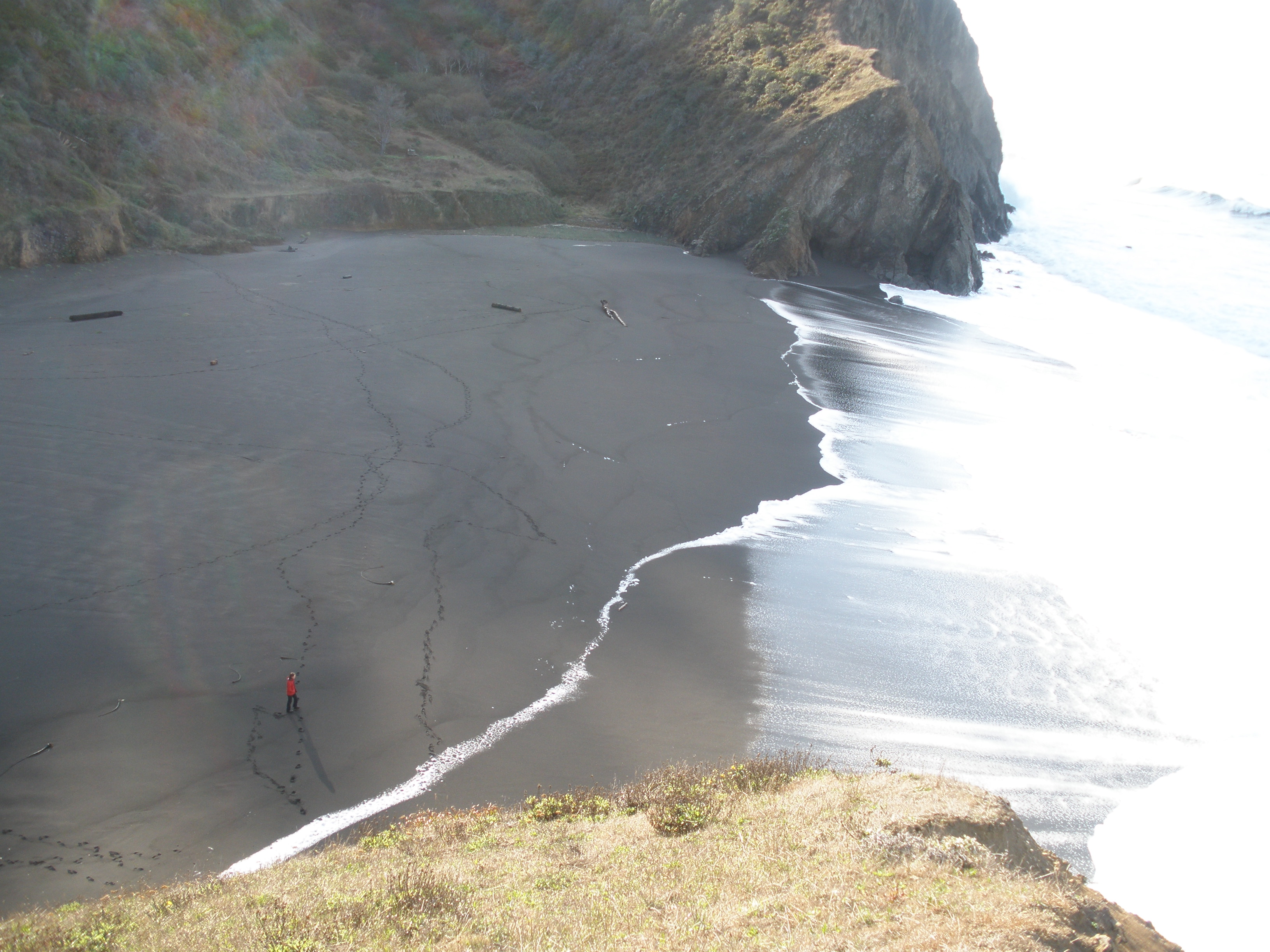
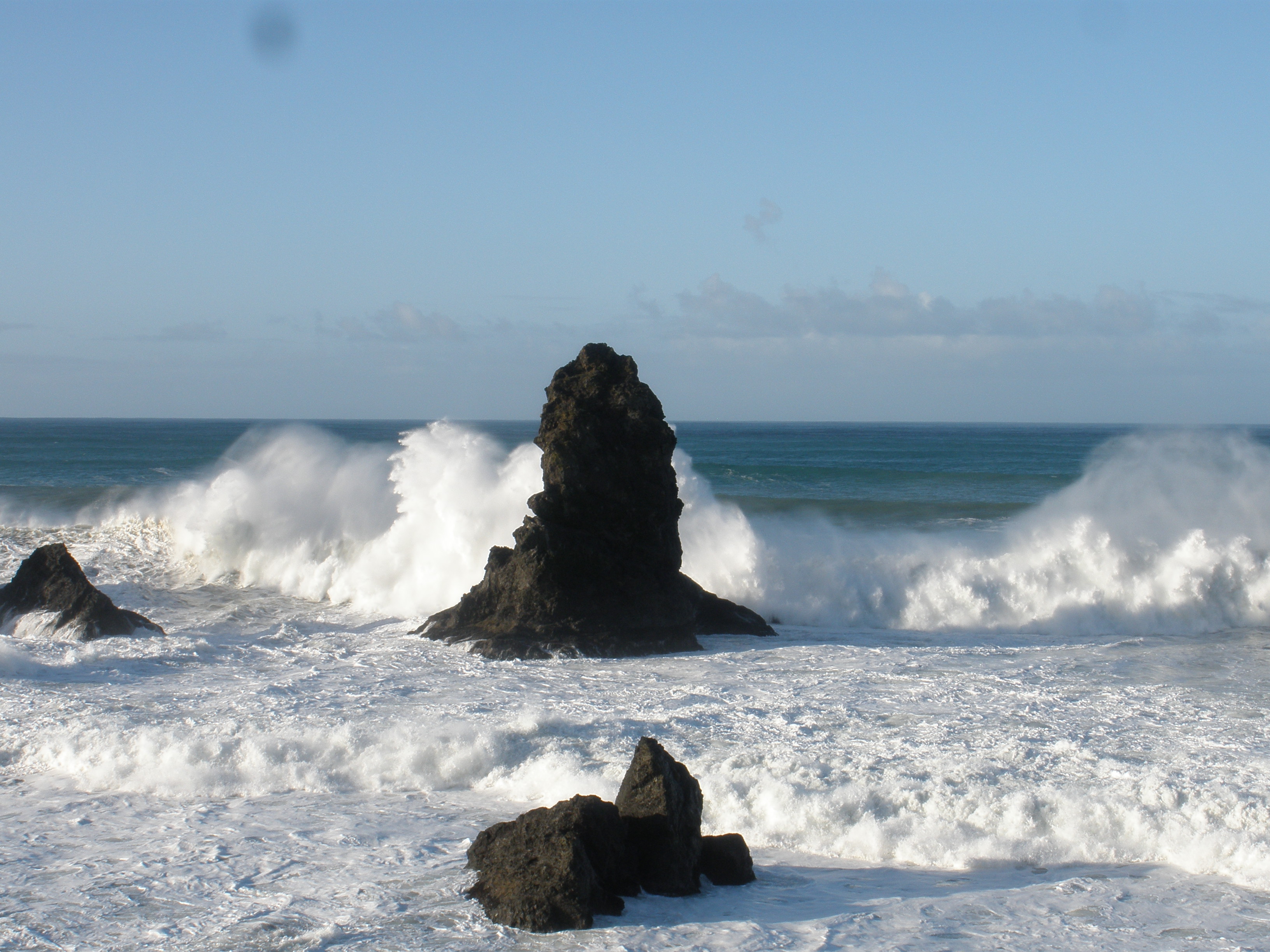
    2009 Lost Coast California

    I started down a path many years ago of trying to understand my mind, a need that arose out of necessity. I was mired in the past, in the future, in desire, in aversion, in uncertainty, analyzing, dreading, wallowing, churning, drifting, dreaming; all of this genuinely impeded my ability to lead a good life, to find peace and genuine happiness. My consciousness appears to need a constant stream or feed by its very nature, something that either comes from within or without. For years I ran from my mind into distraction through substances, through entertainment, through quite frankly anything that could occupy my consciousness, permitted me a momentary modicum of freedom. This type of escapism begins a misery generating cycle of its very own, one of never ending craving and aversion.

    It seemed to be an axiom from looking at the world around me that this is the way our minds work; that this is existence. I was living my life groping through a labyrinth after phantasmagorical carrots, until one day it all suddenly appeared Sisyphean and unbearable.

    On this day a strange journey akin to unraveling or slow dissolution began; it was not clear in the moment, but something broke in my mind. The initial question, the very moment in which something ruptured, sent dendritic and incisive questions echoing through my mind; questions that could no longer be contained, the opening of a Pandora’s box. In this moment I began palpate the labyrinth of my own mind for the first time.

    My own journey into the depths of my mind is exactly that; there is only a vague outline that can be conveyed through intellectual understanding, but I am going to write about a recent foray into my mind nonetheless.

    There are many avenues to explore the mind; altered states of consciousness and meditation seem to be the most incisive. There are many different conceptions of what mediation is, it may or may not involve the following: hovering; extreme suffering; abhorrent boredom; flowing robes; removal of all body hair; lighting oneself on fire; mental dissociation to the point of a dronelike existence; mindless acceptance of precepts delivered through a hierarchical structure, such as a cult; enlightenment to the true relation between mind and matter, permitting oneself to live a liberated existence; robe soiling ecstasy; indulgent Western self importance; dissolution of spaciotemporality and a consequent renunciation of all that is material leading to one living in a cave with unacknowledged colonies of spiders breeding in one’s arm pits.

    I remember the first time that I tried meditating seven years ago after delving into beat literature for the first time: I sat on the floor allowing my mind to range freely from small preoccupations such as looming assignments, an argument I had with my girlfriend, my lack of money before spiraling quickly into uncertainty regarding what I wanted to do with my life. My pulse quickened, my stomach knotted and sweat prickled my forehead before I arose with a panicked start, running away. Always running to the next thing.

    2009 Lost Coast, California

    There came a day when I was committed to a job and a life; I had to find peace within these confines. I had learned more about meditation, about the mind, in the years following my initial foray into idle sitting. I decided to start meditating seriously, to start a daily practice after reading a book entitled Full Catastrophe Living by Dr. Jon Kabat-Zinn written about the Stress Reduction Clinic and the Center for Mindfulness in Medicine, Health Care, and Society at the University of Massachusetts Medical School. There is a completely nonsecular field within traditional Western medicine, called Mindfulness Based Stress Reduction, a treatment used for terminal illness, chronic pain, addictions, anxiety, depression, hypertension, stress, psoriasis… many ailments that affect humans have been treated and seen positive results with MBSR. The approach is similarly practicable for anyone interested in living a better life, to anyone who would like to be more mindful of each moment, which should be anyone and everyone.

    The difficulties that I encountered previously were still extant, yet I began countenancing them for 45 minutes a day, regardless of what my life circumstances were, which often meant getting up as early as 3:30AM to sit in the cold, darkness. I was faithful with this practice for four months before it faltered with some job/life changes. My mind changed though; my stress evaporated; I found myself experiencing everything more richly; my food tasted better; I saw beauty where there was nothing before; I found myself living calmly and tranquilly; I found myself watching my mind in wonder rather than pursuing the same objects or sensations, a process that had become perceptibly futile.

    2009 Lost Coast, California

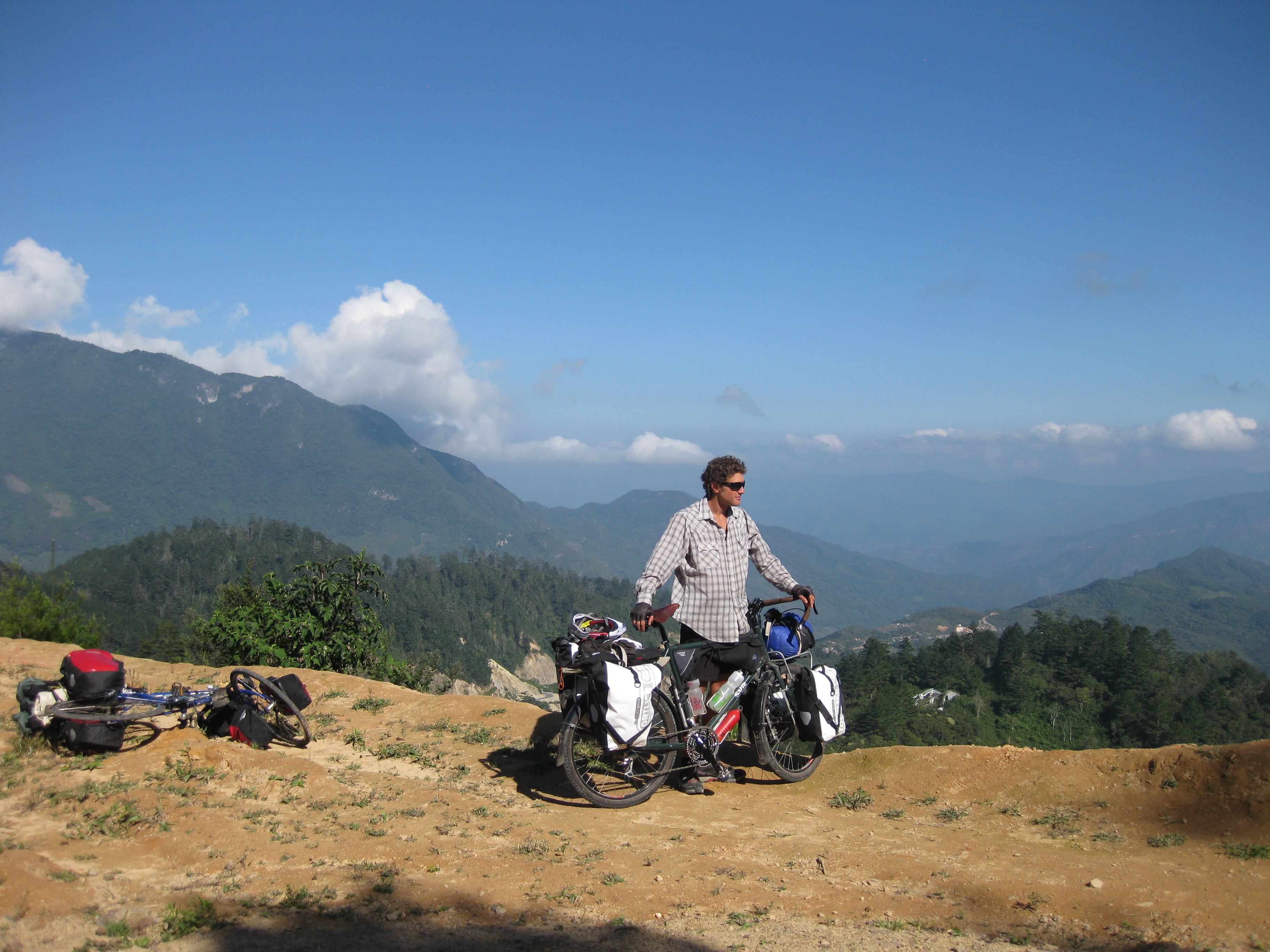
    Often times I have turned back towards meditation as a way to swim out past the breakers and look back at the agitated ebb and flow of my mind and my life, no longer unconsciously caught in the tumult. I found myself seemingly riding away from my life last November towards something uncertain. In the months before the trip I was looking forward to the idea of spending eight hours a day on my bicycle with my thoughts. The reality of meditation, whether on a bike or sitting on the floor, is that it isn’t always pleasant. Every memory, every possible future contingency, every relationship, every desire, every aversion arose over the four months I was riding. Everything disintegrated, again. I launched off in another direction.

    2009 Sam McDonald County Park, California

    I found myself in Guatemala perpetually ill from parasites, with a demanding job, a new relationship, dwindling money, and an uncertain future. A familiar darkness was assiduously creeping in from the sides, slowly blotting out the brightness of each day. I watched myself searchingly flailing. As I was riding through Mexico I met several people who had taken a ten day silent Vipassana meditation course, it sat there lingering in the back of my mind. I started my meditation practice again this summer and decided to register for one of the courses in Oaxaca de Juarez, Mexico.

    Vipassana International operates on a donation only basis teaching the meditation technique used by Gautama Buddha through meditation centers and courses organized around the world. Attendees of the course are required to refrain from any form of communication amongst themselves, but are able to question the assistant teacher regarding the technique or the volunteer coordinators regarding health issues or issues with the facility. Attendees are asked to forsake all religious practices, of any form, for the duration of the course. Attendees are required to stay within the confines of the facility. No electronics, books, or writing implements are permitted. The course is divided by gender. Ultimately, one is asked to accept five basic precepts and to work diligently within teachings of the technique for the duration of the course.

    1. To abstain from killing any living creature.
    2. To abstain from stealing.
    3. To abstain from sexual misconduct.
    4. To abstain from false speech.
    5. To abstain from intoxicants.

    The technique is simple in a sense, but complicated as it not something one can learn or appreciate through discourse; it requires work. The intensive nature of the course – 10 hours a day of pure meditation for ten days – is required to demonstrate the veracity of the teachings on a personal, experiential basis. The course, in its best light, merely offers guidance as one goes through a personal, yet surprisingly universal, experience of self exploration.

    The schedule:

    4:00am – Wake up call.
    4:30-6:30am – Solo meditation in hall or residence.
    6:30am – Breakfast
    8:00-9:00am – Group meditation in hall.
    9:15-11:00am – Solo meditation in hall or residence.
    11:00am-1:00pm – Lunch and rest.
    1:00-2:30pm – Solo meditation in hall or residence.
    2:30-3:30pm – Group meditation in hall.
    3:30-5:00pm – Solo meditation in hall or residence.
    5:00-6:00pm – Tea and rest.
    6:00-7:00pm – Group meditation in hall.
    7:00-8:00pm – Discourse on technique and Buddhist philosophy.
    8:15-9:00pm – Group meditation in hall or residence.

    The first three days are spent working with Anapanasati meditation, a form of breathing focused meditation used to prepare oneself for work within the Vipassana technique for the rest of the course. Both forms of meditation are essentially the cultivating mindfulness, of impartial, concentrated self observation.

    I looked forward to the course with nervous anticipation, seemingly preoccupied with the challenges that would arise to my current life, realizations that could disrupt the precarious balance of my life or the lancing of a heretofore latent misery that would begin suppurating…or something.

    We arrived at the convent where we would be imprisoned for the next ten days with roughly 100 strangers. I talked briefly met a few people before silence descended. The rest of this is a weird collection of jumbled observations and experiences from my addled mind.

    Day 1

    Cataract Canyon, Utah 2012

    The gong rings and I step out into a frigid and lightless desert morning. I feel like a boxer ready for a fight; this is a mistake. We have a 7m by 10m courtyard where we can walk, I pace under the star speckled sky before retiring into the meditation hall. The day passes in struggle as I try to maintain a rigid posture in half lotus with the piece of me that is asking why I am doing this, doubting whether I can, constantly redirecting my attention to my back and legs that burn ardently, and striving to quell the uprising of thousands of thoughts relating to life.

    Here the illusion of cohesive, flowing thought is apparent; for me it is a meaningless wallowing. There is no catharsis, no one directing, a shifting and muddled stream. I am deeply focused one second, shaking and sweating as I focus on the breath passing through my nostrils, and then a throbbing pain in my back grabs my attention and then a thought arises regarding a problem that I have at work which forks into questions about my future, which catalyzes questions about my relationship, which makes me wish I could talk to Lauren, which makes me realize these are going to be ten long days….My consciousness is easily diverted by this wayward thought that morphs into another and another. I feel my breathing quicken, the sweat run down my skin, my blood pressure rising, my stomach tightening. I bring focus back to my breathing assiduously as soon as I realize it has been lost, which sometimes takes a minute and becomes more difficult as the physical agitation seems to build and remain.

    Day 2

    2009 Wild Cat Ridge, Wasatch Mountains, Utah

    I stretch constantly each time I leave meditation. I pace in the courtyard wondering when or if the pain will abate. I fight through several sessions, waiting in quiet desperation for the gong to ring before sprawling out on the floor in release. I am aware that the very craving, the desire for the pain to cease is exponentially increasing my suffering. Minutes seem to endure for hours; time appears to be completely nebulous.

    There is one man who has bronchitis and coughs incessantly without covering his mouth; he is a challenge to my equanimity and meditation in many ways.

    Day 3

    The pain, although I have realized that the very notion of calling it pain is part of the problem, is more manageable. I am learning how to objectively view it and not let it drive my thoughts.

    I lay out in the courtyard in the afternoon, feeling the sun on my face. I focus on the sensation and it grows; it becomes stronger with each passing second until it almost overwhelms me. It feels like my face is on fire, I realize that the sun is on fire, it is on fire right now and then I get the urge to remind everyone by running around screaming ‘THE SUN IS ON FIRE!’ I lie on the ground chortling, imagining that everyone would completely lose their meditative state and equanimity, the retreat devolving into sheer chaos as everyone ran frantically screaming in panicked horror at the realization of the true nature of the sun. The afternoon is characterized by levity, everything suddenly becomes funny. I stop fighting and ruminating.

    Day 4

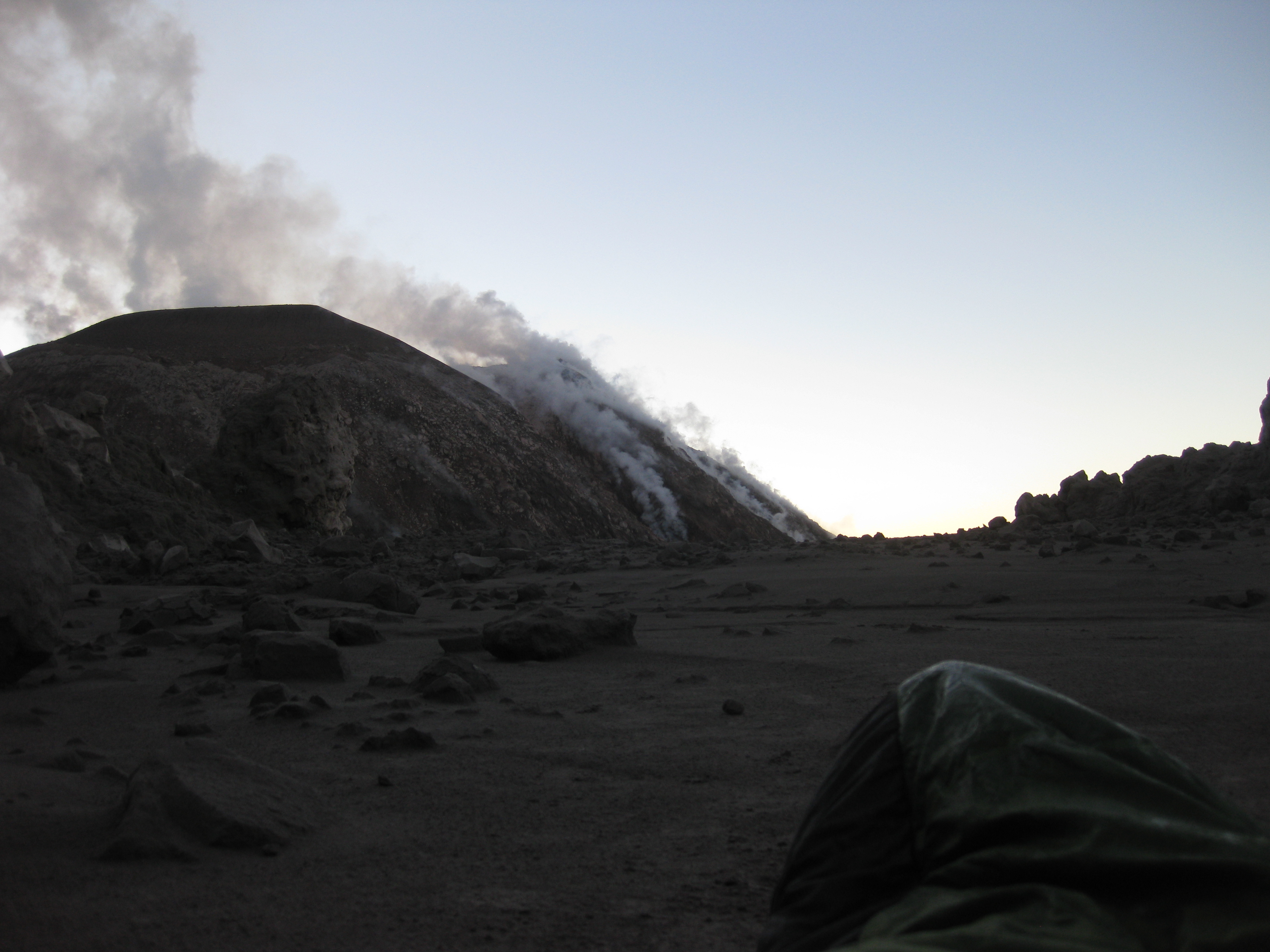
    2013 Volcan Santiaguito, Guatemala

    Vipassana meditation is introduced. The technique consists of learning how to objectively observe all of the sensations that the body is continually generating in every area where there are nerves. The theory: all thoughts are catalyzed by sensations, often times they never even enter into our consciousness as such rather only as thoughts generated as a byproduct. Our mind’s very nature is to react to these sensations, to characterize them as positive or negative. This process leads to the creation of cravings for positive sensations and aversions to negative sensations, our minds try to hold on to these sensations. The most fundamental law of matter is that it changes and therefore every sensation inevitably arises and disappears. Craving and aversion towards something constantly in flux leads to suffering. Through Vipassana meditation one can observe this process and begin to break this cycle through impartially observing sensations and the world around us in the proper light of change; to let it all arise and pass away.

    I lose my concentration for a long time in the afternoon as I intentionally fart as loudly as I can and then childishly laugh about it.

    Day 5

    The morning passes pleasantly, the pain completely disappears for half an hour or so and is replaced by a feeling of flowing energy throughout my body. I feel an immediate release as I understand this as some sort of breakthrough. In the afternoon I painfully realize just how perceptive the concept of craving and aversion really is, as the pain returns with the next sitting. I become preoccupied with it, my attention being pulled to the strong sensation. It gains strength and I am quickly mired in aversion to the pain and in frustration that the pleasant sensations of before have gone. The hours drag on.

    I suddenly see myself in the midst of this process. I take a deep breath and then the following dialogue happens in my head:

    ‘This pain feels like it is eating away at my soul, eating away at me. Maybe I should take a break.’

    ‘That is just the ego speaking, the pain doesn’t really exist, it isn’t going to hurt you. It will arise and pass, let the ego get whipped for a bit.’

    ‘Listen to you talking to yourself you fucking idiot!’

    Then I sat with a blank mind wondering where all of this comes from. You, me, I, ego, who, what? Where does this come from? Is there something cohesive behind all of this? I worry that I have begun a spiral into some sort of madness only previously experienced with drugs.

    Day 6

    2009 Sam McDonald County Park, California

    I work diligently. I pace in the courtyard in between meditation sessions thinking about the ego, the ego that drives me, this conception of Alex, this delusion of a cohesive person. I sum up meditation in my mind in the following way:

    ‘Meditation is you fighting with yourself until one of you gets tired.’

    My mind now easily remains concentrated for longer periods of time; it is losing its reactionary nature. I no longer wince in Pavlovian response to the ring of the gong. My breathing remains steady; I sweat less; there is no more shaking.

    Day 7

    My practice continues to deepen, time easily slipping away along with the dominion of the pain in my back. As this state reigns, memories freely rise from my childhood that have not surfaced in over a decade, from previous relationships, from friends and family lost, from the recessed folds of the mind. There is a slight melancholy with all of this as I feel like it all slipped away without me every appreciating it, without me ever knowing, and I can never have it back. Ultimately, I realize that I want to live more mindfully, more aware, more present with what I currently have in my life as there is nothing more.

    In the afternoon I am sitting and a mosquito passes my ear. I observe the following passing: I hear the sound of the mosquito passing my ear, which causes my muscles to tighten and my breath to sharpen, which gives rise to a negative thought regarding the mosquito, which derails my focus and simultaneously gives rise to other negative thoughts. I calmly return to my breath and then the sensations in my body.

    Day 8

    2013 Eggs in a Bowl, Xela, Guatemala

    I am sitting in the early morning meditation session, sitting in deep concentration. I am accustomed to feeling subtle sensations all over my body and this is generally what I experience. I am scanning up and down my body trying to feel sensation in every part. Suddenly I am observing myself rocking side to side, my entire body moving. Woah, what does this mean? Is this some sort of profound moment? Am I reaching enlightenment? Am I now a god? My attention shifts to the ground below me that is rocking, moving back and forth. I hear a distant siren wailing. EARTHQUAKE! I realize that everyone is silently running out of the meditation hall and I do the same. It is important to react to some sensations. This was the first earthquake that I have ever felt in my life, although I have been present for hundreds.

    As I lay in bed at night a beautiful particolored moth flies into the room and I watch its circles spiral in around the fluorescent light bulb dangling from the ceiling in the middle of the room. It frantically flies in circles around this singularity, careening into the bulb, likely injuring itself. Moths use what is called transverse orientation, which is using a bright fixed celestial object as a point of navigation. There essentially were no artificial lights until recently and their terrestrial location means that moths that are circling them perceive themselves as flying in a straight line. They are unable to see that they are flying in circles as they are inherently trapped within the confines of their perception. There is a profound concept here. I turn out the light.

    I wake a few hours later and the moth is beating its wings against the window above my head. I gently catch it in my hat and then release it out of the window.

    Day 9

    Each person will see a direct correlation between the effort that they put in and the progress that they make with the technique. I dedicate myself to working purposefully, earnestly for the entire day. My concentration builds throughout the day; I do not stop meditating when I take breaks; my mind is undiffused, fixated. I walk outside after one sitting and find myself staring unwaveringly at the wall until the gong rings again. I feel subtle sensations rippling through my body, there is no more pain. I still have constant proprioception and body awareness. I pass hours feeling them flowing up and down before moving onto sensations that are passing internally. I feel air passing through my trachea and into my lungs. I feel movement in my bowels, methane pushing through my serpentine guts. I feel behind my eyeball. I feel my inner ear cavity. I feel my heart beating and each pulse of blood drumming on my finger tips, on my cranium. I feel strange sensations throughout the inside of my body.

    Then the form to my body gradually disappears. I pass through my legs, my torso, my arms, and ultimately my head and they only exist as subtle sensation without form. I no longer have any awareness of the position of my limbs, of any sort of separation from the matter that surrounds me. There exists only some sort of indescribable faint sensation with no location. I am aware of this process as it unfolds, but it is not something that evaporates with this awareness. My mind is pure awareness; I sit with a blank mind for an indeterminate amount of time until the phrase ‘surgir y desaparecer’ begins repeating in my mind, appear and disappear. The gong rings.

    I perceive all of my possible lives. Not specific jobs, or wives, or houses, or places, rather where I will end up if I let myself be dominated by greed, by drugs, by lust, by fear, by hate. I see where these motives, if decisions are made over and over again with them in mind, will lead me; it is nothing but misery. I have a hard time sleeping.

    Day 10

    The pain returns faintly in the morning and I lose my strict adherence to the technique. I play with the sensations in my body and visualize the chopping of my body into small pieces or the amputation of limbs, sensations from these areas disappears as I do this. It is strange and amusing.

    After breakfast we will break the silence, something that I anticipate will not make much of a difference. I imagine everyone slowly coming back to life, some process of gradual reentry. Instead, the compound erupts with conversation and laughter the moment that we finish. I hear myself talking and it is loud, it vibrates and echoes in my ears.

    We discuss our experiences, our reasons for being there, what we have learned. I have never discussed my feelings before with a group of 40 year old men.

    Summation

    2013 Sierra Mixe, Oaxaca, Mexico

    This is my life. This is my insane mind.

    We have nothing but the actually moment that is passing; the past is exactly what it is and the future will soon be as well. This is not a trite expression exhorting Dionysian dissolution; it is quite the opposite. I am earnestly expressing an idea that I have circled around like a moth around a lightbulb for years. It could be artificial light, but it seems real to me. Through cultivation of moment to moment awareness, one can be aware of all that is passing within one’s body, everything exterior, and how this relates to the past/present in order to mindfully make decisions that enrich the series of moments and sensations that our minds artificially string together into a cohesive narrative that we call our life. We can learn to live in and appreciate the present, which is ultimately all that we have.

    Our moment to moment decisions are the footsteps determining the direction of the path that we walk, the one upon which we look back and project into the future. Wisdom is being aware of how these decisions are made and being able to perceive where they will ultimately carry us.

    I emphatically believe in meditation, travel, education, conversation, essentially in challenging oneself and one’s values continually, as a means to cultivate mindfulness, nonjudgement, renunciation, and acceptance in our daily lives. The exercise of these virtues is taught by most philosophies and religions as they are recognized as a means free ourselves from the suffering created by an existence in a material world that is morally neutral, in constant flux, and ostensibly devoid of purpose. In each of our lives we currently embody these ideals to varying degrees.

    I would recommend a Vipassana course to anyone who is interested in meditation or living a better life, but I feel the need to attach several asterisks. Vipassana teaches a universal concept, but situates it in context that, despite all of the proclamations to the contrary, is dogmatic and secular. The most damaging dogmatic concept is that one can only reach ‘enlightenment’ or ‘freedom’ through strict adherence and practice of the principles of Vipassana. There is the presentation of many Buddhist concepts as truisms that are wholly incompatible with other religions, despite claims to the contrary. In one sentence the founder of Vipassana International will rail against ritual or rites, but will staunchly adhere to esoteric and culturally relative concepts such as never pointing the bottoms of your feet towards the place where your teacher sits, regardless of whether the person is there at that moment. There is chanting in Pali, a dead and therefore inaccessible language for the layman, at the beginning and end of every group meditation session; chanting to which the majority of the people chant ‘sadhu’ three times in blind obedience and acceptance. It is no longer presented as something universal in this form; there is absolutely no reason that the teachings cannot be completely abstracted from Buddhism and religion in general. Approach it with an open mind; take what you like and throw away the rest.

    Start learning about yourself, about your mind, about humanity, about existence. As far as meditation and the mind goes, accept nothing that cannot be self realized. The only reason to mediate is that it will improve your life, if this is not the case, then don’t do it.

  • The Reality in the Rows

    There are several sentences in this paragraph that need to be set to the Fresh Prince of Bel Air theme song. Now this is the story all about how my weekend got flipped, turned upside down and I’d like to take a minute, just sit right there. I lay in bed on a Saturday morning, relishing the sunlight angularly splayed across my bed. My phone rings, I spring up and quickly answer it. I had anticipated this call as the night sky over Quetzaltenango erupted with dendritic shafts of lightning and a long anticipated deluge of water. I pick up my clothes off the floor and stuff papers into a backpack and run into the street, headlong into the maize planting season in the communities around Suchitepéquez, Guatemala. I whistle for a bus and as it comes near the windshield says “Lopez” and it has Jesus  in the mirror. If anything, I could say that this bus was rare. But I think nah, forget it. ¡Oye vos a Reu!

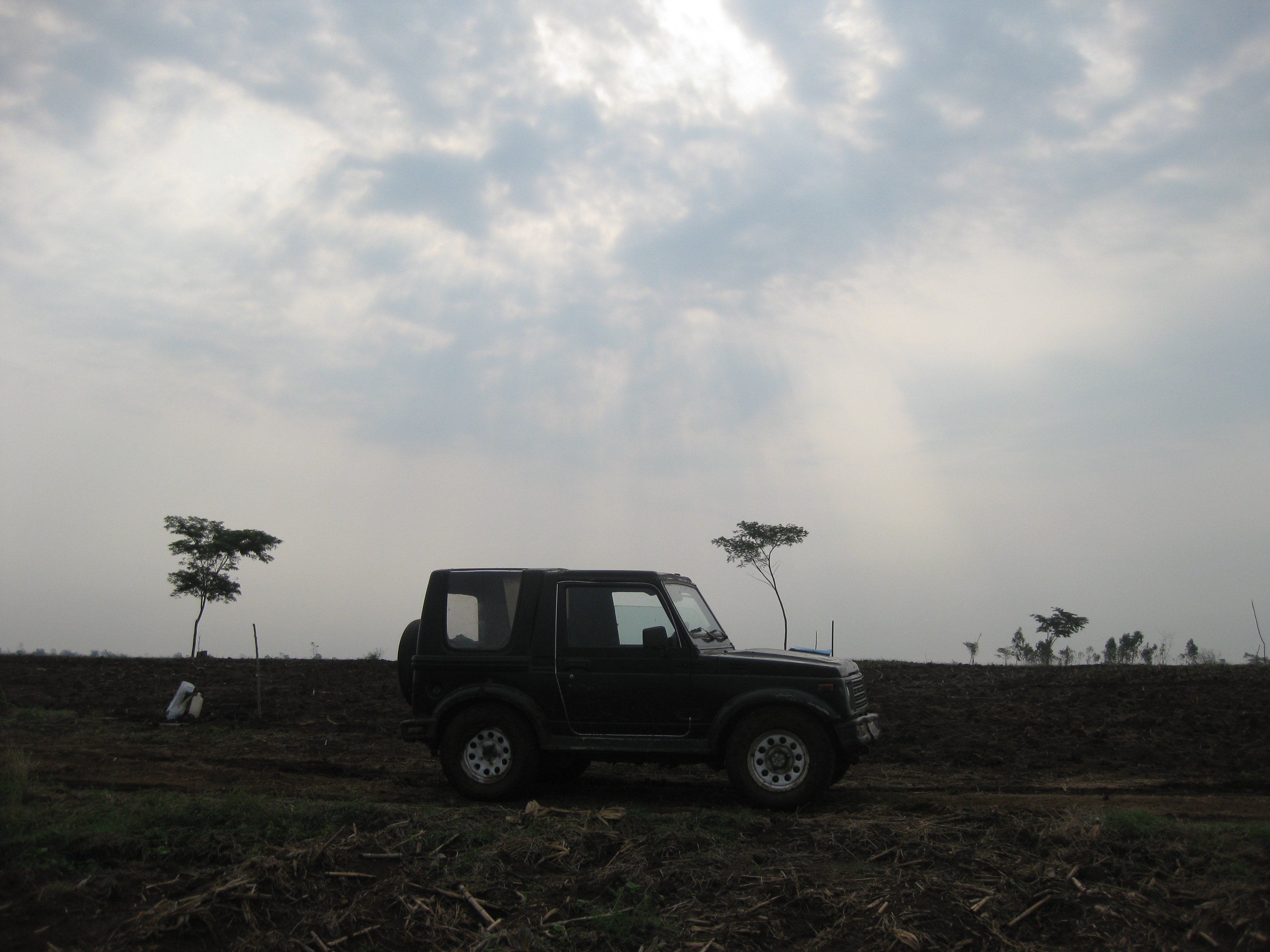
    My curly hair expands outward as the magic school bus slowly immerses me in the coastal humidity. I get dropped off by the bus a kilometer shy of the mechanic’s shop where I will pick up the old champion of a Suzuki that I use in the field. I am walking against traffic in frustration until I hear someone shout:

    ‘Gringo!’ from across the road.

    He runs to the curb with a mango in each hand. We stare at each other from across the road until there is a break in traffic. I run over and he hands me the mangos.

    ‘Por el camino.’ For the road he says through a smile.

    I begin a pothole dodging drive, occasionally spraying rusty water out to the sides as the road itself becomes one large, unavoidable pothole. I shout out the window occasionally at teenagers on mopeds;  there is no time for patience when it comes to agriculture. A slate blanket of clouds smothers the fallow fields; men walk with purpose carrying machetes and hand hewn planting sticks.

    I pass through Cuyotenango, prostitutes lean and leer from cantina doors in the early morning. A drunk pauses as I approach, staring into my eyes, the whites of his eyes cast against the backdrop of the brilliant blood pouring down his face. Nobody else seems concerned.

    I currently work for a farmer to farmer organization that works with smallholders farmers on the Guatemalan Pacific coast to improve agriculture, livelihoods and food security through small scale experimentation. Farmers in this area of Guatemala, Suchitepequez and Retalhuleu, generally plant maize (corn) and sesame in soil depleted from years of intensive cotton monocropping that proceeded the land grants that occurred during or after the civil war. Sesame is planted purely for export, and maize for both sale and consumption. I am planting two different varieties of maize with the farmers that are nutritionally superior to the varieties that are currently planted in this region: Quality Protein Maiz and ICTA Maya. Farmers in this region traditionally only have access to information regarding seeds, chemicals, pests and weeds from rarely seen government officials or self-interested representatives from Monsanto or Disagro. We are trying to offer an alternative: I have collaborated with 15-20 farmers to set up small experiments on their parcels with the aims of introducing them to the experimentation process and these varieties of maize. We have been through the process of measuring and marking the experiment in the field; I am rushing to the coast to assist with planting to both monitor their experiments and to take part in the ritual.

    I rattle through the shady tunnel created by a finca of Palma Africana; the symmetry is both beautiful and disgusting. My feeling is similar with regard to the strange smelling water that hits and cools my face from the sprinklers that line the roadside. I try to make it out to the field of Paula Jimenez in 2wd, but I am quickly mired in deep, slick mud as farmers knowingly snicker as they pass on bicycles. I wade out into the mud and lock the hubs, before emerging in a spray of mud.

    I park the car before one daunting pit where a horse drawn cart wallows. I proceed on foot. I arrive late to Paula’s field, something that I see as a positive cultural adaptation to Guatemala on my part. I watch the farmers wander their fields, barefeet caked in black. I quickly come to understand the custom as I suddenly feel quite Dutch as my shoes are transformed into four inch clogs. I measure and remark an already planted experiment and make plans to return the following day to finish the planting of Paula’s field.

    The day is fading quickly and I need to find somewhere to eat, somewhere to sleep and then be back here before 6am. I pass by a few other homes on my way out of town to check up on planting plans, navigating roads riven by rivulets. I eat five empanadas on the roadside, situate myself in the municipal building of a small town called Lupita and cool myself by dumping bowls of water on myself under a constant cacophony of grackles.

    I sit reading Breakfast of Champions by Kurt Vonnegut under a single dangling lightbulb as I am assailed by mosquitos. In amusement I read, ‘Kilgore Trout once wrote a short story which was a dialogue between two pieces of yeast. They were discussing the possible purposes of life as they ate sugar and suffocated in their own excrement. Because of their limited intelligence, they never came close to guessing that they were making champagne.’

    I hear a polite knock on the screen door and Daniel, Treasurer of the local development organization, pulls up a chair. We talk about the organization where I work and the challenges that Guatemala faces. Daniel explains the history of the village: Lupita was founded 17 years earlier by refugees returning for Mexico as the Guatemalan Civil War drew to a close in 1996. The founders came from indigenous communities in the highlands: Quiche, Quetzaltenango and San Marcos. There are still six different languages spoken in the community. The community has benefited from a high degree of organization, despite the cultural diversity. Community organization here is synonymous with agricultural organization; this has allowed the town to prosper through coordinated development projects.

    Daniel sums up the government development and agricultural extension programs that visit the town by saying the following: ‘They love talking, but hate to get their boots dirty. We learn in the fields, we learn by doing. They pass out sheets about how to do technical things, like make organic fertilizer, to people who cannot read, then a farmer tries to do it and it doesn’t work because they didn’t understand how to apply it because it was never demonstrated. Everyone then thinks that organic fertilizer doesn’t work. It happens all of the time; I don’t even want to ask the community to gather for trainings or meetings from the government anymore. The people have no confidence in them and most of the time just hope to receive free fertilizer.’

    ‘How should an organization try to help people and make lasting change here?’

    ‘You should work closely with a few people that can create good examples. Show us what you’re talking about, show us the benefits. I went to university and studied agriculture, came back, and then tried to convince my father to try using organic fertilizer. He wouldn’t . If I showed him how to do it he might try it, but how does anyone expect to show up as an outsider and convince anyone of anything with words? You need to build trust and a relationship with the people and then they will listen to you.’

    Nuevos Bracitios, Suchitepéquez, Guatemala

    I wake up to the same raucous cackling, the intensity increasing as dawn nears. I throw my things in the car in a somnambulant daze and take off. The sky is light as I park in front of the house belonging to a friend named Catocho in Nuevos Bracitos. I slap him on the back as he mixes his seed with a treatment to combat pests, a neon yellow substance called Blindage, with a grin on his face. We sit down for a bowl of black beans and deep yellow tortillas made from a native variety of corn. Catocho and his wife were brought together, in my mind, by one defining and hilarious mannerism: they scream to communicate. They will shout at you from across the table about a mango or to offer you a delicious, cold drink.

    Catocho began working in the cotton fincas at the age of six years old, something that was normal in the 1970s. He grew to be a man who is constant motion and energy, words coming out of his mouth in torrents punctuated with laughter. He is off to an early start today, spinning tales of bad harvests and about the time they accidentally planted all of the rows maize diagonally. Everyone is in high spirits; there is an energy in the fields and houses that is a release after months of anticipation.

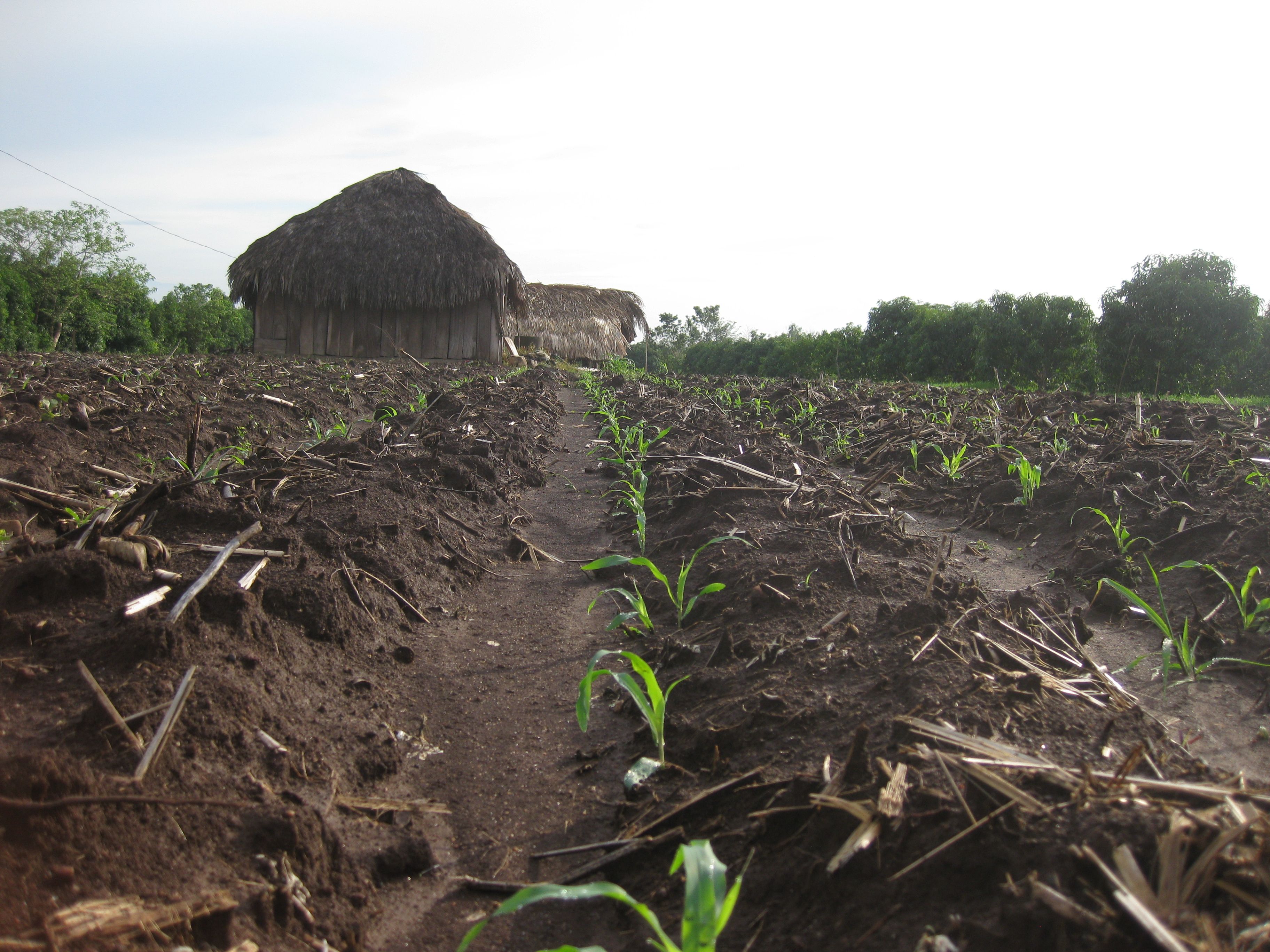
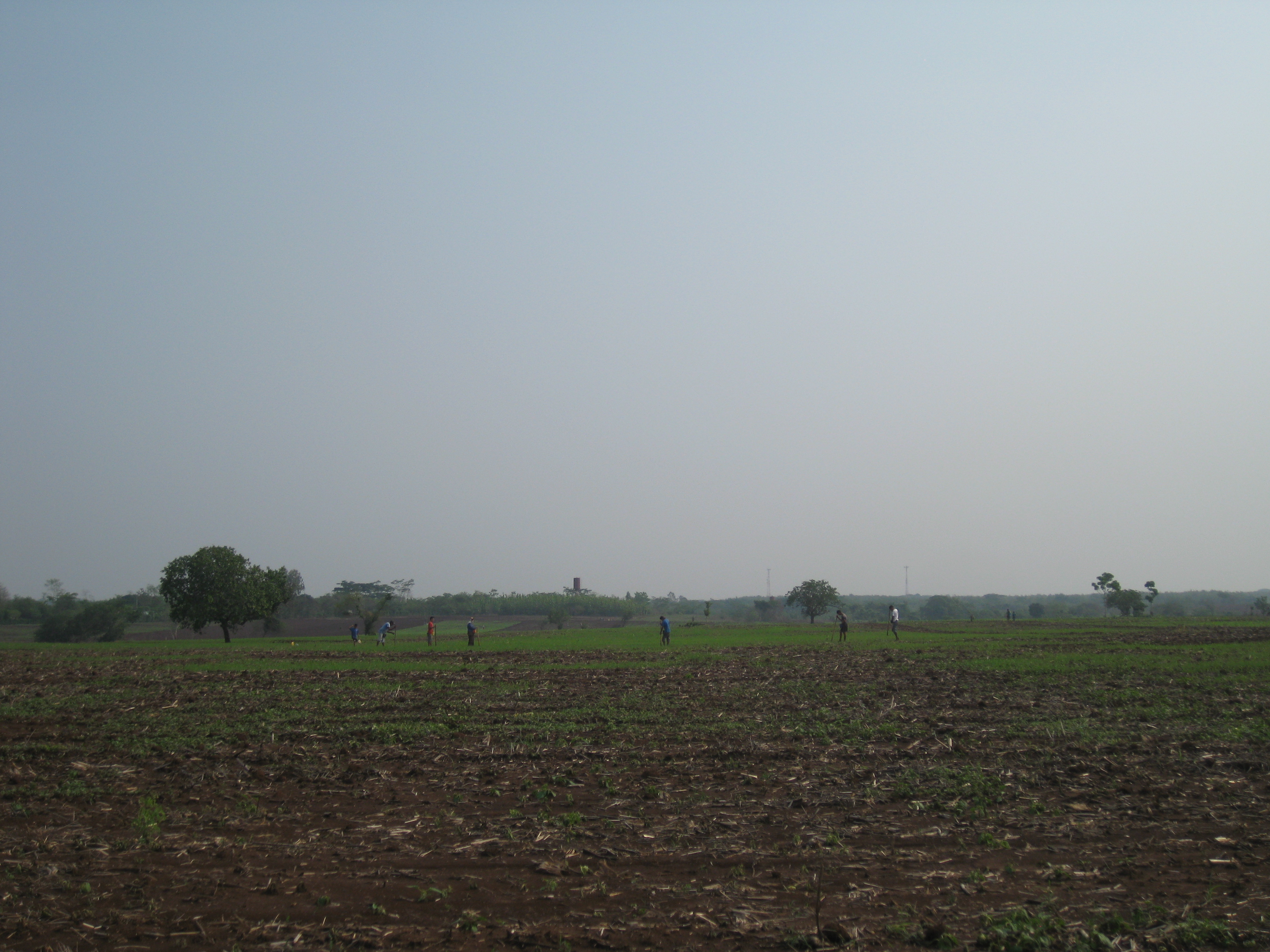
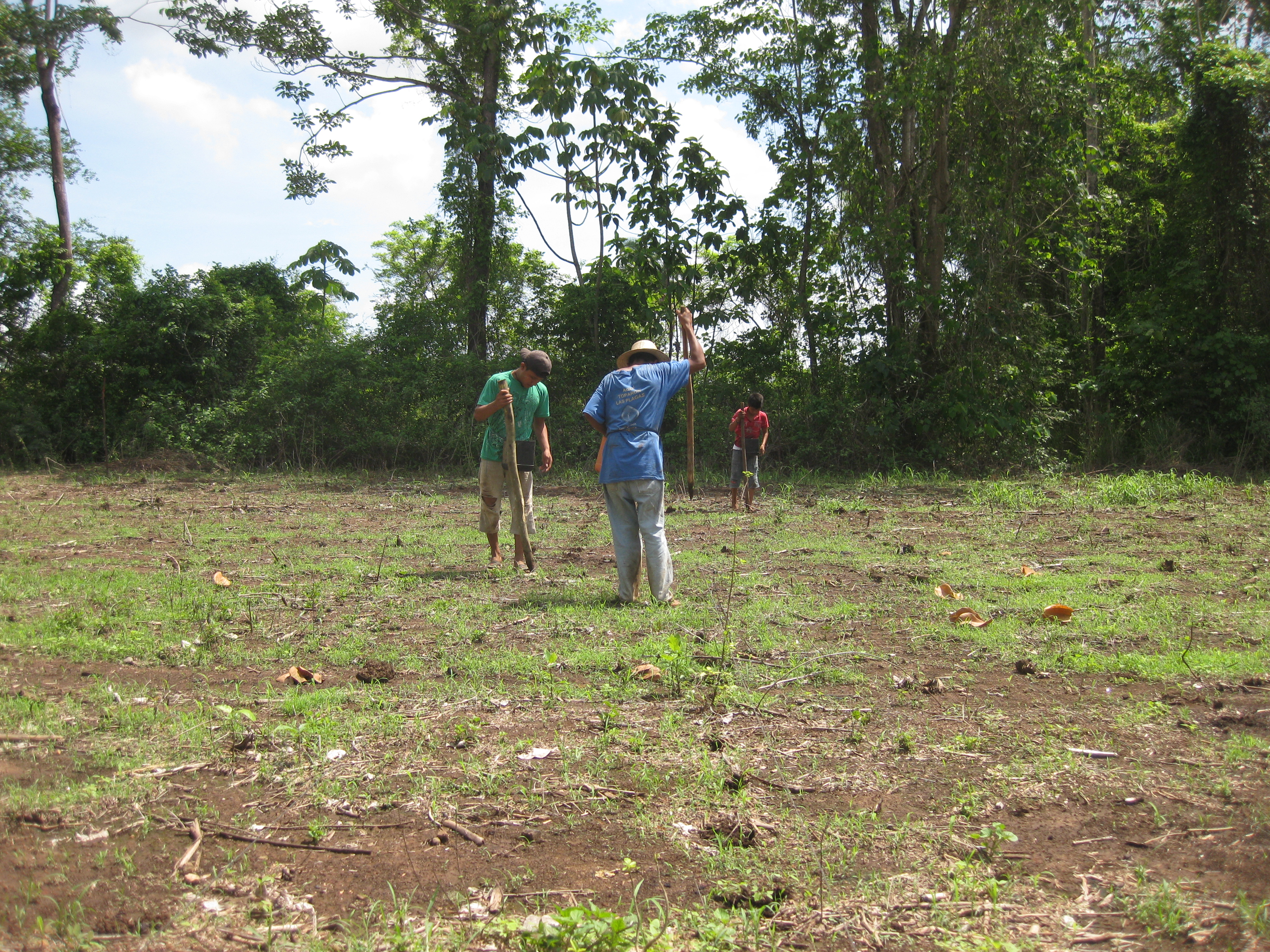
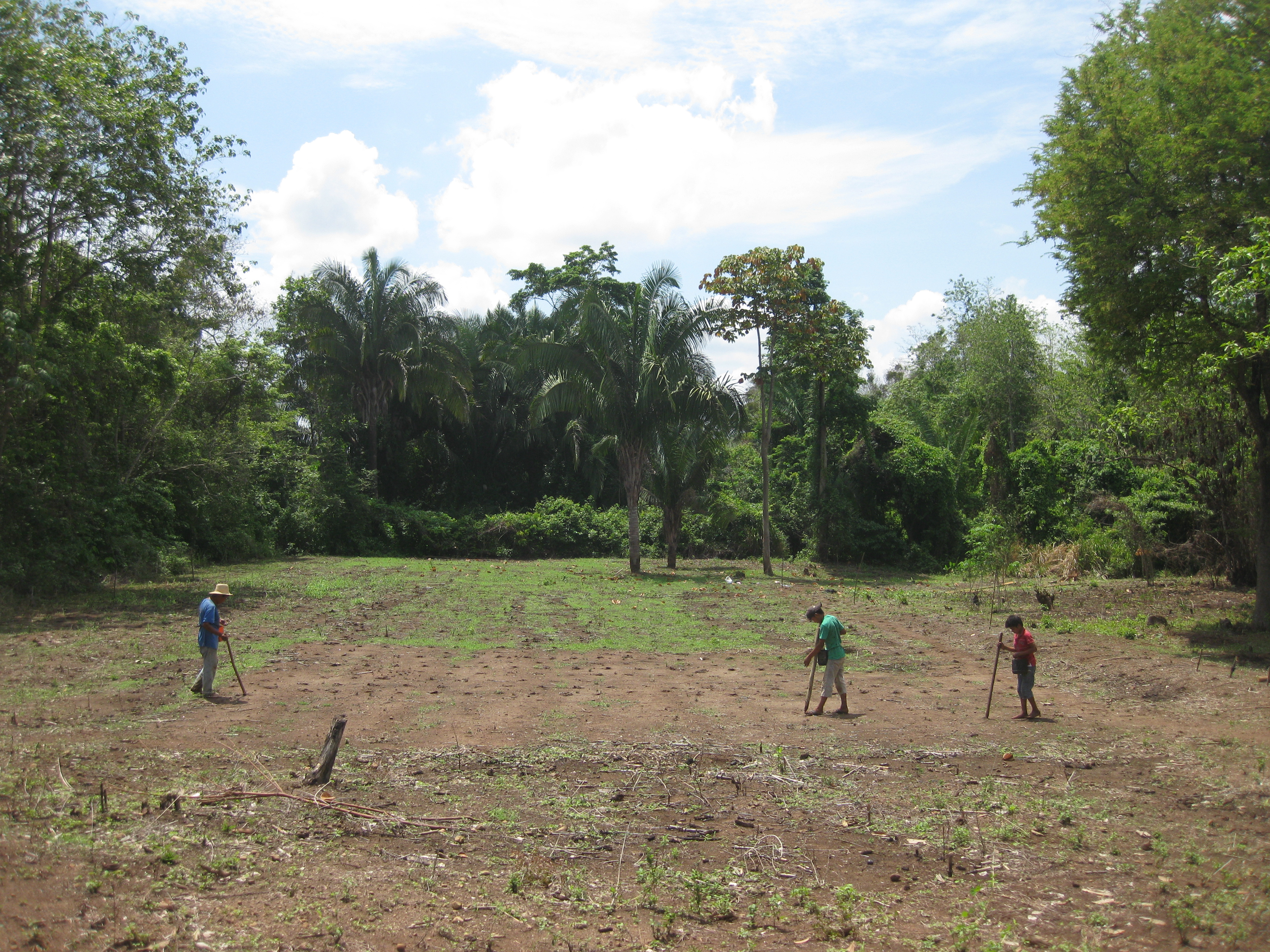
    The fields in every direction are filled with men, women and children thrusting planting sticks into the ground made soft by the rain. They expertly cast two kernels into each hole before gently covering it.  I  measure several parcels, help plant one and then head out to help Catocho. I leave the car at an impassable mudhole and walk through the fields with my machete, a few sticks and some twine. I pull off my shoes and fill up a plastic container that I sling off my hip with seed.  We plant seed that will yield hundreds of pounds of food nourished by the sun, rain and soil…..well and copious amounts of chemicals. The fields are  littered with colorful plastic bottles from frequently fertilizer and pesticide applications, the water in one puddle glows bright blue. The poor soils and imbalanced ecosystem here have lead to an unhealthy reliance on chemicals, both economically and physically, to yield a decent harvest.

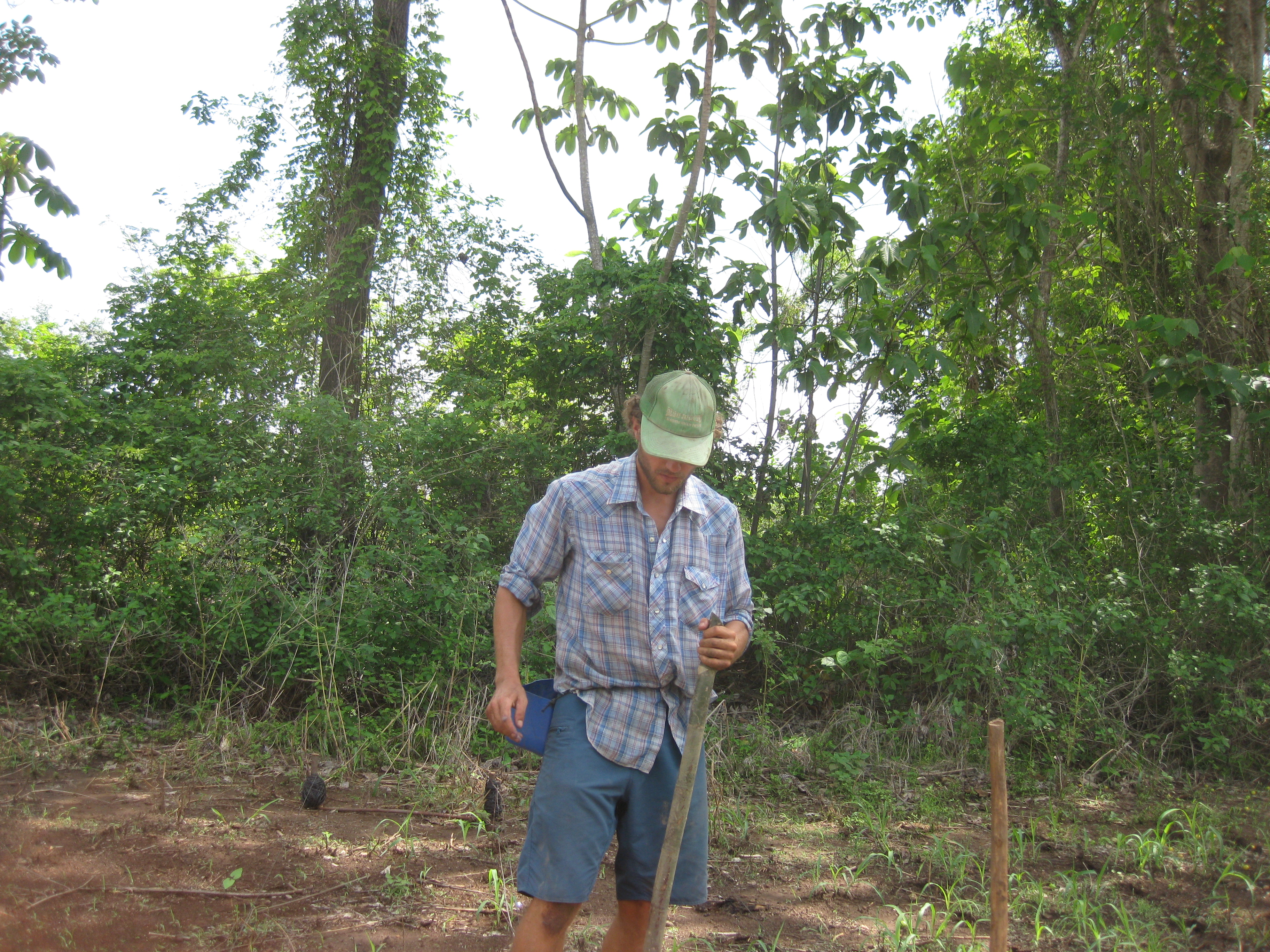
    We work silently, each in our own row. It is a meditative exercise for me; Catocho talks on his cell phone and still plants quicker than me.

    ‘I didn’t hire anyone. I just have one slow gringo.’ He looks over at me grinning.

    After planting, we head back to Catocho’s house to eat lunch. Catocho quickly bathes and changes before we sit down to eat. His wife Gaby has set the table beautifully, in keeping with the auspiciousness of the day.

    I check up on a few more parcels before Humberto, an agronomist with whom I work, and I rush out towards Conrado de La Cruz to mark a parcel there, racing against the fading day. Mango trees line the road, holding the last of the season’s bounty, much to my dismay as I often pick mangos out of the car window for lunch. I get out of the car at one point and wade out into a flowing stream,  which comes midway up my thigh, to make sure it is passable. I think that I learned this from Oregon Trail. I shrug at Humberto and he grins before plowing the truck into the chocolaty flow.  The fan slaps the water and the truck billows steam as it roars through the waterhole.

    Linea A-13, La Maquina, Suchitepéquez, Guatemala

    The rains are late here.  A-13 falls within the ‘dry corridor,’ something that local belief holds to have resulted from severe deforestation. I pass the following week in waiting, clouds perpetually looming in the distance. I mark parcels amidst the smell of rain and rumbling in the distance. I ask all of the farmers if it is going to rain and they always answer optimistically while looking at the sky.

    The week passes without rain. On Friday morning I am awakened by a soft blob bludgeoning me in the face, interrupting my slumber in a bed made of straw.

    ‘What the fuck!’ I shout in confusion in the pitched black, windowless room.

    I frantically grab around my face to confront my assailant. I grab a roughly textured, cool blob that takes both hands to corral before it urinates on me. I toss it on the floor.

    ‘What is it? What was that?’ Humberto inquires in concern from the floor where he lies.

    ‘A toad!’

    ‘What did you do with it?’

    ‘I put it on the floor.’ I start laughing.

    ‘You mean where I am sleeping?’

    ‘Yeah.’ He starts laughing as well.

    To this day it remains a mystery how this toad got into the room, how it got onto the bed, how it gained enough force to bludgeon me from above with substantial force. There is simply no way realistic explanation. I briefly harbor suspicions that maybe Humberto is responsible, but I dismiss them as paranoid.

    The one thing that I think that I, along with every witch or shaman, would agree upon is that this is a sign that it will rain today. I check a few more parcels and then wait. The sky unleashes a torrent all over Southern Guatemala that night, setting in motion the last round of planting.

    The sky is clear, the cones of the volcanoes idyllically hang over the fields as the farmers plant a crop derived from a grass thousands of years ago; a sacred ceremony under volcanoes that have been shrouded in clouds for months. I plow through puddles once again, frantically answering phone calls regarding planting from all directions. I visited planted parcels in the morning and then plant all afternoon. Stab, throw, step, cover.

    I eat dinner with Humberto at a family’s home in a town called Willy Woods. We repeat a ritual that keeps both of us contented in the field: eating stacks of ember toasted tortillas in Rosaura’s smoke filled kitchen. Chickens, a cat and a few puppies mill the room. I snicker to myself as Rosaura always makes noises at them and softly yells at them to get out, but never actually does anything about it.

    The following morning we rise in the darkness to canvas different areas. I check two experiments before arriving at Cirilo’s house in A-13. We treat the seeds with a different neon blue treatment and then start planting with his sons; the four of us work two different rows, each one starting at an opposite end. We quickly shift the ropes and my inefficiency shines.

    ‘Let’s go to Los Angeles.’ Cirilo declares in jest.

    ‘Why? Do you want to plant corn there?’

    ‘No, I want to see the skyscrapers.’

    ‘I think we should go plant corn there instead.’

    We finish up and scrub the pesticides off of our hands.  I decapitate a coconut and devour a mango, filling my beard with orange flesh. I get into the car in excited exhaustion, chickens and iguanas scatter as I clatter and clunk down the dirt roads of A-13.

    What awaits these people? It is a question that is increasingly tied to the question of what happens to us, to the earth in general. The problems that Guatemala currently faces have not arisen overnight, but they are increasingly more apparent and exacerbated by our interconnected world. Inequality, resource scarcity, expanding populations and environmental degradation are universal problems that cannot be contained by borders, yet we live within an economic and political order that is currently structurally unsuited to deal with complex, global problems. I feel that, as individuals, we are left with several options:

    1. Live in a solipsistic world and deny the reality of these problems.

    2. Defer to some other hypothetical man’s infinite ingenuity as justification for personal inaction. To look towards technology as a solution to the problems that technology causes.

    3. Recognize the reality of these problems.

    • Do nothing in despair/perception that one’s locus of control is limited.
    • Make mindful choices in your personal life each day to try and create a better world.
    • Actively work to create a better world using increasing interconnectedness; economically, socially, politically, informationally; to foster a counterbalance to these externalities.
  • The Strong Protect the Sweet

    I have ridden my bicycle through Mexico and through Guatemala, learning about where our food comes from as the panorama passes and through conversations with farmers on the roadside. I have slept in corn fields, cow pastures, below apple trees and in the wild. I felt seen the trees, grasses, stalks and vines. I have met the sinewy, tired, wrinkled, tough, proud people who tend them. I became strangely interested in agriculture and today I find myself interviewing farmers on the Southern coast of Guatemala with the intent of helping a sustainable agriculture organization learn more about the communities where they work. I have spent weeks so far swinging in hammocks and reclining in the shade as I try to capture their story. In my spare time I climb mango trees and gorge myself, unsure whether my stomach pain is from too many mangos or parasites. I consistently fail at resisting the delicious cold beverages made with well water that consistently leave me running to the bathroom.

    Here is generalized profile of a campesino (small farmer): A small landholder, with 1-3 manzanas (1.72-5.16 acres)  through land grant or a lease, that farms maize (corn) for consumption and sale and sesame for export. The typical diet here revolves around beans and tortillas, with occasional garnishes when they are affordable. Farming is the sole source of income for the family (occasional family members contributing through remittance payments from the United States or by working on palm, banana or sugar plantations). The agriculture in this region, due to the poor quality land of the land received, requires a substantial amount of inputs in the form of fertilizers, pesticides and herbicides. Incomes have risen through yield increases that reflect an increased intensification of agriculture through the heavy use of these inputs and hybrid seeds adapted to their use. Money is borrowed from banks, money lenders or input distributors to finance the agricultural process at usurious rates. A succinct summary of their felt need: economic development, a healthy environment and a path forward for their children. It sounds relatively similar to what much of the rest of the world desires.

    The connection that farmers here feel to the land is difficult to fully grasp for anyone from a culture that is disconnected from the land, as is typical of much of the industrialized world. The culture of Guatemala today grows from agrarian life, which is rooted deeply in the land itself. Virtually all strife within this country can be traced back to land, especially the 36 year civil war that ravaged the countryside before ending in 1996. Here is one rant from the coast, one of many that I hope to share. It is a rant because I am not sure if I know how to assimilate all of these things that I am feeling and trying to understand into a coherent narrative. We live in a complex world. Here is where sugar comes from:

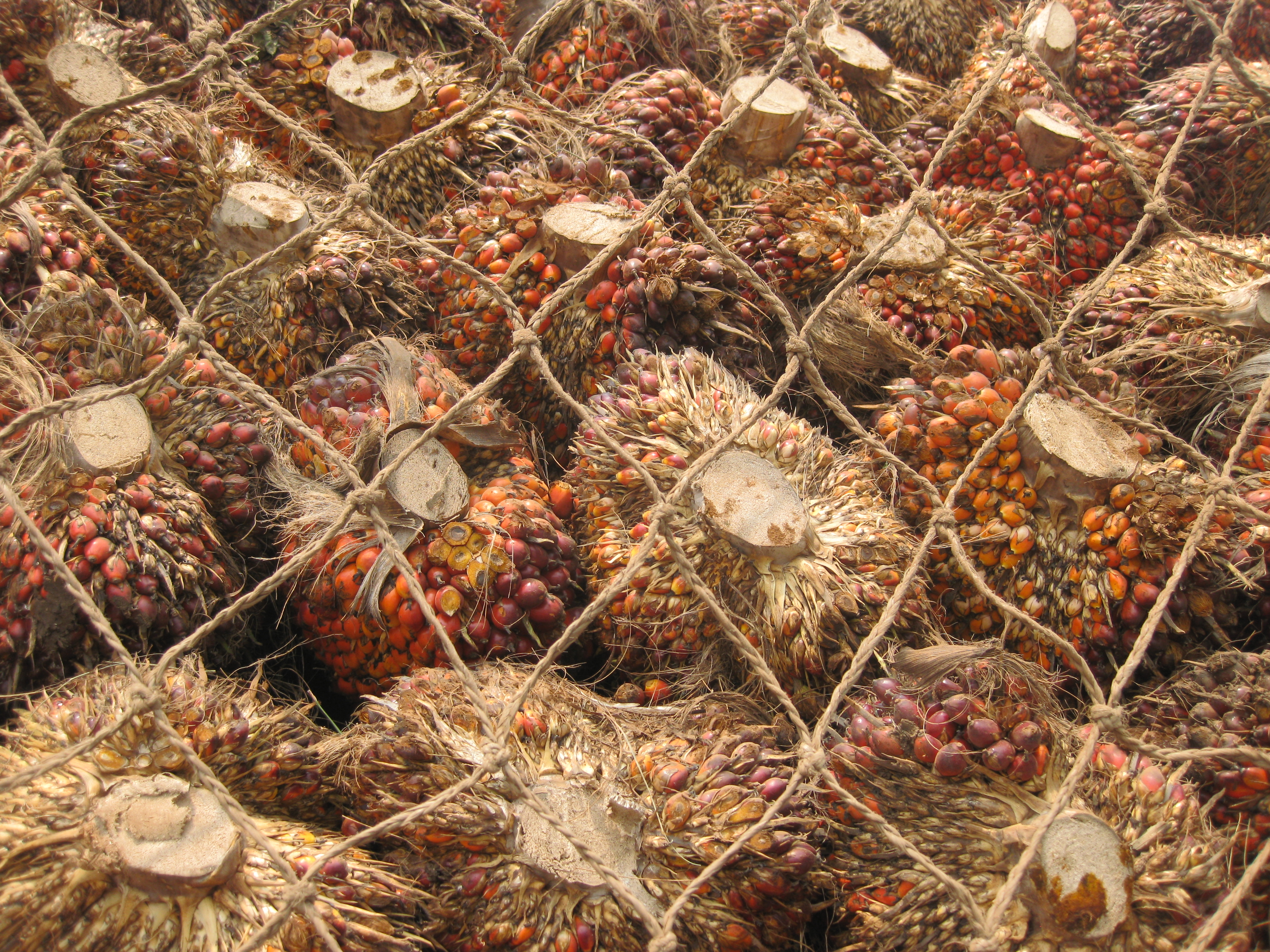
    Palma Africana

    Land ownership in Guatemala has a markedly skewed distribution: 2.5% of the country’s farms control 65% of agricultural land, while 88% of all farms, with an average size of 1.5 hectares, occupy 16% of the land. Approximately 40% of the economically active rural population does not own land. Along the South slope this distribution is reflected at ground level in expansive plantations that produce valuable export crops that can exploit the cheap cost of labor and the simple spreads of the cheap labor. The primary export crops produced on a large scale are: palm oil, sugar cane and bananas. I spend my days weaving through potholes and inhaling dust as I navigate the endless and confusingly homogenous landscape on my way to small communities sometimes only known by a name like A-13 or Calle 2.

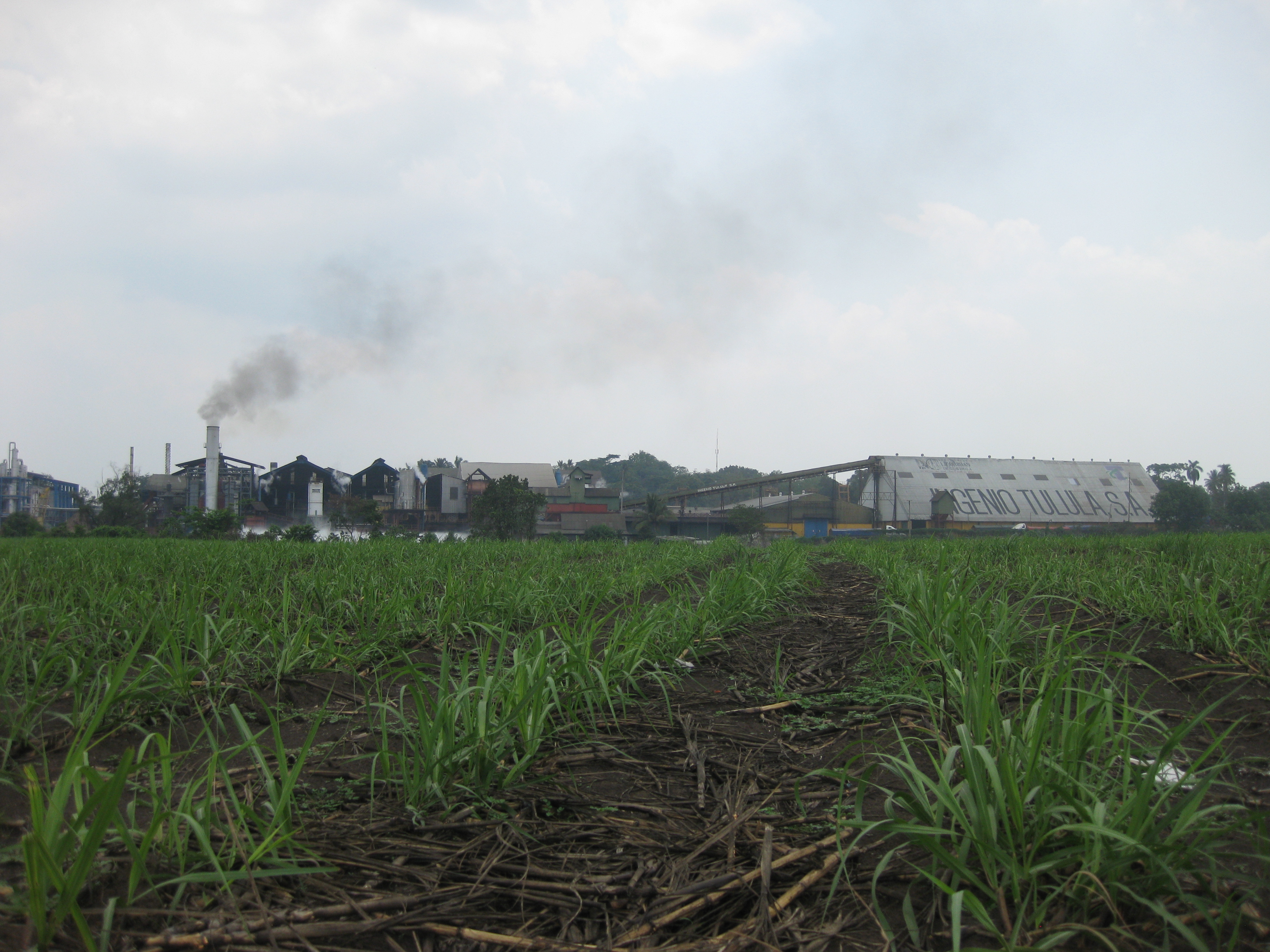
    Sugar processing facility with cane in the foreground.

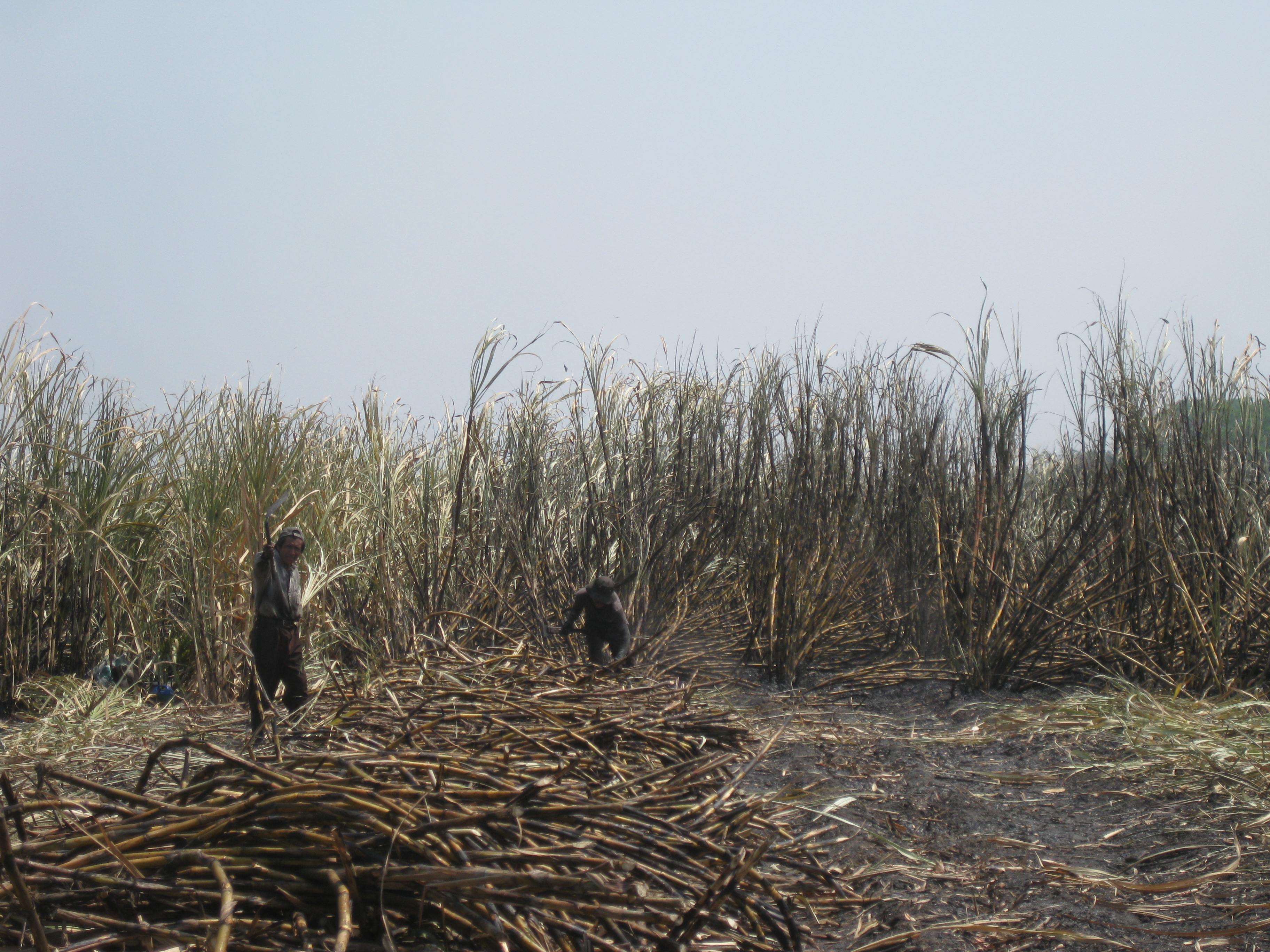
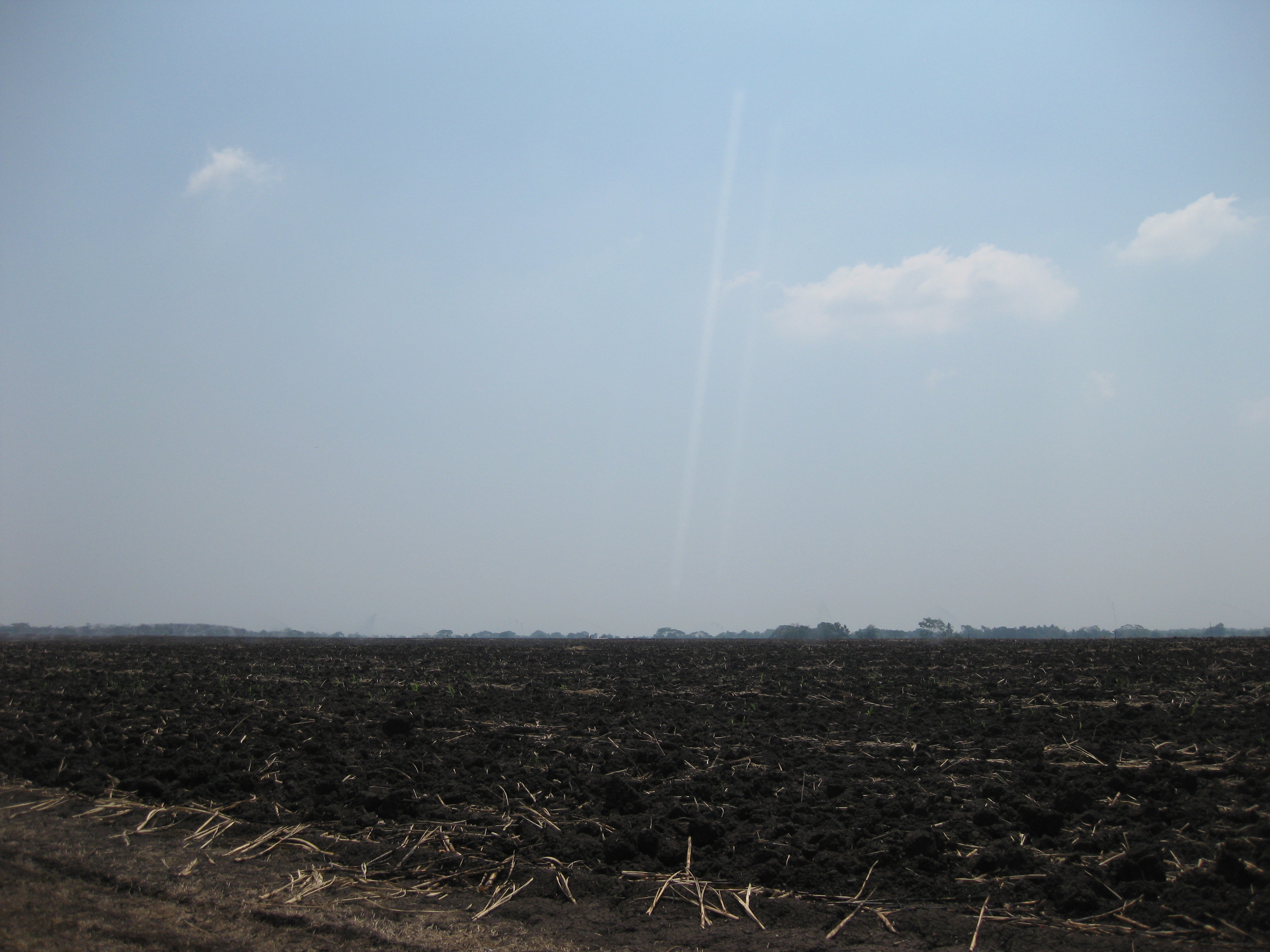
    After spending the week in La Montana speaking with farmers, I am driving the wife of a friend of the organization to the market in Retalhuleu. The air is sweet with the smell of burning sugarcane, a smell that has permeated the coast for months, one that I will never forget. I keep the truck in second gear as Graciela and I jar our way down roads ruined by overloaded semis stacked high with cut cane as white clouds streaked with black smoke billowed on the horizon. Many men and quite a few kids walk the scorched earth and cleave their way through hellish rows of blackened cane with machetes, their faces and arms swarthy with ash stuck to the sweat that runs in the midday heat. The machetes seem disproportionate in size relative to the kids.

    Workers cutting cane.

    “How old are those kids in the fields?” I ask Graciela with a grimace.

    “Some are as young as 12. Most of the kids whose parents cannot afford to send them to school start working with their fathers on the plantations.” Graciela readily responds, her tone seemingly not adequately reflecting how sad and strange this reality seems to me.

    Sugarcane is tall grass native to South Asia that has been cultivated for thousands of years. The production process in Guatemala occurs over the course of a year. The sugar cane is irrigated and left to grow on fields maintained clean through heavy applications of herbicides. After it reaches maturity, the fields are set on fire to remove the parts of the plant that are not used in the production process. This step significantly reduces manual labor costs. The cane itself is then manually cut and loosely piled into semis that are bound for nearby processing plants, as the cane loses sucrose with the passage of time. The canes are pressed to remove the cane juice, which is then processed and refined into the product completely devoid of nutritional value that we are all familiar with.

    We pass fields of sugarcane kept radiantly green during the dry season through extensive irrigation that drains the earth with large motors pulling from wells over 30 meters deep. Many farmers have mentioned that their wells have run dry as the water table is has been consistently dropping since the sugar cane plantations arrived with advanced machinery in the past five years. A well 8-10m deep is no longer enough.

    Planes hum overhead before they disappear in self-produced clouds of chemicals. The planes are dropping what is called a maldurativo, which is used to artificially ripen the cane, but has the additional effect of destroying the fruit on neighboring farmer’s land. Several farmers have spoken of mango trees dropping small unripe mangoes and of lime trees producing nothing. One of the few farmers growing vegetables in an area suffering from a very imbalanced diet decided not to plant tomatoes this year as it is too risky with the effects of the maldurativo.

    The way in which plantations affect the area is part of a global economic problem afflicting thousands of campesinos. An interaction between various variables feed a cycle that appears to be without end. Maize is not a high value export crop, thus the value generated by a hectare is low relative to palm oil, bananas or sugar. Maize is life in Guatemala. Maize and sesame prices have been increasing in recent years, which has provided some gains for farmers, but this is offset by many other factors.

    Input costs are rising. Rents are increasing. The land is degrading. In general the costs of life are increasing in this area, as are expectations related to quality of life.

    A small farmer has the advantage of exploiting his own labor and that of his family to increase profitability, but this decreases with additional land, rendering non-mechanized agriculture at a scale more than a few manzanas not very profitable. The economic analysis that I have done in conjunction with the survey paints a bleak picture with no clear path forward. The long run is more challenging as land is expected to be divided amongst children, which deepens the situation created by a lack of land and resources. Many campesinos are now forced to work on plantations to supplement their income or to pay down debt.

    After the harvest.

    Is this just the process of development? The transition of rural labor into industrial labor? Not all jobs that are created equal: the plantations only hire laborers that are aged from 12-25 years of age from what I can gather. The jobs are almost entirely low value manual labor that entails toiling in the fields for punishing hours every day. After just a few years many of the workers are exhausted, leading the plantations to only hire young workers.

    After age 25? There are no other jobs other than on the plantations or producing maize and sesame; there is no apparent or bright future for these kids in the fields. The viability of sustaining a family producing just maize and sesame appears increasingly difficult. This cycle is not new, but it is worsening.

    Conflict

    I spend a week in Calle 2 outside of Retalhuleu. I am interviewing, Don Pedro, a boisterous man who spins tales from the hammock about the civil war and the time he spent working in the United States. He swats at dogs and throws objects at chickens as they cluck and strut around us. He tells me about a strange farm in South Carolina where he worked only picking small cucumbers many years ago. He doesn’t know why. I think about it for a second and start laughing.

    ‘It was a farm for pickles!’ I realize.

    He tries grins with the teeth he still has and repeatedly mispronounces pickles as he laughs. I finish the interview with the following question:

    ‘Is there anything else that you want me to add?’ I ask randomly.

    ‘Well, yeah there is one thing that maybe you guys could help with since you know people in the government.’

    ‘Sure. What is it?’

    ‘Well, my brother just called me and he works in irrigation at the plantation up the river called ‘La Virgen.’ They plantation just dammed the river that runs behind the house to irrigate, el Rio Espanol. They did this a month ago with a larger river and we blocked the highway for several days before they removed the dam. Can you call anyone you know and ask for help? This can’t keep happening.’ He asks timidly.

    ‘Let’s go see the river.’ I am incensed.

    We hop on bicycles and pedal hard down singletrack trails to the river; the level is low and it is barely flowing. I shout down to a woman washing her clothes in the river who confirms that something is wrong.

    ‘Where is the dam? I want to go see it.’

    ‘Let me call my brother.’

    …..

    ‘There are four men guarding the dam right now with shotguns. I don’t think it is a good idea for you to go there right now.’

    ‘Well we need to do something. They aren’t going to do anything unless you take action like before. You should block the highways again.’ I am indignant, the Western American urge to kill for water rising in my veins.

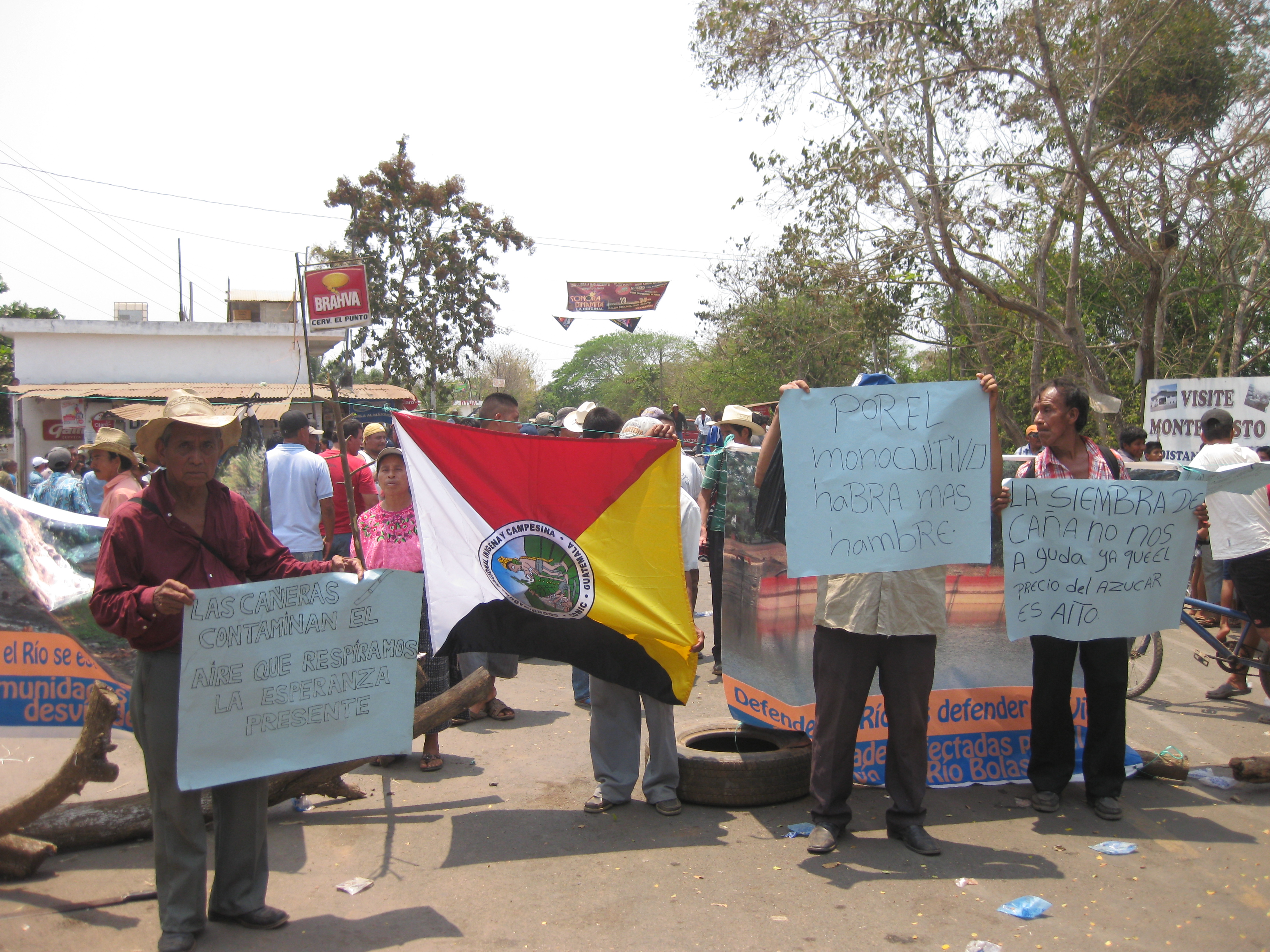
    ‘The sugar plantations pollute the air we breathe..’
    ‘For monoculture there will be more hunger’
    ‘The planting of sugar doesn’t help us, the other cost is high.’

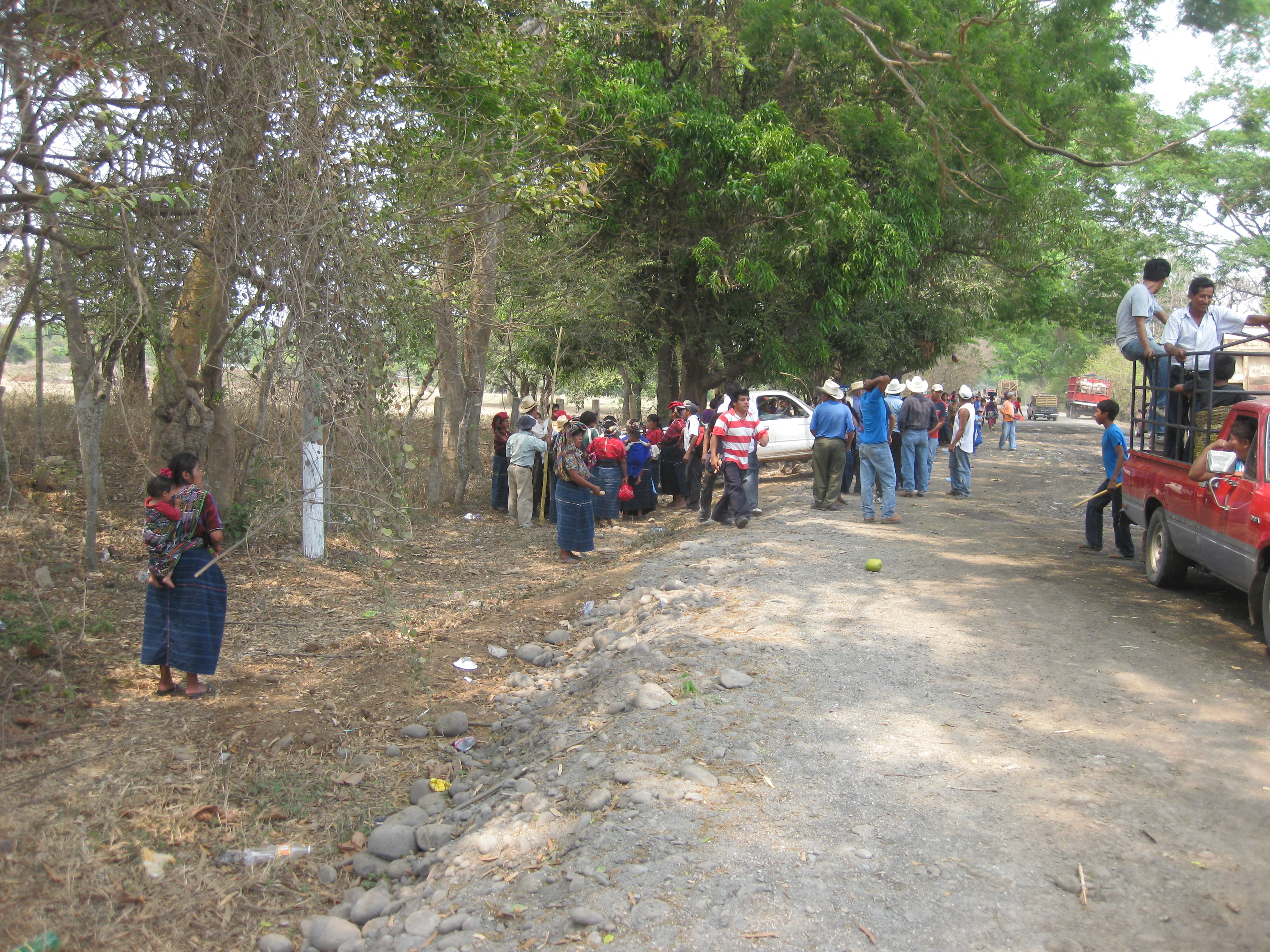
    We set out early for Xela after interviewing a few more farmers. We received word that the road is blocked, but decide it is worth the effort to try. We flag down a pickup truck that is carrying a few other passengers to carry us to the first roadblock. I get my wish: as we approach a mob comes screaming and running towards us brandishing clubs. Angela and I sit uneasily in the back of the truck as they hit the outside of the truck and force the driver to stop and turn off his vehicle. Eventually the mob subdues and returns to the blockade. The road is blocked with logs, rocks and several banners declaiming the campesino’s quandary. A woman is screaming loudly, the kind of desperate and angry wail that brings tears to my eyes. We talk with several of the protestors who explain to me that the protest is about more than simply the river being blocked, it is about air quality, it is about the roads, it is about their future. The plantations expect to expand several thousand acres in the next two years according to one of the protest organizers.

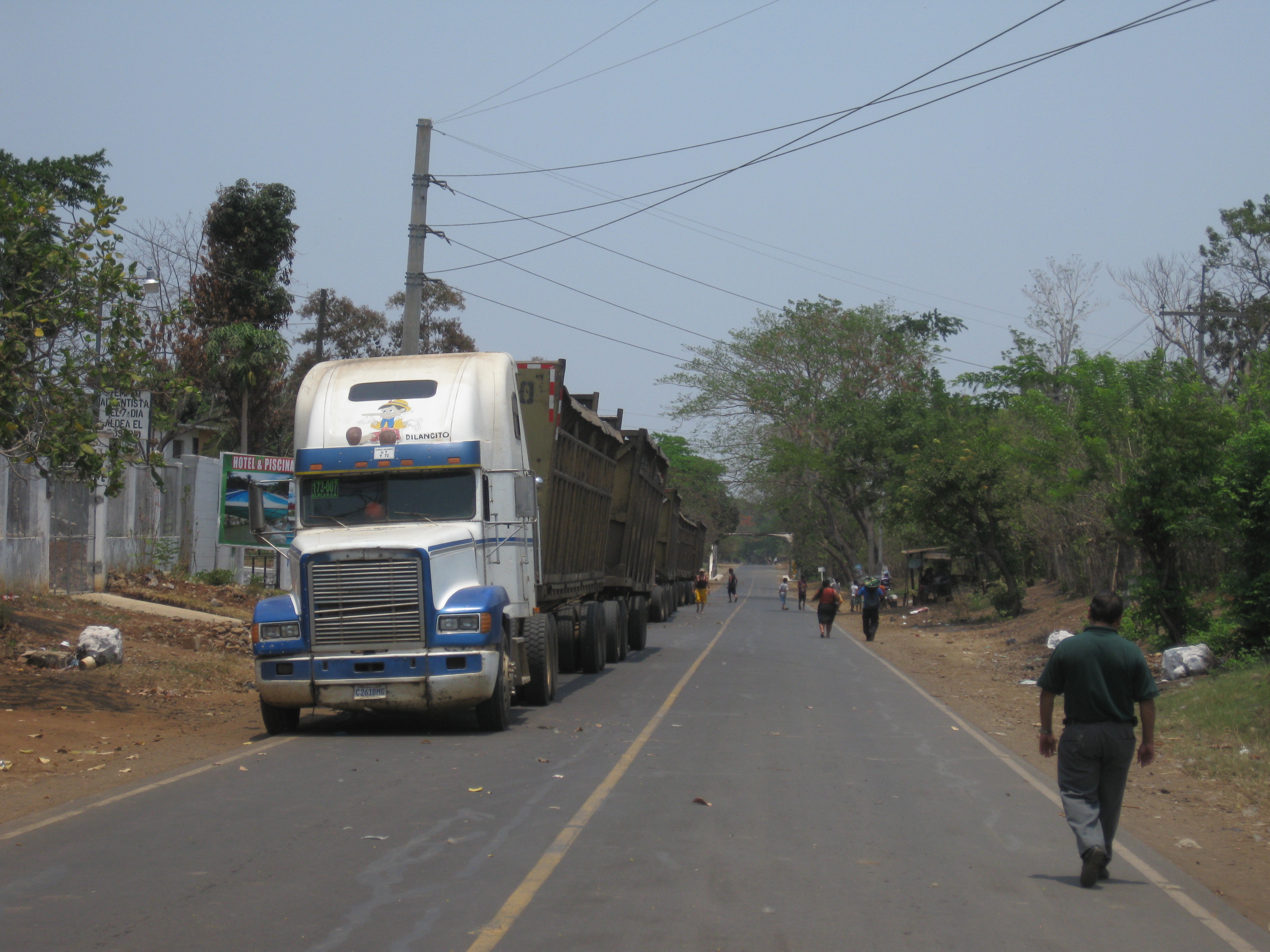
    Sugar cane trucks.

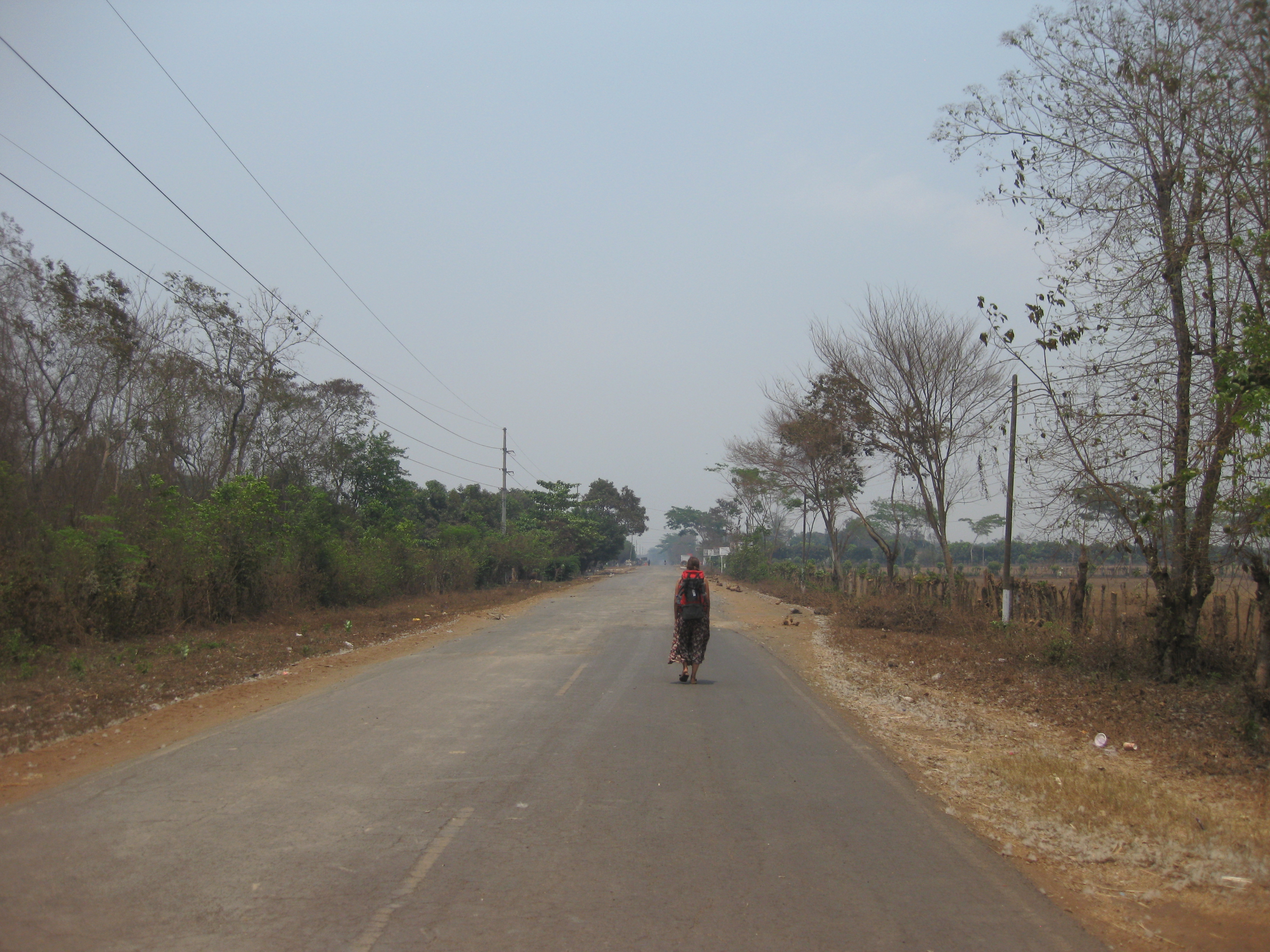
    We set out walking in the heat, past lines of parked trucks from the sugar plantations. I feel like a scab. The highway is filled with pedestrians. We stop and chat with other people walking, we buy a watermelon from a family selling fruit on the roadside and eat it on the spot. One pickup truck carrying mangos hits a speedbump and a few fall out the back, I pick them up and feast. It is beautiful.

    Angela walks a desolate road.

    We arrive at the second roadblock after walking and catching rides for a couple of hours. We arrive at the second roadblock as the protest is breaking up.  A government bureaucrat makes incredibly vague conciliatory remarks while surrounded by police, ending by saying there will be a dialogue between the government, the plantations and the campesinos the following Friday. Women stand barefooted in the audience staring with eyes wizened by decades of the same rhetoric. The sugar trucks lurch back into action and we catch an old schoolbus back to Xela.

    The protest breaks up.

    The fight continues. I receive word the next week that the roads will be blocked again as the government, nor the sugar plantations, made any concessions. Unfortunately change does not happen unless it is forced to happen.

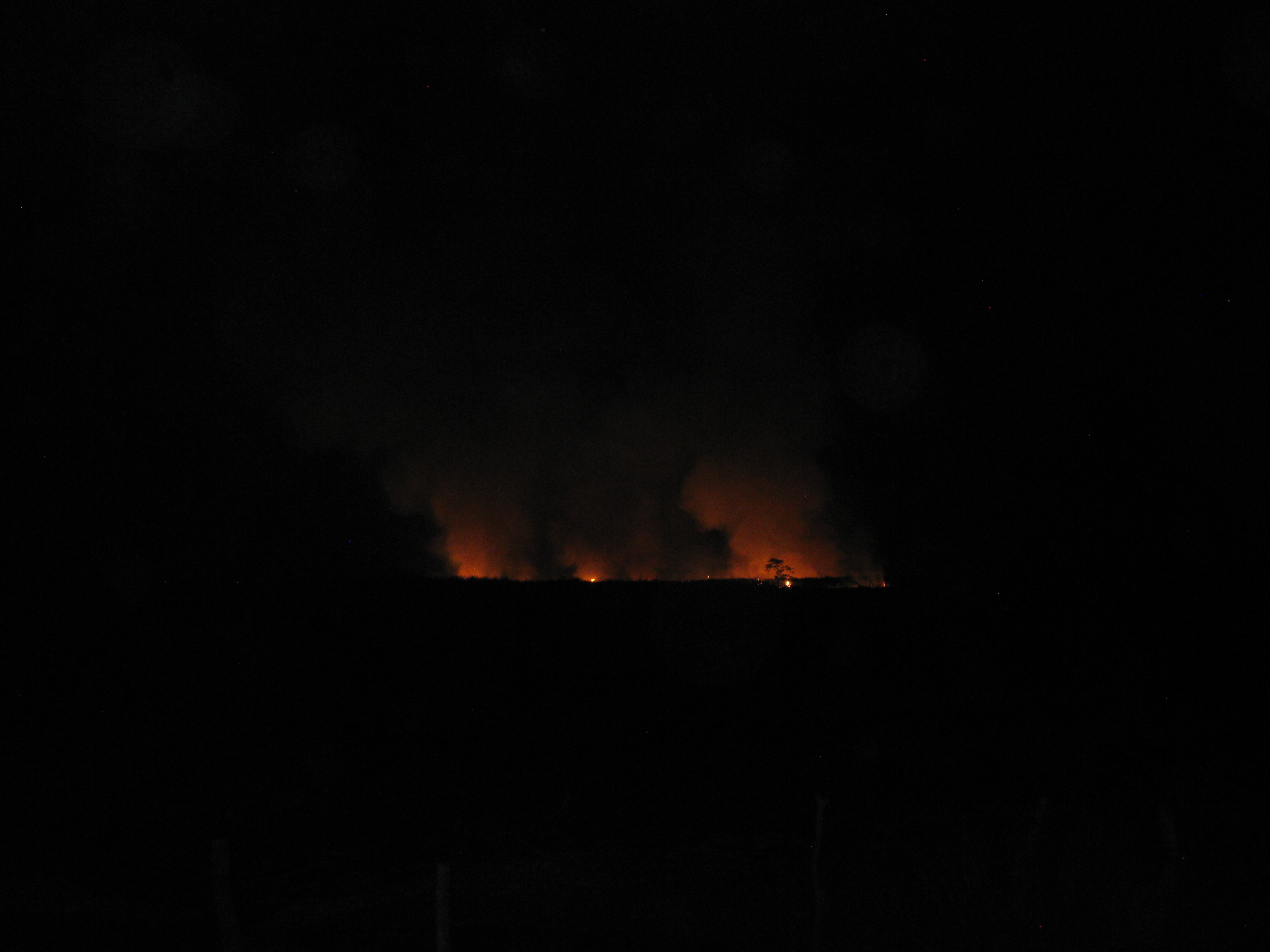
    Workers work through the night, the field burning.

    I sit watching one of the fields burn at night, the strange orange glow of the smoke and fire on the horizon evokes thoughts of burning oil fields. Ash rains down upon me as I sit on a street corner in Los Encuentros speaking to a few farmers about the sugar cane that now surrounds their houses. It is the first year it has been planted in the area. I look up and a piece of ash goes into my eye and I go for a walk by myself as I wince for the next few minutes. Ash covers everything. I stand in the darkness thinking.

    I want to live in a world where there are small farmers who have a connection to the land. I want to live in a world where people are paid fairly for their work and where we all have a right to clean air and water. I may not be directly fighting, but it seems inherent in so many aspects of my daily life. The degree of interconnectedness in our world, how the actions of millions of individuals on one continent can affect the lives of millions in another, is difficult to grasp and be conscious of at every moment. We have the opportunity to make the best choices that are in accordance with the information that we have and our values. We cannot keep diffusing responsibility, equivocating or looking to someone else. Be conscious of the decisions that you make, you choose what you support with your actions.

    The path to a better world involves widening our moral circle, the extent to which we extend moral consideration. Is it just your family? Is it your friends? Acquaintances? Fellow citizens? People who you identify with culturally? All other human beings?

    References (dead links removed 10/31/2026):

    http://www.agmrc.org/commodities__products/grains__oilseeds/sugarcane_profile.cfm